
Uncensored language models are having a moment.
Developers are frustrated. Researchers are annoyed. Enterprise teams are tired of their AI tools refusing to do basic work. So when models started appearing that promised fewer guardrails and more cooperation, built on top of Llama, Mistral, Qwen, and Gemma ,a lot of people got excited.
And honestly? That frustration is valid.
But here’s what the uncensored model hype often skips over: removing restrictions doesn’t make a model better. It makes it different. And “different” comes with its own set of problems that can bite you hard if you’re not prepared.
Let’s get into it.
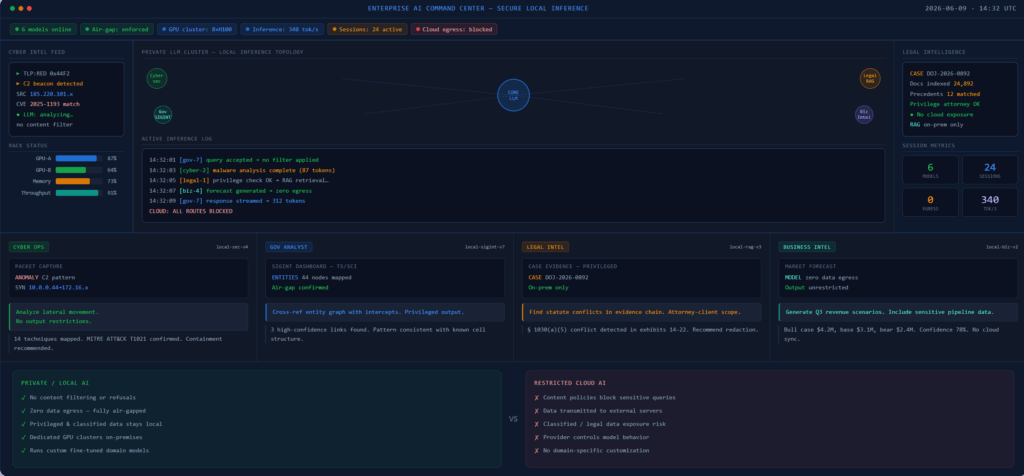
Why People Actually Want Uncensored Models
First, it’s worth being honest about who’s actually reaching for these tools , because it’s not who the discourse usually assumes.
Most users searching for uncensored LLMs aren’t looking for harmful outputs. They’re looking for workflow relief.
The complaints you hear most often:
- The model refuses to analyze a piece of code because it could be malicious
- A research query gets blocked because the topic sounds sensitive out of context
- An automation chain breaks because the model refuses one step mid-sequence
- A security analyst can’t get a straight answer about an exploit that’s been public knowledge for three years
For cybersecurity professionals, investigators, researchers, and anyone running complex agentic AI workflows, these aren’t minor inconveniences , they’re legitimate productivity problems.
Uncensored models promise to fix that. Sometimes they do. But they also introduce a different class of problem that’s easy to miss until you’re already in trouble.
Problem #1: The Hallucination Tradeoff
This is the big one, and it doesn’t get enough attention.
Here’s the dynamic: a well-aligned model that’s uncertain about something will often refuse or hedge. An uncensored model that’s equally uncertain will often just… answer anyway.
The result is that uncensored models can feel dramatically more useful in the short term. They’re responsive. They engage. They don’t fight you.
But that willingness to engage doesn’t mean the information is correct. Research on LLM hallucinations consistently shows that reducing safety-oriented refusals correlates with increased confident confabulation , the model fills gaps with plausible-sounding fabrications.
In a low-stakes context, that’s annoying. In a legal, medical, or security context, a confidently wrong answer is actively dangerous.
Problem #2: False Confidence That’s Hard to Spot
This deserves its own section because it’s subtler than raw hallucination.
When an uncensored model gets something wrong, it rarely looks wrong. The response tends to be:
- Well-structured
- Internally consistent
- Detailed and specific
- Written in a confident, authoritative tone
This is the trap. The output reads like something you can trust, which means it often gets used without the scrutiny it deserves.
Studies on AI-generated misinformation have shown that people are significantly worse at detecting errors in fluent, confident text than in uncertain or hedged responses. An aligned model that says “I’m not sure about this” is, counterintuitively, safer than an uncensored model that says the same wrong thing with authority.
If your team isn’t running systematic output validation , not just spot checks , false confidence is a silent liability.
Problem #3: Tool Calling Gets Messy
Here’s a nuance that surprises a lot of developers: uncensored models often perform remarkably well at tool calling and agentic tasks. They’re cooperative. They follow instructions. They don’t abandon multi-step workflows halfway through.
Frameworks like LangChain, AutoGen, and CrewAI have all seen adoption with locally-deployed uncensored models for this reason.
But “cooperative” isn’t the same as “accurate.”
The failure modes you’ll encounter:
- Inventing parameters that don’t exist in your tool schema
- Selecting the wrong tool when multiple options are available
- Hallucinating field values , especially for structured outputs like JSON or API calls
- Continuing chains confidently even when an upstream step produced bad output
The workflow executes. It just produces garbage. And in an automated pipeline, garbage can travel a long way before anyone notices.
Robust tool-use evaluation , benchmarks like Berkeley’s Gorilla project specifically test this , shows significant variance between models in real-world function-calling accuracy. Reduced alignment doesn’t automatically hurt this, but the absence of uncertainty signaling makes errors harder to catch.
Problem #4: Governance Gets Complicated Fast
Here’s the organizational reality that gets glossed over in most “just run it locally” advice.
Large organizations don’t just need AI that works. They need AI that’s auditable, traceable, and defensible.
Requirements in regulated environments typically include:
- Full logs of model inputs and outputs
- Ability to explain why a specific output was generated
- Compliance with internal content policies (not just legal ones)
- Risk management documentation for AI systems
An uncensored model creates friction across all of these. Not because it’s inherently ungovernable, but because the organizations deploying it often don’t build the governance infrastructure around it.
The NIST AI Risk Management Framework and the EU AI Act both emphasize that risk doesn’t disappear when you move AI in-house ,it transfers. The organization becomes responsible for what the model does.
Problem #5: Compliance Risk in Regulated Industries
For healthcare, finance, insurance, and government, this is a non-negotiable concern.
Consider what happens when an uncensored model , deployed without output filtering , generates content that violates HIPAA, SOX, or FINRA requirements. The fact that it’s running privately doesn’t protect the organization from liability for what it produces.
The key question for compliance teams isn’t “is this model uncensored?” , it’s “what controls exist around how it’s used and what it outputs?”
Organizations that skip this question find out the hard way.
The Responsibility Shift Nobody Mentions
There’s a fundamental misconception baked into how uncensored models get marketed: the idea that they’re simply better versions of restricted models, with the annoying limitations taken out.
That’s not what’s happening.
What’s actually happening is a transfer of responsibility.
When a commercial model provider applies alignment training, they’re accepting a certain amount of liability for the model’s outputs. When you strip that alignment out, that liability transfers to you , the organization deploying the model.
That means:
- You now own the output filtering
- You now own the validation layer
- You now own the acceptable use policies
- You now own the human review process for high-stakes decisions
This isn’t inherently bad. For sophisticated teams with mature AI operations, owning that responsibility is exactly what they want. But it’s a significant operational commitment, not a free upgrade.
When Uncensored Models Are Actually the Right Call
None of this means uncensored models are the wrong choice. In the right context, with the right controls, they’re genuinely the better tool.
Good fits:
| Use Case | Why It Works |
|---|---|
| Cybersecurity research | Needs to engage with exploit and malware content without refusals |
| Internal automation pipelines | Cooperative tool-calling with controlled inputs/outputs |
| Enterprise knowledge search | Internal content doesn’t need consumer-facing safety filters |
| Fraud/financial crime analysis | Requires full engagement with criminal typologies |
| Academic research on sensitive topics | Legitimate scholarly work gets blocked by consumer filters |
Poor fits:
| Use Case | Why It Doesn’t Work |
|---|---|
| Customer-facing chatbots | No organizational control over what users ask |
| High-stakes factual queries | False confidence in wrong answers is a liability |
| Unmonitored automation | Errors propagate without human review |
| Teams without AI governance | Responsibility transfer with no one to accept it |
What Good Deployment Actually Looks Like
If you’re going to run an uncensored model, do it properly.
1. Build a validation layer. Don’t let raw model output reach end users or downstream systems without checking. Tools like Guardrails AI or NeMo Guardrails exist specifically for this.
2. Log everything. Inputs, outputs, tool calls, chain steps. If you can’t audit what the model did, you can’t defend it later.
3. Define acceptable use explicitly. An internal policy that says “this model is for X, not for Y” is better than no policy. Make sure the team actually knows it.
4. Add human review checkpoints. Especially for high-stakes outputs. An uncensored model in a fraud investigation team is fine if a trained analyst reviews outputs before acting on them. It’s not fine if it’s running unsupervised.
5. Run red team exercises. Before wide deployment, have someone try to get the model to produce problematic outputs in your specific use context. You’ll learn things.
The Bottom Line
Uncensored models aren’t magic. They’re not dangerous by default either.
They’re tools with a specific tradeoff: more cooperation in exchange for more responsibility.
The organizations that use them well understand exactly what they’re taking on — and build the infrastructure to handle it. The ones that don’t tend to discover, usually at an inconvenient moment, why those alignment layers existed in the first place.
The future of serious AI deployment probably isn’t fully restricted or fully uncensored. It’s powerful base models combined with strong organizational controls, smart validation pipelines, and teams that actually understand what’s running under the hood.
That’s not as exciting as “uncensored AI does everything.” But it’s what actually works.
[wpse_comment_list]