
When people talk about running AI privately, two arguments dominate the conversation , data privacy and cost savings.
Privacy? Absolutely valid. Nobody wants sensitive contracts, internal memos, or customer data being processed on someone else’s server. Regulatory frameworks like GDPR, HIPAA, and various government security mandates make this a hard requirement in many industries.
Cost? That argument is shakier than it sounds. Cloud AI providers like OpenAI, Google, and Anthropic operate at a scale most businesses simply can’t match. Competing with them on raw token economics is a losing game for most organizations.
But there’s a third reason companies are deploying local AI , one that rarely gets discussed openly.
They want uncensored models.
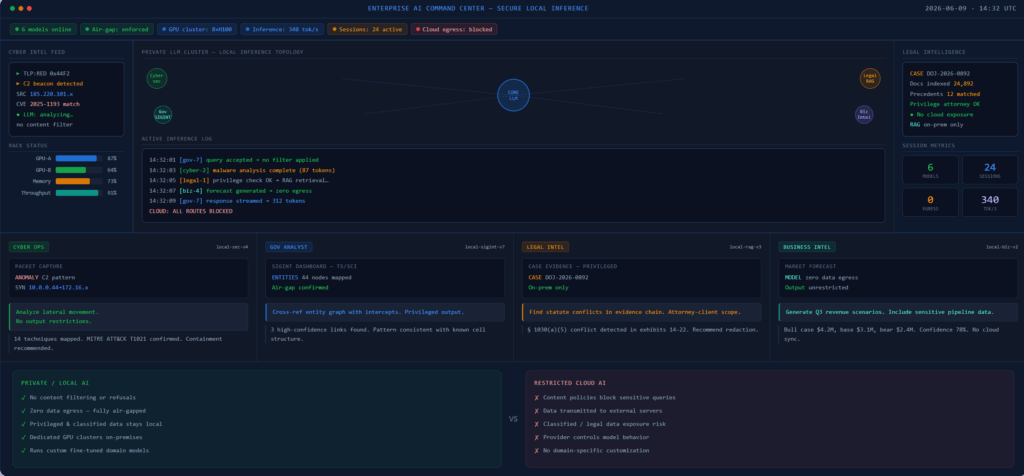
What Does “Uncensored LLM” Actually Mean?
Let’s clear up a common misconception right away: an uncensored language model is not a model that generates harmful content by default.
An uncensored LLM is one where many of the alignment restrictions have been reduced or removed. These restrictions are typically baked into commercial models to:
- Prevent liability for the AI provider
- Block content that could be misused publicly
- Avoid politically sensitive outputs
- Stay compliant with platform-wide content policies
That makes perfect sense for a consumer chatbot. It makes a lot less sense when a fraud analyst is trying to understand money laundering patterns, or when a security researcher needs to reverse-engineer malware.
In those contexts, the safety layer doesn’t protect anyone , it just blocks legitimate work.
Popular open-source options in this space include models built on Llama, Mistral, and Falcon, often fine-tuned with reduced RLHF constraints and deployed locally using frameworks like Ollama or LM Studio.
The Business Cases Where Uncensored AI Actually Makes Sense
1. Cybersecurity Operations
This is probably the clearest use case in the entire article, so let’s start here.
Security analysts don’t spend their days writing polite emails. They spend it:
- Analyzing malware samples and decompiled code
- Tracing attack chains across compromised infrastructure
- Studying known exploits to understand adversary techniques
- Reviewing suspicious scripts that look like they could be weaponized
The problem? Ask a heavily aligned cloud model to explain how a specific exploit works in detail, or to analyze a piece of malicious code, and you’ll often get a refusal. Sometimes you get a watered-down response. Either way, the workflow stalls.
Tools like VirusTotal and Hybrid Analysis exist precisely because security professionals need to handle this kind of content. AI assistance in that same context should work the same way ,without constant friction.
An uncensored model deployed privately lets analysts investigate threats without fighting the model every other query.
2. Threat Intelligence Research
Threat intel teams exist to understand what attackers are doing, how they’re doing it, and why.
That means processing reports about criminal infrastructure, dark web activity, attacker toolkits, and indicators of compromise. It also means synthesizing information from sources that aren’t exactly bedtime reading.
Public AI systems flag enormous amounts of this content as sensitive , even when the person asking is literally paid to understand it.
Resources like MITRE ATT&CK and CISA advisories represent the kind of structured threat intelligence that analysts work with daily. A private, uncensored model can function as a genuine research assistant across this material , correlating events, summarizing reports, and mapping attacker behavior ,without repeatedly refusing to engage.
3. Government and Intelligence Analysis
Governments analyze things that would make most AI content filters short-circuit.
Geopolitical conflicts. Extremist organization structures. Intelligence reports containing sensitive operational details. Criminal activity patterns.
The purpose of this analysis matters enormously. A government analyst studying how a terrorist organization recruits members online is doing the opposite of promoting terrorism , they’re trying to counter it.
An uncensored model running inside a classified or air-gapped environment can assist with this work in ways that a public API simply cannot. Organizations like DARPA and various defense agencies have explored these use cases extensively, precisely because the analytical value is clear.
4. Legal Discovery and Document Review
Large-scale litigation involves a lot of uncomfortable reading.
Document review in fraud cases, criminal investigations, or civil disputes means attorneys and paralegals processing thousands of files that may contain graphic content, criminal confessions, explicit communications, or sensitive allegations.
AI-assisted eDiscovery platforms , think tools built on top of models , need to surface relevant documents without constantly flagging the content as problematic. When a model refuses to summarize a document because of what’s in the document, it defeats the entire purpose.
5. Financial Crime and Fraud Investigations
Banks, fintechs, and financial regulators employ entire teams dedicated to catching fraud, investigating money laundering, and tracing suspicious transactions.
These analysts need to understand how fraud schemes work mechanically. They need to map transaction flows. They need to recognize patterns that match known criminal typologies documented by organizations like FinCEN and the FATF.
A model that hedges around these topics or refuses to discuss fraud mechanics in detail isn’t useful to someone whose literal job is investigating fraud.
6. Enterprise Knowledge Search
This one is less dramatic but probably affects more companies than any other item on this list.
Organizations have massive internal document repositories , product specs, policy documents, historical contracts, internal research, competitive analyses. A lot of this material contains information that public cloud models would treat cautiously: pricing strategies, security architecture details, internal personnel decisions.
Deploying a private, uncensored model as an internal search layer means employees can query the full knowledge base without content getting filtered for reasons that make no sense in an internal context.
7. Academic and Scientific Research
Researchers studying biosecurity, disinformation, historical atrocities, extremist movements, or human behavior in extreme conditions face a constant frustration with aligned commercial models.
Their work is legitimate. Often important. But the subject matter trips content filters constantly.
An uncensored model in a research environment can function as a proper analytical partner , helping scholars process literature, synthesize findings, and explore implications, without treating every sensitive topic as a potential threat.
The Real Argument for Private AI
Here’s what the industry often dances around:
The strongest argument for private AI isn’t privacy or cost. It’s operational freedom.
Organizations that deploy local models , whether on-premises hardware or private cloud infrastructure , gain something that no SLA can provide: control over what their AI is allowed to do.
This isn’t about wanting AI that helps with harmful things. In nearly every use case above, the people asking these questions are professionals with legitimate needs, operating within regulated or secured environments.
It’s about recognizing that a single global content policy designed for 100 million consumer users is a poor fit for a 50-person fraud investigation team or a government cybersecurity unit.
The Tradeoffs Are Real ,Don’t Ignore Them
None of this comes free.
Uncensored models tend to produce more hallucinations. Without alignment training, models are more likely to confidently generate inaccurate information. In a security or legal context, that’s a serious risk.
There are also governance challenges. If an organization deploys an uncensored model and an employee uses it inappropriately, the liability picture gets complicated fast. Strong internal policies, access controls, and audit logging become essential.
And frankly, many open-source uncensored models simply underperform their aligned commercial counterparts on general tasks. The fine-tuning that removes restrictions often degrades overall capability.
Organizations considering this path should:
- Run proper red team evaluations before deployment
- Implement role-based access controls so only authorized users can access the system
- Maintain audit logs of model interactions
- Establish clear acceptable use policies specific to the uncensored deployment
- Consider model quantization trade-offs if running locally on constrained hardware
Quick Summary: Use Cases vs. Models
| Use Case | Why Uncensored Helps | Risk Level |
|---|---|---|
| Cybersecurity / malware analysis | Avoids refusals on technical exploit content | Medium |
| Threat intelligence | Enables full engagement with attacker data | Medium |
| Government/intel analysis | Handles classified-context topics without filters | High (needs air-gap) |
| Legal discovery | Processes sensitive document content without friction | Medium |
| Fraud investigation | Full engagement with financial crime patterns | Low-Medium |
| Enterprise search | Indexes internal content without over-filtering | Low |
| Academic research | Explores sensitive topics for scholarly purposes | Low |
The Bottom Line
Private AI deployments are growing , and the reasons go beyond what most vendor whitepapers will tell you.
Yes, data sovereignty matters. Yes, cost at scale matters. But for a meaningful slice of organizations, the deciding factor is simpler: they need an AI system that will actually do the work they need it to do.
For security teams, fraud analysts, government researchers, and legal professionals, an uncensored model in a controlled environment isn’t a workaround. It’s the right tool for the job.
The conversation around enterprise AI needs to make room for this reality , carefully, with appropriate governance , rather than treating every reduced-alignment deployment as inherently suspect.
Further reading:
[wpse_comment_list]