
Germany is quietly hoping for the death of giant language models. And on the surface, that hope is about to come true: the era of ever-larger monolithic text giants really is nearing its end. Yet anyone in Europe who believes compact local models automatically put Germany back on equal footing with the United States is overlooking the real final boss, and misunderstanding what those American gigawatt datacenters were actually built to run.
In San Francisco boardrooms, a sobering engineering consensus has already become an open secret while much of the wider world still stares reverently at chat windows: you do not need trillion-parameter Large Language Models (LLMs) to operate productive enterprise software and agents.
For years, the industry tried to overpower the fundamental weakness of language models, genuine logical reasoning, with brute force. Labs flooded weights with Reinforcement Learning (RL), tweaked attention mechanisms, and scaled parameter counts into the stratosphere. What eventually crystallized is an uncomfortable architectural truth: the main reason frontier models have to be so monstrously large is the static world knowledge stuffed into their neural weights.
Once you separate language routing and orchestration logic from static world knowledge, the house of cards holding up mega-models collapses.
The “Ghost in the Machine” and the AGENTS.md Reality
To see why the current LLM bubble is headed for a sharp market correction, look at how naively most decision-makers still view this technology. Executives across boards and ministries genuinely believe “Superintelligence” is months away: a digital organism superior to humans in every dimension.
Even AI pioneers like Andrej Karpathy have pushed back sharply against that framing. Speaking on the Dwarkesh Podcast, Karpathy drew a razor-sharp distinction: we are not building learning organisms (“animals”), we are “summoning ghosts” conjured out of static internet text. Yet the broader market still treats the ghost as if it were alive.
Every developer who works seriously with coding agents hits this wall daily. You place a clean, tightly structured AGENTS.md or CLAUDE.md file in your repository, define crystal-clear architectural rules, and three prompts later the model silently violates them anyway. You might explain a rule to a child five times, and by the fifth time the child has internalized the principle because a child builds an active world model and learns continuously. An LLM still does not truly understand it on the fiftieth prompt. It suffers from permanent session amnesia, holds no causal model of reality, and cannot be “educated” by lecturing it in prose (a structural boundary we analyzed in depth in The General Limitations of LLMs: Convergence, World-Knowledge Limits & The Logic Ceiling).
OpenAI co-founder Ilya Sutskever said the quiet part out loud during his NeurIPS 2024 invited talk (“Sequence to Sequence Learning with Neural Networks: What a Decade”): “Pre-training as we know it will unquestionably end.” We have reached “peak data” because there is only one internet, and raw web text behaves like a finite fossil fuel. Meanwhile, pouring billions of dollars of compute into post-training RL on monolithic weights burns cash for rapidly shrinking marginal reasoning gains (as we unpacked in Reasoning Models, Chain-of-Thought & World Models vs. Neuro-Symbolic AI).
What frontier labs like OpenAI and Anthropic already know internally is simple: the neural model itself does not need to be an omniscient oracle. It only needs to be a fast, precise variable filler and router wrapped in deterministic software (the exact hidden harness we exposed in our companion article, Sam Altman Didn’t Build AGI. Silicon Valley Just Built a Neuro-Symbolic Harness).
The 20B-to-Sub-1B Revolution: Blueprint + Ontologic RAG Beats Gigantism
You do not even need fully mature neuro-symbolic theorem provers to break the old monolithic paradigm. The moment you evict static world knowledge from neural weights and inject it on demand through structured RAG (Retrieval-Augmented Generation anchored to typed domain ontologies and relationships) paired with intelligent prompt batching, the burden on the underlying model shrinks dramatically.
All the model needs is an exact blueprint: which external fact goes into which variable for which tool call? Better still, you can force output tokens onto strict rails at generation time using formal schemas and context-free grammars (Constrained Decoding), a technique that 95 percent of enterprise AI buyers do not even realize exists. Open-source engines like Outlines (pioneered by Willard and Louf in Efficient Guided Generation for Large Language Models, arXiv:2307.09702), XGrammar (using byte-level pushdown automata), and llguidance mask invalid logits token by token inside runtimes like vLLM, SGLang, and llama.cpp, making malformed JSON and invented parameter names mathematically impossible.
The hardware consequence is already sitting on Hugging Face today:
- Compact Sparse MoE Target Size (20B to 35B Total Parameters): The practical sweet spot for enterprise orchestration has converged on sparse Mixture-of-Experts (MoE) architectures such as OpenAI’s Apache-2.0 gpt-oss-20b (21B total parameters, 3.6B active per token, fitting inside roughly 16GB of VRAM with native MXFP4 quantization) and Alibaba’s latest hybrid-attention Qwen3.5-35B-A3B (36B total parameters, ~3B active per token, combining Gated DeltaNet linear attention, native vision-language support, and massive context lengths extensible toward 1 million tokens).
- Only ~3 Billion Active Parameters Per Token: Because sparse MoE routing activates only a narrow slice of experts per forward pass, memory bandwidth demand collapses compared to dense 70B models or multi-trillion-parameter cloud flagships like Alibaba’s hosted Qwen4-Max (launched in November 2026 at ~2.4 trillion backbone parameters plus ~328 billion N-gram embedding parameters and 71B active per token).
- Single Local Workstation Card (or Everyday CPU): Combined with a structured Ontologic RAG index, constrained decoding, and a deterministic neuro-symbolic guardrail layer, a 20B to 35B MoE runs at blazing speed on a single local NVIDIA workstation GPU, while the compact Qwen3.5 dense family (Qwen3.5-0.8B, Qwen3.5-4B, Qwen3.5-9B) brings sovereign multi-step orchestration directly onto standard enterprise CPUs.
Going Even Smaller: How Tuning and Neuro-Symbolic AI Push Models Down to 0.8B to 9B
The 20B to 35B MoE wave is only the midpoint of model compression, not the floor. Each engineering layer strips another slab of dead weight out of the neural network while actually increasing real-world enterprise capability:
- Sematic RAG + Prompt Batching removes the frozen encyclopedia from neural weights so the model stops acting as a bloated database.
- Sparse Hybrid MoE + Domain Tuning (LoRA, SFT, Distillation) + Constrained Decoding drops active compute down to roughly 3 billion parameters per token (gpt-oss-20b, Qwen3.5-35B-A3B) while locking tool syntax deterministically at the logit level.
- Neuro-Symbolic AI (Neuro-Symbolization + Neuro-Symbolic-RAG + Formal Ontologies + Deterministic Hallucination Detection) goes one decisive step further: it evicts business logic, state tracking, and compliance verification out of the neural weights entirely (see our foundational primer, What Is Symbolic AI?).
Once you pair a compact local model from the open-weight Qwen3.5 lineup (Qwen3.5-0.8B, Qwen3.5-2B, Qwen3.5-4B, or Qwen3.5-9B) with dedicated neural symbol extractors like our Open-Weights GLiNER Neuro-Symbolic Symbol Extractor (INT8 ONNX) and wrap every tool call inside the ypipe Manifold Engine and Hallucination Breaker, the language model no longer carries the burden of flawless multi-step reasoning on its own. That is why we proved across 3,829 official UC Berkeley BFCL V4 tool-calling benchmarks in What A Neuro-Symbolic BFCL AI Test Revealed About the Anthropic IPO that compact local models backed by a neuro-symbolic harness rival and outperform naked frontier giants, and why even sub-1B (800M) to 9B models execute serious multi-step enterprise workflows on everyday Intel Core and AMD Ryzen CPUs without needing a datacenter GPU at all (documented in Can Local AI on Intel Core Run Serious Multi-Step Enterprise AI? and Alibaba Qwen, MariaDB & AMD Ryzen: Sovereign Enterprise AI on Everyday CPUs with YPipe).
| Architectural Stage | Representative Models (2026) | Total / Active Params | Technique That Removes Weight Bloat | Effective Enterprise Capability | Hardware Footprint |
|---|---|---|---|---|---|
| 1. Monolithic Frontier Giant | Qwen4-Max (Nov 2026), closed cloud giants | ~2.4T (+328B N-gram) / 71B active | Brute-force pre-training + post-training RL | Broad trivia and chat; still suffers session amnesia (AGENTS.md drift) and unconstrained schema slips | Multi-MW cloud GPU cluster (recurring API rent) |
| 2. Dense Open Weights + Ontologic RAG | Qwen3.5-27B, 70B dense | 27B to 70B / 100% active | Ontologic RAG + smart prompt batching | Fresh private domain facts grounded in typed schemas without retraining weights; high memory bandwidth per token | Multi-GPU server or high-VRAM workstation |
| 3. Sparse Hybrid MoE + Tuning + Grammar | Qwen3.5-35B-A3B, gpt-oss-20b | 21B to 36B / ~3B to 3.6B active | Hybrid Gated DeltaNet MoE + LoRA/SFT tuning + Outlines / XGrammar / llguidance | Fast variable routing, 100% valid JSON/tool schemas, native vision + 262K to 1M context on-premise | 1x local workstation GPU (16GB to 24GB VRAM) |
| 4. Compact Local + Neuro-Symbolic Verification | Qwen3.5-0.8B, Qwen3.5-2B, Qwen3.5-4B, Qwen3.5-9B | 0.8B to 9B / 0.8B to 9B active | Neuro-symbolization, formal ontologies, external rules/state & deterministic hallucination detection | Auditable multi-step tool execution, zero silent policy drift, rivals naked frontier models on BFCL V4 | Everyday enterprise CPU (Intel Core / AMD Ryzen) |
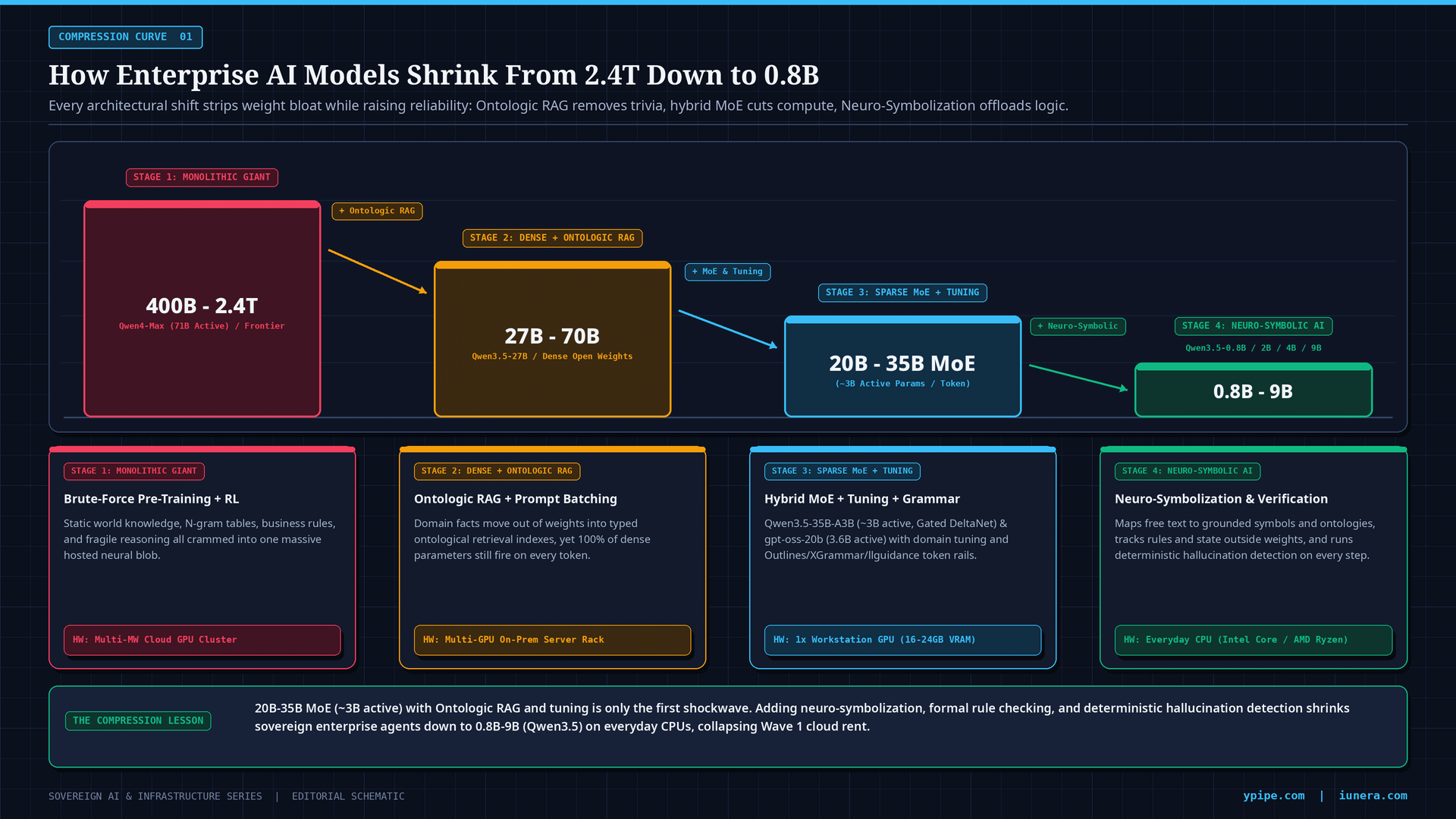
Schematic 1: The Wave 1 model-size collapse curve. Ontologic RAG strips static trivia, hybrid MoE (Qwen3.5-35B-A3B, gpt-oss-20b) plus task tuning and constrained decoding cuts active weights to ~3B on one GPU, and neuro-symbolization plus deterministic hallucination detection shrinks enterprise agents down to Qwen3.5-0.8B to 9B on standard CPUs.
The moment global enterprise IT realizes that a disciplined 20B to 35B MoE model, or an even leaner 0.8B to 9B neuro-symbolic agent running on existing office servers, handles daily workflows more reliably than a billion-dollar frontier API (and without the blind spots of naked weights we detailed in Why Running a Local LLM Does Not Give You an AI System), the classic text-LLM bubble bursts.
And you can already hear the reaction in Berlin and Munich when that day arrives.
In Germany, policymakers and pundits will pop champagne. They will clap each other on the back and declare: “Look at that! Good thing we never wasted billions building gigantic datacenters! Now we just drop a sleek open-weight model onto our local hardware and we have caught up with the United States!”
That celebration will be Germany’s final mistake in the AI race – I hope this future does not come true.
America’s Real Treasure: What Happens to the “Empty” GPU Cathedrals?
Assume for a moment that the classic text-LLM hype collapses completely. Per-token chatbot pricing crashes, several frontier wrappers go bankrupt, and equity multiples compress overnight.
What physically remains standing after the crash?
Rewind to the dotcom telecom bust of 2000. Carriers borrowed hundreds of billions of dollars to bury transcontinental fiber-optic cables across North America. When the stock bubble imploded, skeptics mocked millions of miles of unlit “dark fiber” rotting under the soil. Yet financial crashes wipe out paper valuations; they do not dig up glass already buried in the ground. A few years later, YouTube, Netflix, AWS, and the entire US Web 2.0 and Social Media oligopoly rode that written-off, pennies-on-the-dollar bandwidth straight to global monopoly.
The exact same infrastructure physics now repeats at ten times the scale. Standing across Texas, Virginia, and the American Midwest are colossal, concrete-and-steel GPU Cathedrals packed with hundreds of thousands of NVIDIA chips, wired directly to cheap, reliable baseload electricity.
Those datacenters do not evaporate when chatbot margins shrink. They pause for a logical second on text generation, and then flip immediately to the second, far bigger wave of artificial intelligence.
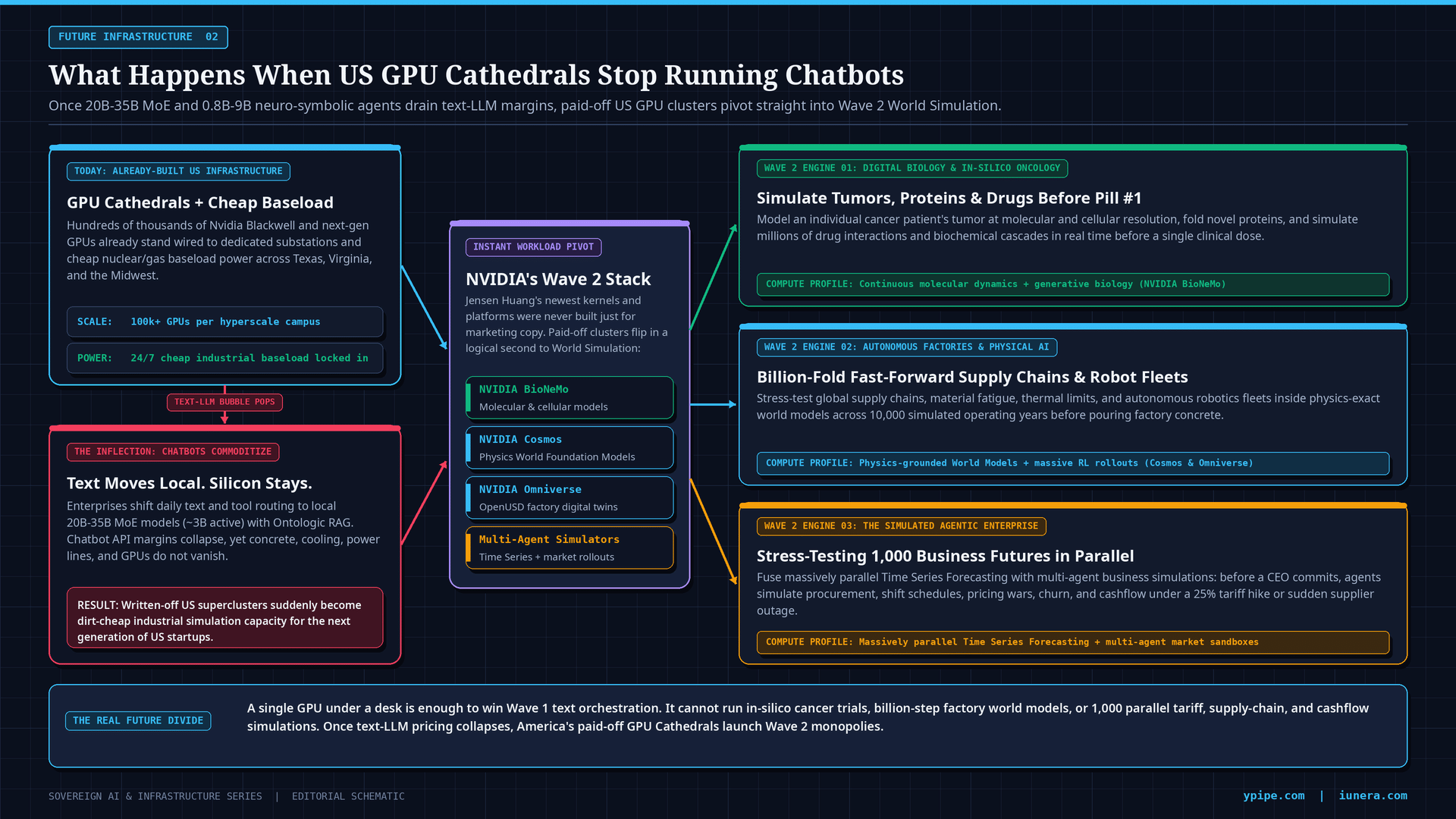
Schematic 2: Once compact local 20B to 35B MoE and 0.8B to 9B neuro-symbolic agents drain text-LLM margins, America’s already-built GPU Cathedrals and cheap baseload power pivot immediately into three Wave 2 simulation engines: digital oncology, physics-exact factory twins, and massively parallel enterprise and market simulation.
NVIDIA CEO Jensen Huang engineered this pivot years in advance. NVIDIA’s newest GPU kernels, acceleration libraries, and software stacks, spanning NVIDIA Cosmos (open World Foundation Models for physical AI), NVIDIA Omniverse (physics-grounded OpenUSD digital twins), and NVIDIA BioNeMo (generative molecular and biological foundation models), were never designed primarily to draft polite marketing emails. They were architected for physical, biological, and economic world simulation.
The day those mega-clusters in Texas and Virginia stop summarizing Slack threads, three industrial revolutions ignite on top of written-off American silicon:
1. Digital Biology and In-Silico Oncology
Instead of guessing the next English word, clusters simulate human physiology at molecular and cellular resolution. Researchers model an individual cancer patient’s specific tumor biology, simulate millions of drug interactions in real time, fold novel proteins, and play out complete biochemical cascades in silico before a patient ever swallows the first pill.
2. Full Factory Simulation and Physical AI
Entire global supply chains, material fatigue curves, thermal tolerances, and autonomous robotics fleets are executed billions of times in fast-forward inside physics-exact world models. By the time a physical robot touches a factory floor or a manufacturing line ships version one, it has already lived through ten thousand simulated years of edge-case failures.
3. The Simulated, Agentic Enterprise (Stress-Testing 1,000 Business Futures in Parallel)
Once an enterprise is thoroughly wired with autonomous software agents across purchasing, production, sales, and finance, executive decision-making itself mutates beyond recognition. Companies fuse massively parallel Time Series Forecasting with multi-agent economic simulations. Before committing to a major strategic move, a CEO simulates the entire business end to end across 1,000 parallel future scenarios: stress-testing in minutes how procurement contracts, factory shift schedules, regional pricing, inventory bottlenecks, customer churn, and free cash flow react if an export tariff jumps by 25 percent, a key supplier goes offline overnight, or a competitor launches a price war.
The Bitter Endgame for Germany as an Industrial Hub
Look at the brutal hardware asymmetry between those two waves:
- For Wave 1 (text orchestration and sovereign enterprise agents), a single workstation GPU under a desk, or even an on-premise enterprise CPU running a compact 20B to 35B MoE or 0.8B to 9B neuro-symbolic agent, is genuinely enough.
- For Wave 2 (simultaneous cellular oncology, physics-exact factory twins, or 1,000 parallel multi-agent market and supply-chain simulations), desk-scale hardware does nothing. You need brutal, continuous, industrial-scale compute running around the clock.
That is where the trap snaps shut on Germany.
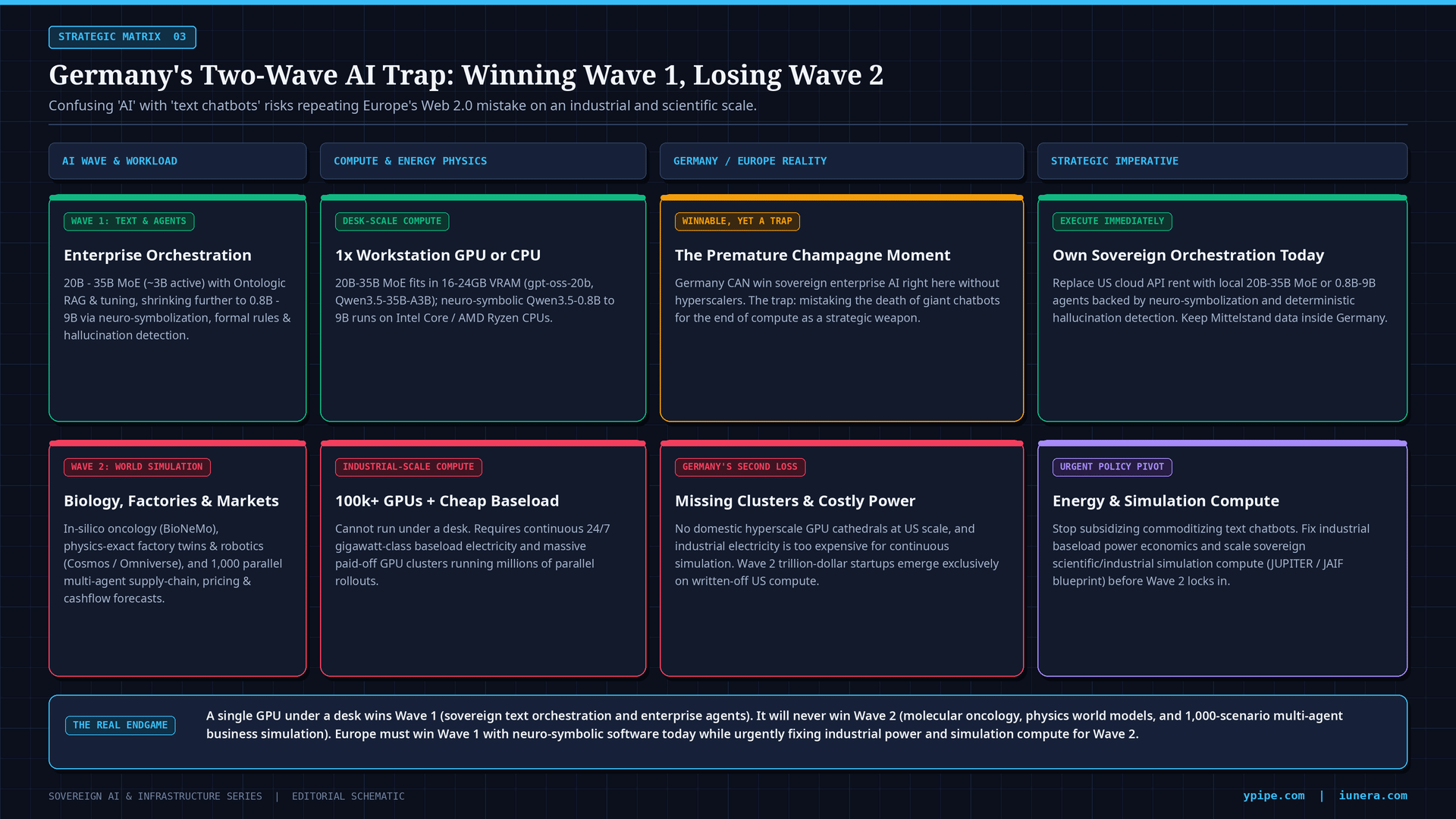
Schematic 3: Germany’s Two-Wave Trap. Winning Wave 1 on local hardware with 20B to 35B MoE or 0.8B to 9B neuro-symbolic agents is real and urgent, yet mistaking Wave 1 for the entire AI war leaves Europe defenseless when Wave 2 World Simulation takes over.
Germany faces a double structural deficit right where Wave 2 begins:
- No Domestic Hyperscale GPU Cathedrals: Outside select public research flagships like Forschungszentrum Jülich’s exascale JUPITER supercomputer and its AI Factory (JAIF), Germany does not have commercial hundreds-of-thousands-GPU campuses sitting paid-off and ready for startup redeployment at US scale.
- Uncompetitive Industrial Baseload Power: Running continuous 24/7 world simulations is an electricity-conversion business. According to the International Energy Agency (IEA), electricity prices for energy-intensive industries in Europe have persistently averaged more than twice US levels, while Eurostat’s non-household electricity database and the German energy association BDEW show German medium-industrial tariffs hovering around ~22.6 ct/kWh (roughly 23 percent above the EU average) due to heavy grid fees, taxes, and levies. At those power costs, operating gigawatt-class simulation clusters profitably at continuous full load is structurally broken.
Just as happened during the rise of Social Media and cloud platforms, when much of Europe treated the internet as a digital brochure while Silicon Valley assembled global platform ecosystems on cheap dark fiber, Germany today is mistaking “AI” for “language models.”
The next generation of trillion-dollar startups will not build another chatbot with a nicer dark-mode interface. They will sit directly on top of suddenly freed-up, dirt-cheap US datacenter overcapacity, designing targeted cancer therapeutics in silico, pre-training autonomous factories before concrete is poured, and simulating entire regional economies ahead of every pricing or supply-chain move.
While Germany briefly congratulates itself for proving that a lean 20B to 35B MoE or sub-1B neuro-symbolic agent with Ontologic RAG never needed a ten-billion-dollar datacenter after all, the true industrial and scientific AI revolution accelerates away at light speed on top of those exact written-off American clusters. And unless Europe changes course immediately, Wave 2 will not produce a single category-defining startup out of Germany.
How Germany Avoids Losing Twice: Play to German Strengths and Fix the Power Equation
Recognizing the Two-Wave Trap is the only way out of it. Germany does not need to imitate Silicon Valley’s consumer-chatbot hype; it needs a disciplined four-part industrial strategy that combines its real engineering advantages with competitive energy physics:
- Make Industrial Electricity Cheap and Reliable Again (The Crucial Prerequisite): Nothing in Wave 2 scales without affordable 24/7 baseload power. As IEA and Eurostat figures make painfully clear, Germany cannot run continuous molecular oncology, factory world models, or multi-agent market simulations at more than double American industrial power costs. Slashing industrial grid fees, eliminating punitive energy levies on productive compute, and securing abundant, uninterrupted baseload electricity is not a side issue; it is the physical foundation of Germany’s entire industrial AI future.
- Play to Germany’s Unmatched Strengths: Neuro-Symbolic Engineering, Precision Industry, and Mittelstand Data: Germany already owns global bottlenecks in semiconductor optics and lasers (Carl Zeiss SMT, TRUMPF), factory automation and robotics (Siemens, KUKA, Festo, NEURA Robotics), deep chemistry and life sciences (BioNTech, Merck), and over 1,300 Mittelstand hidden champions. Deterministic neuro-symbolic AI (Ontologic RAG, neuro-symbolization, formal verification, auditable hallucination detection, and ISO-grade safety engineering) plays directly to German precision systems engineering rather than brute-force web scraping.
- Keep Mittelstand Data Sovereign While Winning Wave 1 Today: Instead of waiting for subsidized domestic chatbots or streaming operational records into foreign cloud agents (which exposes raw enterprise rows as we documented in The Hidden Data Leakage Risk of MCP Servers), German companies can capture Wave 1 immediately on-premise with YPipe and YPipe SmartPipes. Cutting recurring US cloud API rent today frees both capital and clean ontological data structures for tomorrow’s simulations.
- Redirect Public Grants From Commoditizing Chatbots to Sovereign Wave 2 Simulation Compute: Stop subsidizing me-too text base models that depreciate every 90 days. Scale the JUPITER and JAIF blueprint into shared, commercially accessible scientific and industrial simulation clusters dedicated to German pharma, automotive, robotics, chemistry, and Mittelstand digital twins.
If you want to experience the full chronology of how Germany kept jumping into the wrong AI race from 1988 to 2026, play our 90-second retro arcade game Germany in AGI Land (and read the companion breakdown, Germany in AGI Land: Why Europe Keeps Running the Wrong AI Race). Explore our open work on GitHub (iunera/ypipe), see how Germany can still win the industrial AGI/superintelligence race, or contact the iunera team to see sovereign local neuro-symbolic orchestration running live on standard hardware.
Frequently Asked Questions (FAQ)
1. Why does separating world knowledge from reasoning break the business model of giant LLMs?
Most of the parameter mass inside a frontier LLM exists to memorize static facts, API syntax, and trivia in its weights (even Alibaba’s November 2026 Qwen4-Max pairs a ~2.4T backbone with ~328B N-gram embedding parameters). When you move domain knowledge into an external Ontologic RAG index, enforce strict output grammars with constrained decoding (Outlines, XGrammar, llguidance), and validate tool calls inside a deterministic neuro-symbolic harness like the ypipe Manifold Engine, the neural model only has to route variables and follow structured blueprints. Sparse 20B to 35B MoE models with roughly 3B active parameters (gpt-oss-20b, Qwen3.5-35B-A3B) handle that job locally on a single workstation GPU, while Qwen3.5-0.8B to 9B models with neuro-symbolic verification run on everyday CPUs, destroying the pricing power of rented mega-chatbot APIs.
2. Why do coding agents keep ignoring rules in AGENTS.md or CLAUDE.md?
Because current LLMs are stateless statistical engines (“ghosts,” as Andrej Karpathy puts it) without continual weight learning or a causal world model. Prose instructions in a markdown file compete probabilistically with millions of pre-trained patterns across a growing context window. Without deterministic token-level grammar masking and an external symbolic verification layer like YPipe’s Hallucination Breaker, compliance degrades silently after just a few turns.
3. If 20B to 35B MoE and compact neuro-symbolic models run locally, why do American GPU megaclusters still matter?
Because local Qwen3.5 and gpt-oss-20b stacks only solve Wave 1 (text, code, and enterprise workflow orchestration). They cannot execute Wave 2: continuous molecular oncology simulations (NVIDIA BioNeMo), physics-exact factory and robotics world models (NVIDIA Cosmos and Omniverse), or thousands of parallel multi-agent business and market simulations fused with massively parallel Time Series Forecasting (testing pricing shocks, supplier outages, production rerouting, and cash flow before a decision is made). Once the text-LLM bubble corrects, America’s already-built, paid-off GPU clusters and cheap baseload power pivot immediately to Wave 2 at bargain compute prices, just as dark fiber powered Web 2.0 after the 2000 dotcom bust.
4. What should German enterprises do right now instead of waiting for policy?
Win Wave 1 immediately on sovereign infrastructure: deploy compact local open-weight models locked inside a deterministic neuro-symbolic harness with strict schema enforcement and zero cloud data leakage (YPipe). That cuts recurring US API dependency today, protects Mittelstand intellectual property, and builds the structured agentic operational and data foundation required to participate in Wave 2 simulation tomorrow.
Related Deep Dives on iunera.com/kraken/
- The General Limitations of LLMs: Convergence, World-Knowledge Limits & The Logic Ceiling
- Reasoning Models (o1, DeepSeek-R1, Chain-of-Thought) & World Models vs. Neuro-Symbolic AI
- What A Neuro-Symbolic BFCL AI Test Revealed About the Anthropic IPO
- Alibaba Qwen, MariaDB & AMD Ryzen: Sovereign Enterprise AI on Everyday CPUs with YPipe
- Open-Weights GLiNER Neuro-Symbolic Symbol Extractor (INT8 ONNX)
- Sovereign AI in Europe: Why Enterprises Need More Than Consumer AI Platforms