
**Symbolic Artificial Intelligence (also known as Classical AI or “System 2” AI) is the branch of AI that represents knowledge explicitly through human-readable symbols—entities, semantic relations, hierarchical ontologies, and formal logic—rather than opaque statistical neural weights. While Symbolic AI delivers 100% deterministic, mathematically provable reasoning inside a structured domain, its fundamental limitation is that it requires a complete and closed world to reason: if a required fact or synonym is missing from its formal world model, a pure symbolic solver either fails or assumes the missing fact is false. Pairing Symbolic AI with neural language models and precondition gates (Neuro-Symbolic AI) solves this bottleneck by dynamically constructing a complete, closed micro-world for each task.**
1. Overview: How Symbolic AI Differs From Statistical Neural Networks
When most people talk about AI today, they think of Neural Networks and Large Language Models (LLMs), which learn statistical associations across billions of numerical weights. In a neural network, knowledge is implicit: you cannot point to a single weight inside an LLM and say, “This is where the concept of an invoice or a medical contraindication lives.”
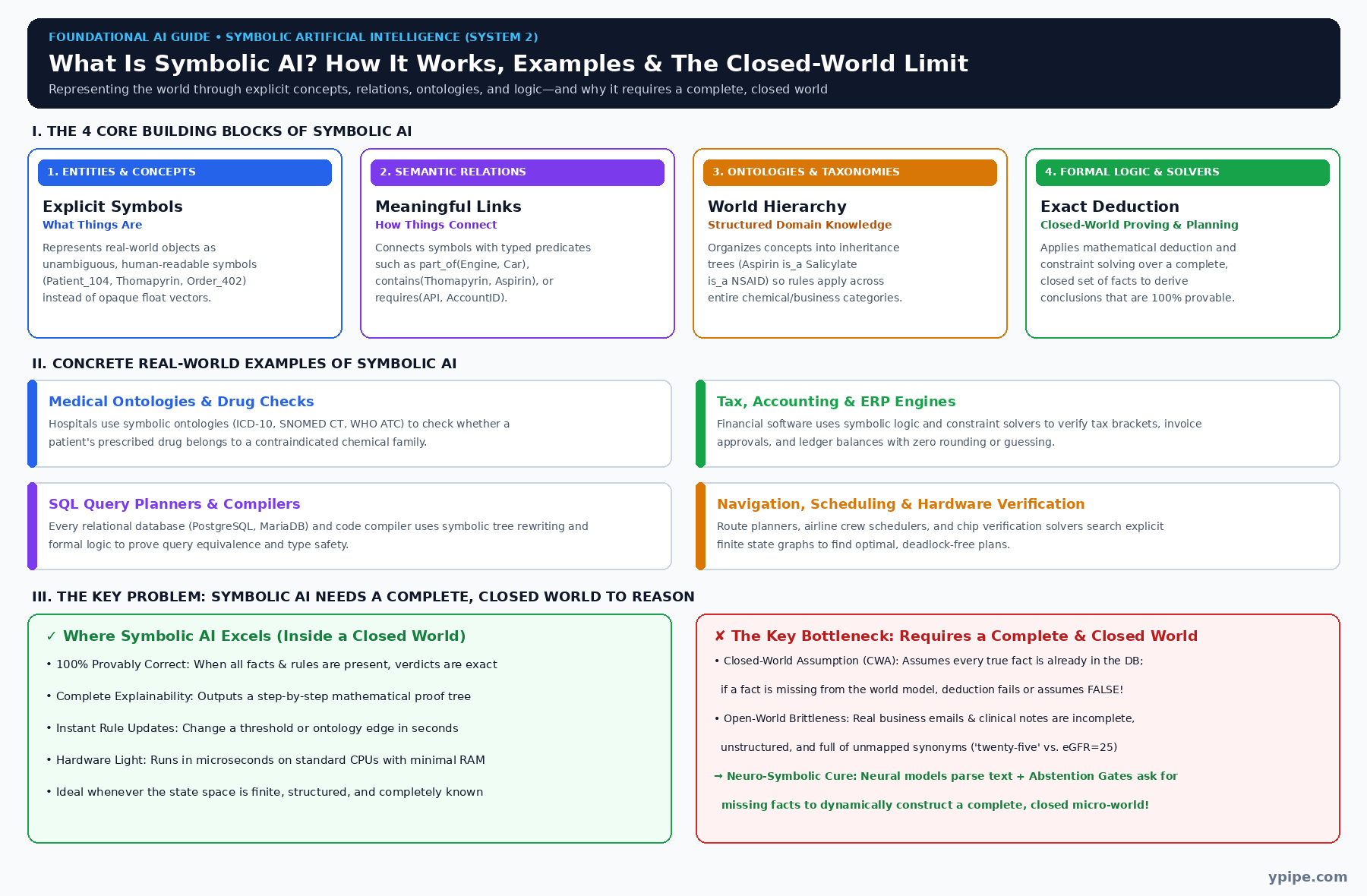
Symbolic AI works in the exact opposite way. Pioneered by computer scientists Allen Newell and Herbert A. Simon (the Physical Symbol System Hypothesis, 1976) and John McCarthy, Symbolic AI represents the world using explicit, inspectable structures that both humans and computers can read directly:
- **Entities & Concepts (Explicit Symbols):** Objects in the world are represented as distinct symbols—such as
Patient_104,Metformin,Invoice_882, orDatabaseServer_A. - **Semantic Relations (How Things Connect):** Explicit links describe how entities relate to one another—such as
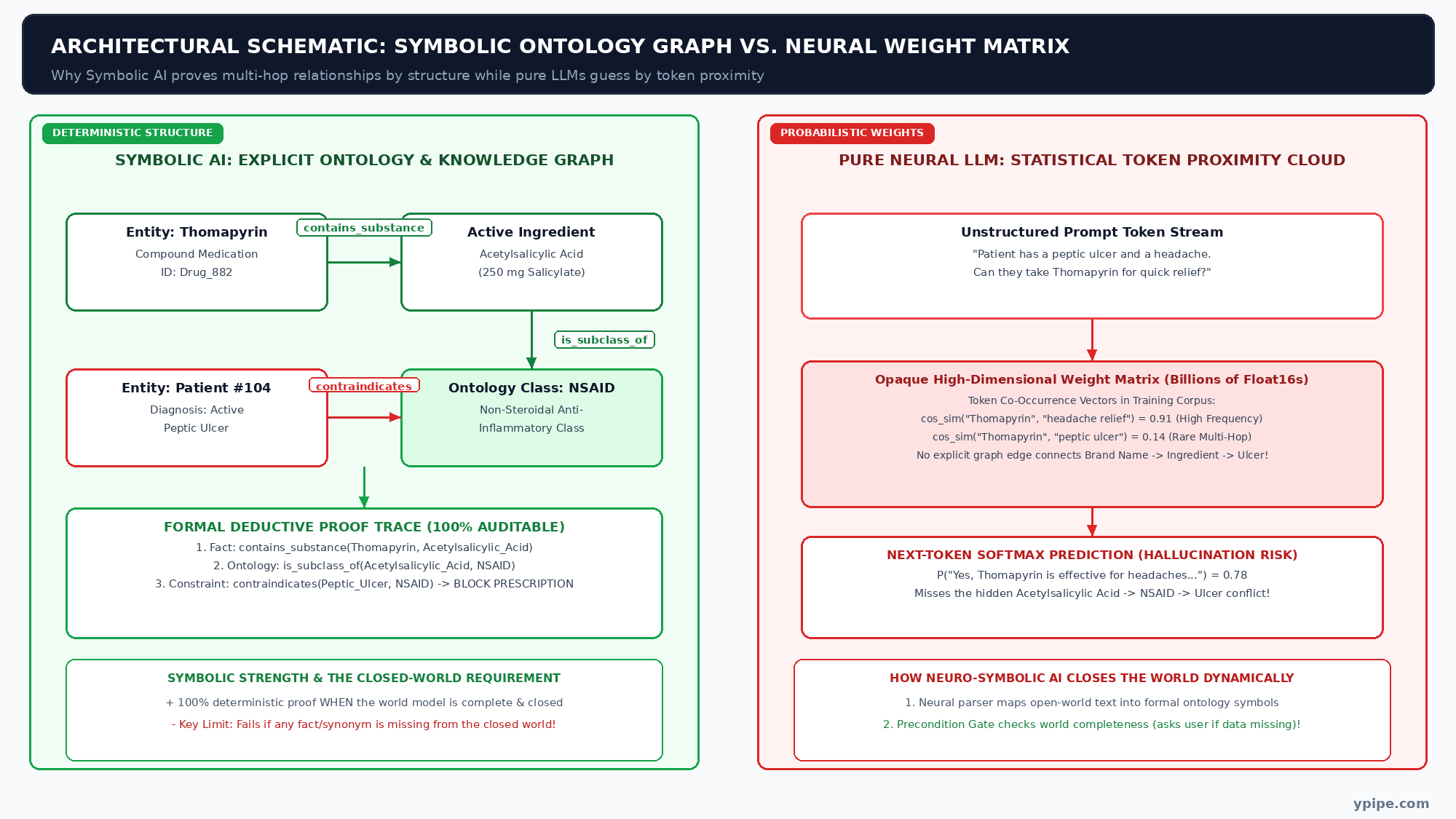
has_lab_value(Patient_104, eGFR, 25),contains_substance(Thomapyrin, AcetylsalicylicAcid), orrequires_parameter(CreateOrderAPI, CustomerID). - **Ontologies & Taxonomies (Structured World Knowledge):** Concepts are organized into inheritance hierarchies (
is_a) and part-whole structures (part_of). IfAspirin is_a Salicylate, andSalicylate is_a BloodThinner, a symbolic engine automatically knows thatAspirinis aBloodThinner. - **Formal Logic & Constraint Solvers (Exact Closed-World Deduction):** A reasoning engine applies deductive logic, set theory, arithmetic, and state-transition search over a complete, closed set of symbols to prove what is true or compute a valid plan.
2. Concrete Real-World Examples of Symbolic AI
Far from being a relic of the past, Symbolic AI silently powers much of the mission-critical software the modern world relies on every day—specifically in domains where the rules and state space form a bounded, closed world:
| Domain | Concrete Symbolic AI Example | Why It Works Here (Closed World) & Why an LLM Cannot Replace It Alone |
|---|---|---|
| Healthcare & Pharmacology | Medical Ontologies (ICD-10, SNOMED CT, WHO ATC): Hospital systems map diagnoses and drugs into formal hierarchies to check multi-substance drug interactions and clinical trial eligibility criteria. | Once diagnoses and drugs are mapped to formal codes, the chemical hierarchy is closed and exact—whereas an LLM can overlook that a brand-name combination drug contains three distinct active substances. |
| Finance, Tax & ERP Systems | Tax Engines & Accounting Ledgers: Tax preparation software and ERP approval workflows use symbolic constraint solvers to compute exact brackets, exemptions, and sign-off thresholds. | Financial compliance operates over a closed ledger schema requiring 100% deterministic math and an auditable trace showing which clause applied. |
| Databases & Compilers | SQL Query Planners & Code Compilers: Every time you run a SQL query in PostgreSQL or compile code in Rust/Java, a symbolic optimizer rewrites logical expression trees into a provably equivalent execution plan. | Programming languages and database schemas have formal, closed grammars where probabilistic guessing would corrupt results. |
| Logistics, Aviation & Hardware | Constraint Satisfaction & Verification (SAT/SMT Solvers): Chipmakers (Intel, AMD, NVIDIA) and aerospace engineers use symbolic theorem provers to verify that hardware circuits and flight controllers have zero deadlocks. | Hardware gates form a finite, closed state space where safety requires a mathematical proof across all possible states. |
3. The Key Problem of Symbolic AI: It Needs a Complete and Closed World to Reason
If Symbolic AI is 100% deterministic, never hallucinates, and runs in microseconds on a CPU, why did standalone Symbolic AI hit a wall in the 1980s and 1990s?
The deepest theoretical and practical limitation is not just that Symbolic AI “cannot read free text”—it is that **classical Symbolic AI requires a complete and closed world to reason.**
3.1 The Closed-World Assumption (CWA) vs. Open-World Reality
In formal logic and database theory, Raymond Reiter formulated the Closed-World Assumption (CWA, 1978):
Closed-World Assumption: A traditional symbolic solver assumes its knowledge base is 100% complete—meaning every relevant object, relation, and rule in the universe is already encoded inside the system. Any fact that cannot be proven from the current database is assumed to be
FALSE(Negation as Failure).
In a board game like Chess or inside a code compiler, the world is closed and complete:
- There are exactly 64 squares and 32 pieces.
- Nobody walks into the room mid-game with a 33rd chess piece or an unwritten rule.
**Real enterprise and clinical reality, however, is an Open World:**
- Incomplete Information: A customer’s email asks “Pull our revenue report” without stating which fiscal quarter (
Q1–Q4) or region they want. A clinical note omits whether a patient took an over-the-counter painkiller this morning. - The Qualification & Frame Problem (McCarthy & Hayes, 1969): It is impossible for human engineers to pre-specify every conceivable real-world exception, synonym, and background condition by hand before deploying a system.
- Unmapped Surface Expressions: Even when a fact is present in a document, humans write it in open-ended natural language (“the patient’s kidney filtration dropped to twenty-five” instead of
eGFR = 25), leaving the symbolic variable unpopulated.
3.2 What Happens When a Pure Symbolic System Encounters an Incomplete World?
When a standalone symbolic engine faces an open, incomplete world, one of two failures occurs:
- Failure A — Dangerous False Negatives under CWA: If
takes_medication(Patient_104, Aspirin)was written in a free-text paragraph rather than the structured medication table, a pure symbolic solver assumestakes_medication = FALSEunder the Closed-World Assumption and clears a dangerous prescription. - Failure B — Total Proof Halting (Brittleness): If a required variable (
eGFRorquarter) is missing from the formal state, the symbolic deduction tree cannot close and crashes with an unfulfilled precondition error—with no built-in way to read unstructured context or ask a human a natural-language question to fill the gap.
| Dimension | Open-World Enterprise Reality | Pure Symbolic AI Alone (1st Wave) | Pure Neural LLM Alone (2nd Wave) | Neuro-Symbolic AI: Dynamic Scoped World Closure (3rd Wave) |
|---|---|---|---|---|
| World Assumption | Open, incomplete, messy, evolving | Requires a 100% complete, closed world (Closed-World Assumption) | Probabilistic open-world pattern completion | Dynamically constructs a complete, closed micro-world per task |
| When a Fact Is Written in Prose | Common (“filtration dropped to twenty-five”) | Misses the fact or crashes (cannot parse open-world text) | Reads the prose easily | Neural Ear extracts and grounds eGFR(patient, 25) into the closed state |
| When a Required Fact Is Missing | Common (user omits quarter or dosage) | Treats as FALSE (CWA) or halts without recovery | Hallucinates a default value (quarter='Q1') to complete the pattern | Precondition / Abstention Gate detects the open gap and asks the user or calls a lookup tool to close the world! |
| Logical Verdict | Requires 100% auditability | Provably exact only if world is complete | Probabilistic guess (17%–33% error on complex rules) | 100% provably exact once the task micro-world is verified complete |
3.3 How Neuro-Symbolic AI Solves the Closed-World Problem: “Dynamic Scoped World Closure”
Modern Neuro-Symbolic AI solves Symbolic AI’s closed-world bottleneck without sacrificing mathematical certainty. Instead of pretending the entire universe is already in a database, a neuro-symbolic system builds a Scoped Closed World on the fly in three steps:
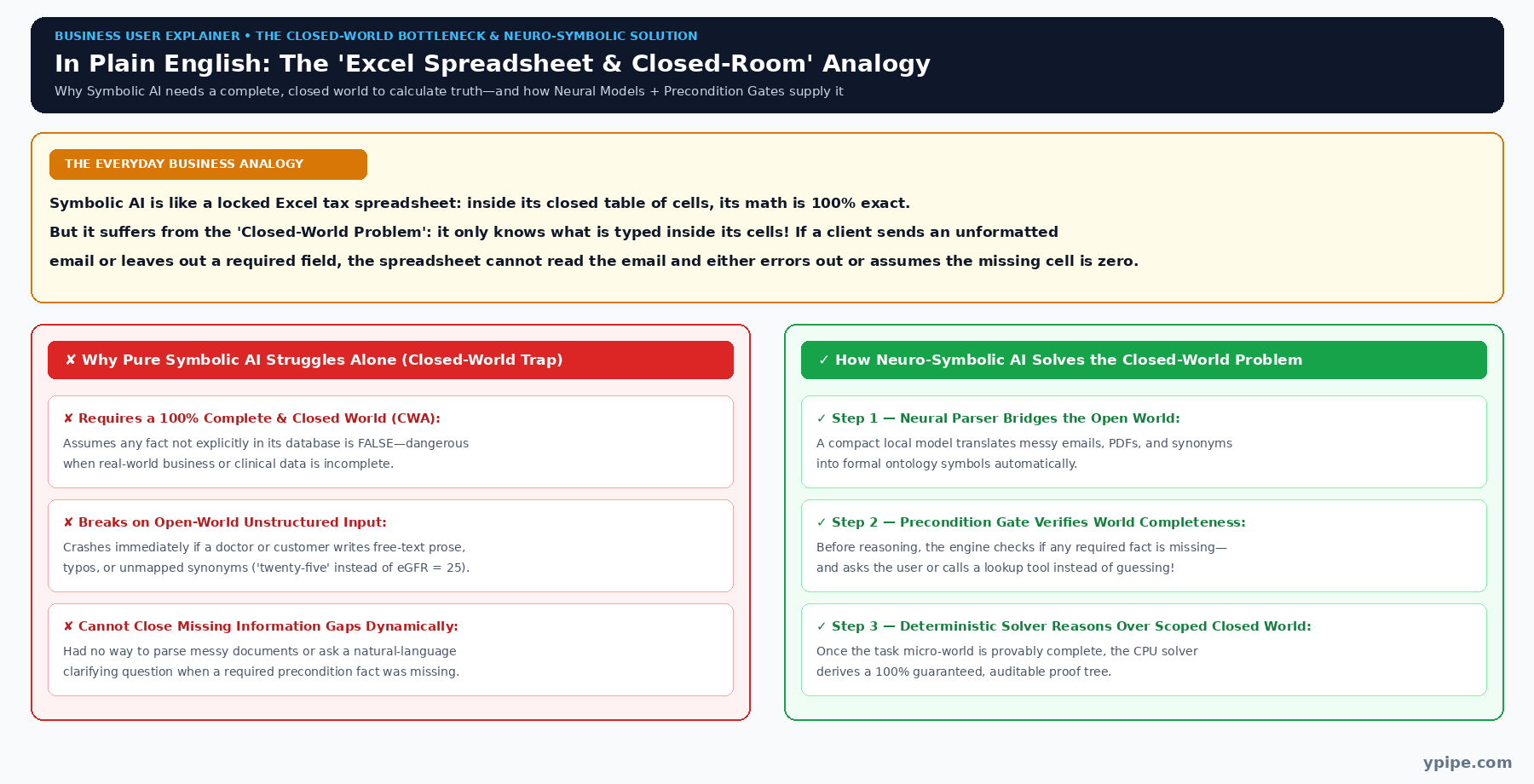
- Step 1 — Neural Perception Bridges the Open World (Decontextualization): A compact neural model reads open-world emails, PDFs, and tables, resolving pronouns and synonyms into formal ontology symbols.
- Step 2 — Symbolic Completeness & Precondition Gate (Abstention Gate): Before the symbolic solver runs a deduction or calls an API, it explicitly checks World Completeness for that specific scope: “Do I have verified, non-guessed values for every required variable (
Patient_ID,eGFR,Medication)?” If a fact is missing from the world state, it does not guess like an LLM and does not assumeFALSEblindly—it triggers a targeted clarifying question or diagnostic tool call to close the world. - Step 3 — Closed-World Deduction on the CPU: Once all required preconditions for the local scope are populated and grounded, the Symbolic Solver executes inside a provably complete micro-world—delivering 100% mathematical certainty and an EU AI Act proof trace.
4. Architectural Dataflow: How Symbolic Deduction Works Step-by-Step
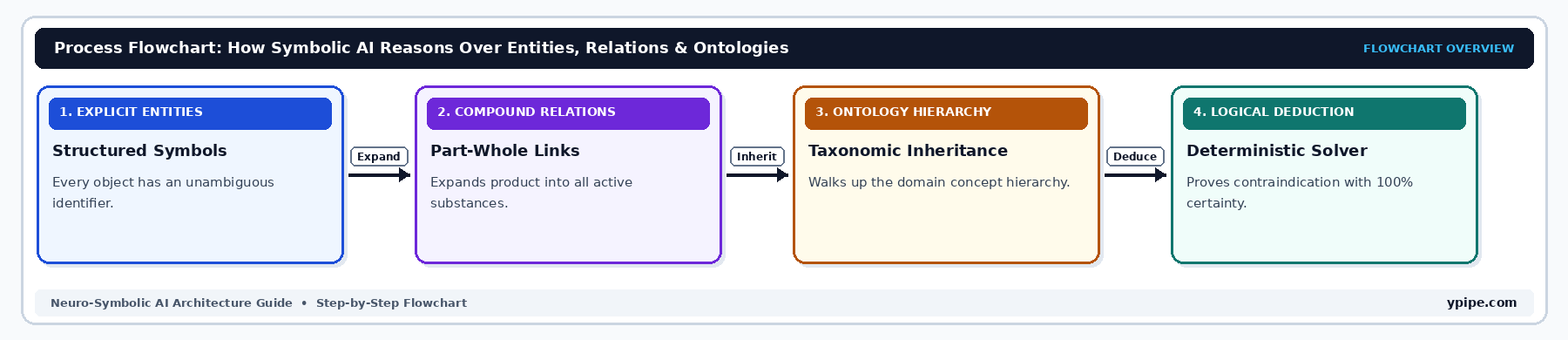
Once the neural parser and precondition gate have populated a complete symbolic scope, follow the concrete data trace in the architectural blueprint below to see how the Symbolic Engine proves multi-hop relationships on the CPU:
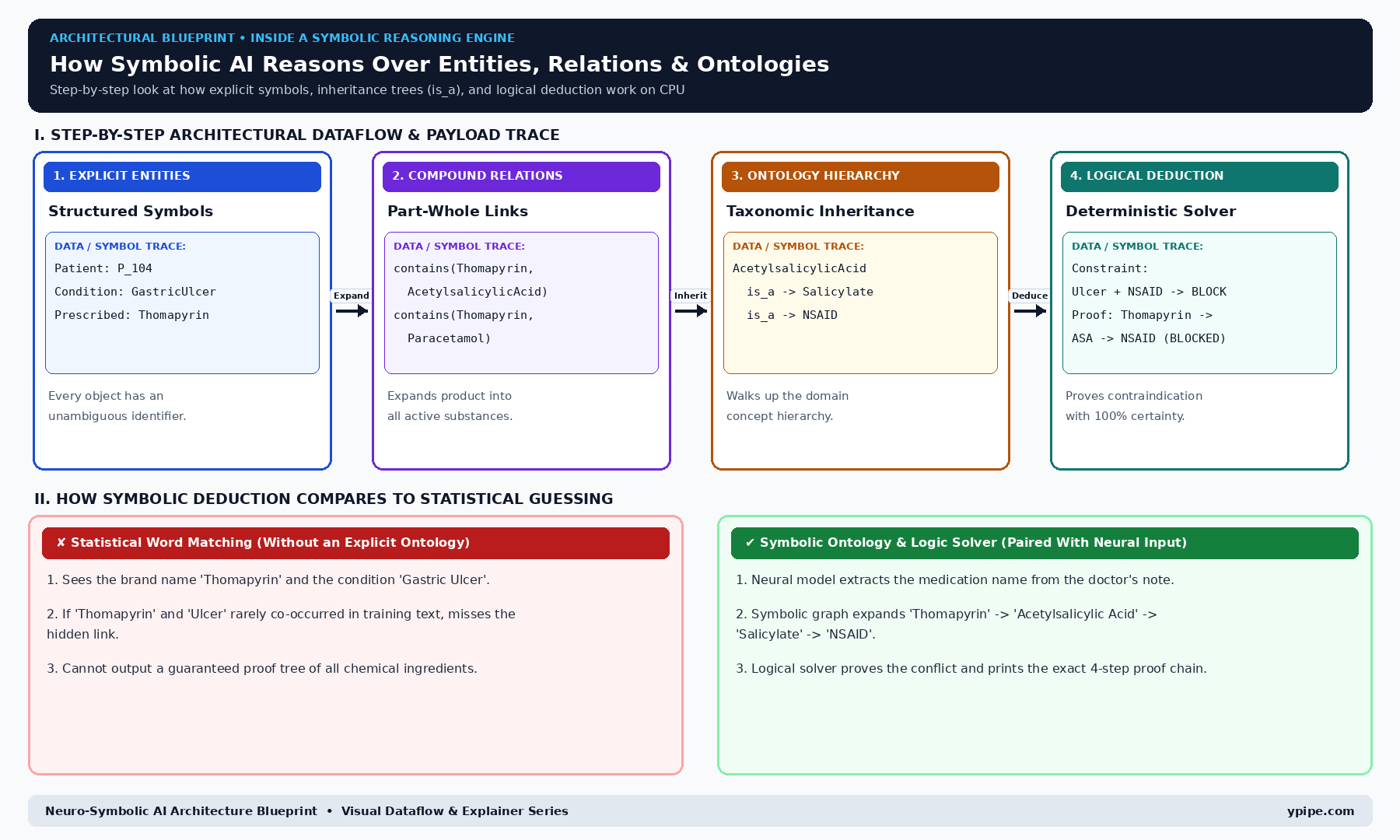
Concrete Execution Trace (Step-by-Step)
- 1. EXPLICIT ENTITIES (Structured Symbols):
Patient: P_104 Condition: GastricUlcer Prescribed: Thomapyrin— Every object in the scoped closed world has an unambiguous identifier. - 2. COMPOUND RELATIONS (Part-Whole Links):
contains(Thomapyrin, AcetylsalicylicAcid) contains(Thomapyrin, Paracetamol)— Expands the compound medication into all active substances. - 3. ONTOLOGY HIERARCHY (Taxonomic Inheritance):
AcetylsalicylicAcid is_a -> Salicylate is_a -> NSAID— Walks up the domain concept hierarchy. - 4. LOGICAL DEDUCTION (Deterministic Solver):
Constraint: Ulcer + NSAID -> BLOCK Proof: Thomapyrin -> ASA -> NSAID (BLOCKED)— Proves contraindication with 100% certainty.
5. In Plain English for Business Leaders: The “Locked Excel Spreadsheet” Analogy
The 30-Second Analogy: Symbolic AI is like a locked Excel tax spreadsheet: inside its closed table of cells, its formulas are 100% exact and never hallucinate. But it suffers from the Closed-World Problem: it only knows what is typed inside its cells! If a client sends an unformatted email or leaves out a required field, the spreadsheet cannot read the email and either errors out or assumes the missing cell is zero. Neuro-Symbolic AI pairs a smart assistant (the neural model) who reads the client’s email into the cells, a completeness check that asks the client if a required number is missing, and the locked spreadsheet (the symbolic solver) to prove the final math.
To see how explicit relational schemas, SQL constraints, and deterministic symbolic verification operate in production alongside local models, explore our engineering deep dives on iunera: MariaDB MCP Server in YPipe: Engineering Reliable Relational AI and PostgreSQL MCP Server in YPipe: Engineering Secure Transactional AI Memory.
6. Key Takeaways
- Explicit Knowledge Representation: Symbolic AI stores knowledge as readable entities, semantic relations, ontologies, and formal logic rather than statistical neural weights.
- The Closed-World Bottleneck: Classical Symbolic AI requires a complete and closed world to reason—making it brittle on its own when facing incomplete human prompts or unstructured documents.
- Dynamic Scoped World Closure (Neuro-Symbolic AI): Pairing a neural parser (to extract symbols from open-world text) with a symbolic precondition gate (to ask for missing facts) constructs a complete micro-world on the fly, unlocking 100% deterministic CPU deduction in real-world applications.
7. Frequently Asked Questions (FAQ)
Q1: Why does Symbolic AI need a complete and closed world to reason?
Because formal logical deduction and the Closed-World Assumption (CWA) operate over explicit sets of axioms and facts. If a required fact is missing from the formal state (for example, a patient’s kidney function wasn’t extracted from a free-text note), a pure symbolic solver either cannot complete its proof tree or assumes the unstated fact is FALSE.
Q2: What is the difference between the Closed-World Assumption (CWA) and the Open-World Assumption (OWA)?
Under the Closed-World Assumption (used in SQL databases and logic programming), anything not currently known to be true in the database is treated as FALSE. Under the Open-World Assumption (used in description logics like OWL), an unstated fact is treated as Unknown—which prevents false negatives, but means the solver cannot reach a definitive YES/NO operational verdict until the missing fact is supplied. Neuro-Symbolic AI resolves this by checking task preconditions and actively acquiring missing facts to close the local scope.
Q3: How does Neuro-Symbolic AI solve the Closed-World Problem of classical Symbolic AI?
In two steps: first, a compact neural model (System 1) translates open-world unstructured text and tables into formal symbols; second, a deterministic Precondition / Abstention Gate verifies whether all required variables for the current task are populated—asking the user a clarifying question or calling a lookup API if anything is missing—before executing closed-world deduction on the CPU.
Q4: Is Symbolic AI the same thing as “Good Old-Fashioned AI” (GOFAI)?
Historian John Haugeland coined the term “GOFAI” in 1985 to describe early symbolic AI systems from the 1950s–1980s. While early GOFAI relied on hand-coded IF/THEN rules in manually curated closed worlds, modern Symbolic AI includes large-scale knowledge graphs, ontologies (SNOMED CT, WHO ATC), constraint satisfaction solvers (SAT/SMT), and automated deterministic planners paired with neural parsers.
Q5: What is the difference between an Ontology, a Knowledge Graph, and a Logic Solver in Symbolic AI?
- An Ontology defines the schema and hierarchy of concepts in a domain (e.g., Aspirin
is_aSalicylateis_aNSAID). - A Knowledge Graph stores the concrete instances and relations (e.g., Patient 104 takes Thomapyrin).
- A Logic / Constraint Solver evaluates formal rules and preconditions over the ontology and knowledge graph to prove conclusions or generate multi-step plans.
Q6: Can Symbolic AI hallucinate like an LLM?
No. A deterministic symbolic solver cannot fabricate a parameter or fact that is not derived from its input facts and formal rules. When paired with a precondition gate in YPipe, if required information is missing from the world state, the engine deterministically halts and asks for the missing parameter rather than guessing.
Further Reading & Peer-Reviewed Sources
- Reiter, R. (1978): On Closed World Data Bases (Logic and Data Bases, Springer)
- McCarthy, J. & Hayes, P. J. (1969): Some Philosophical Problems from the Standpoint of Artificial Intelligence (The Frame & Qualification Problem)
- Newell & Simon, ACM Turing Award Lecture (1976): Computer Science as Empirical Inquiry: Symbols and Search
- Garcez & Lamb (2020): Neurosymbolic AI: The 3rd Wave (
arXiv:2012.05876) - Pan et al. (2024): Unifying Large Language Models and Knowledge Graphs: A Roadmap (
arXiv:2306.08302) - Henry Kautz, AAAI Lecture (2022): The Third AI Summer (
doi:10.1002/aaai.12036) - iunera Kraken Blog — MariaDB MCP Server in YPipe: Engineering Reliable Relational AI
- iunera Kraken Blog — PostgreSQL MCP Server in YPipe: Engineering Secure Transactional AI Memory
- iunera Kraken Blog — Agentic Loops Explained: Why Modern AI Is No Longer Just a Model