
How do you unite Alibaba’s open-weight Qwen models (800M to 32B), MariaDB Vector & Relational SQL, and local AMD Ryzen CPUs into a turnkey, on-premise enterprise AI platform without expensive GPU clusters?
Recorded live on a standard HP EliteBook 845 G10 (AMD Ryzen 5 PRO 7540U, 6 cores, zero dedicated GPU), this showcase demonstrates how YPipe by iunera serves as the operational binding layer uniting Alibaba Qwen, MariaDB, and AMD hardware across deterministic MCP tool calling, visual SmartPipes workflows, native MariaDB Vector RAG & zero-ETL SQL, and clinical/industrial decision safety.
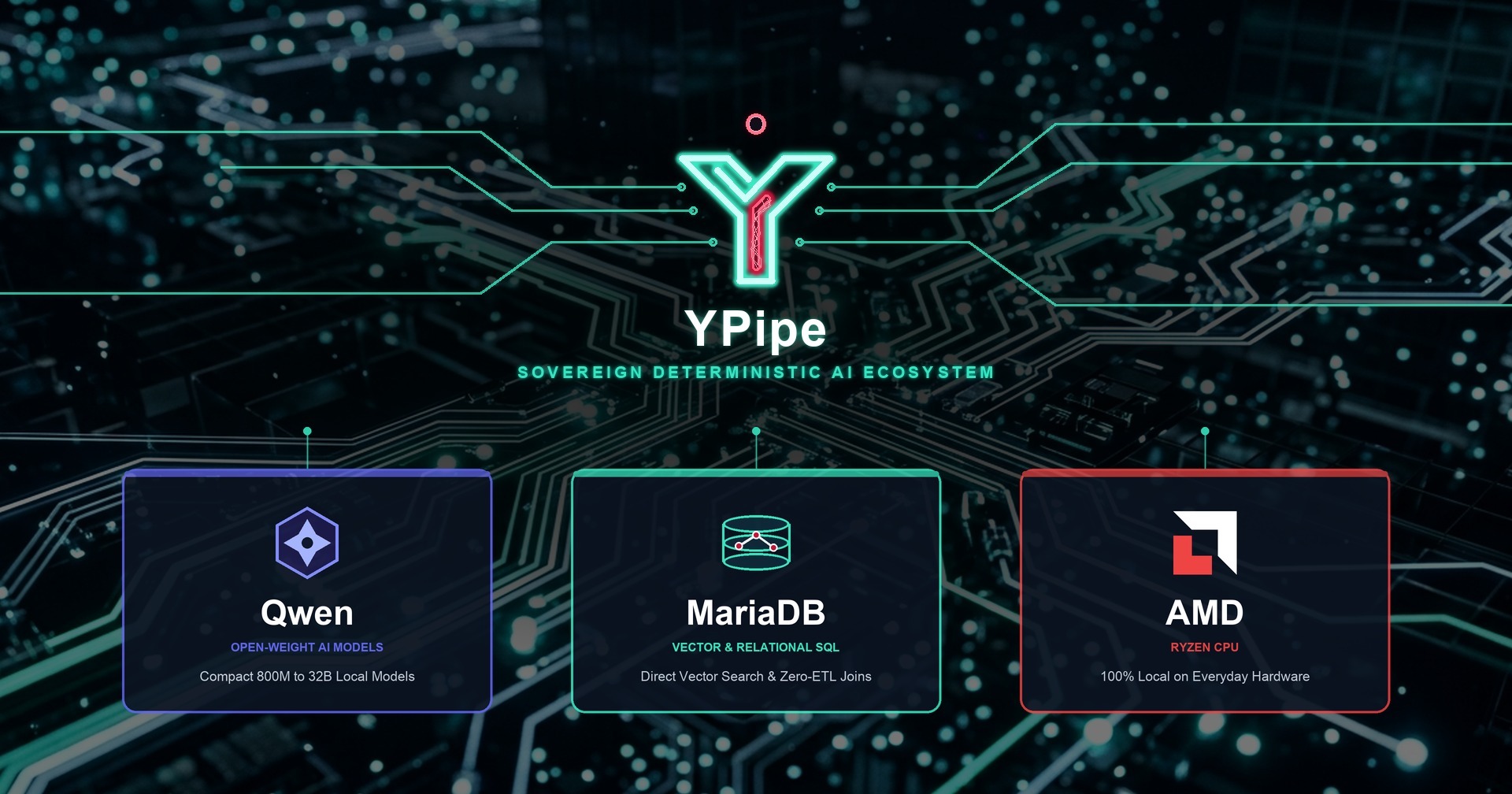
Table of Contents
- Key Takeaways
- Uniting Intelligence, Data, and Local Compute: Alibaba Qwen + MariaDB + AMD Ryzen
- Deterministic Orchestration: The YPipe Manifold Engine + Qwen 800M as Semantic Advisor
- SmartPipes & KnowledgePipes: Chaining Multimodal Workflows into MariaDB Vector & Zero-ETL SQL
- End-to-End Enterprise Blueprint: From Hospital Ward Rounds to Manufacturing & Finance
- Cloud GPU Silos vs. Sovereign Enterprise AI Stack (YPipe + Alibaba Qwen + MariaDB + AMD Ryzen)
- Step-by-Step Walkthrough Inside YPipe
- Frequently Asked Questions
- Related Articles & Video Series
Key Takeaways
- The Sovereign AI Stack on Everyday CPUs: YPipe unites Alibaba Qwen (800M to 32B open-weight models), MariaDB (Vector & Relational SQL), and AMD Ryzen processors into a single turnkey platform.
- YPipe Manifold Engine + Qwen 800M: Manifold governs deterministic tool selection, parameter formatting, and execution state while using Qwen as a semantic advisor and hypothesis generator whenever structured data is missing.
- 7-Step Chained SQL Tool Calling & Live Rule Learning: Autonomously discovers 6 database tables and queries each in sequence in a single turn, plus learns stateful natural-language operational rules on the fly.
- Visual Multi-Model SmartPipes: Chains local Whisper speech recognition, Qwen vision OCR, and Qwen language models into MariaDB sinks—exposed as human Web Forms, REST webhooks, and reusable MCP tools.
- Native MariaDB Vector & Zero-ETL Relational SQL: Embeds clinical and enterprise records directly into MariaDB vector tables (VEC_FromText) with scoped JSON_VALUE isolation alongside live read-only SQL joins.
Uniting Intelligence, Data, and Local Compute: Alibaba Qwen + MariaDB + AMD Ryzen
Delivering sovereign, on-premise enterprise AI requires more than a standalone language model—it requires a tightly integrated combination of compact intelligence, enterprise-grade data storage, and accessible local compute. In modern enterprise architectures, Alibaba’s open-weight Qwen models (scaling from 800 million to 32 billion parameters) provide high-density language and multimodal intelligence, MariaDB delivers a unified relational and native vector database, and AMD Ryzen processors provide efficient local CPU execution across standard employee laptops and on-premise servers.
YPipe by iunera serves as the operational binding glue that unites Qwen, MariaDB, and AMD into a single turnkey platform. Recorded live on an everyday HP EliteBook 845 G10 powered by a 6-core AMD Ryzen 5 PRO 7540U CPU with zero dedicated GPU VRAM, Episode 07 demonstrates how organizations can run deterministic, airgapped AI workflows on standard business hardware without expensive GPU clusters.
Deterministic Orchestration: The YPipe Manifold Engine + Qwen 800M as Semantic Advisor
What makes this joint architecture so effective on standard CPUs is how the ypipe Manifold Engine and Alibaba’s compact 800M Qwen model divide responsibilities. Rather than leaving raw tool schemas and multi-step execution state to probabilistic token prediction alone, the Manifold Engine takes the deterministic lead—governing tool selection, parameter formatting, and state transitions—while using Qwen as a semantic advisor and hypothesis generator whenever structured data is missing.
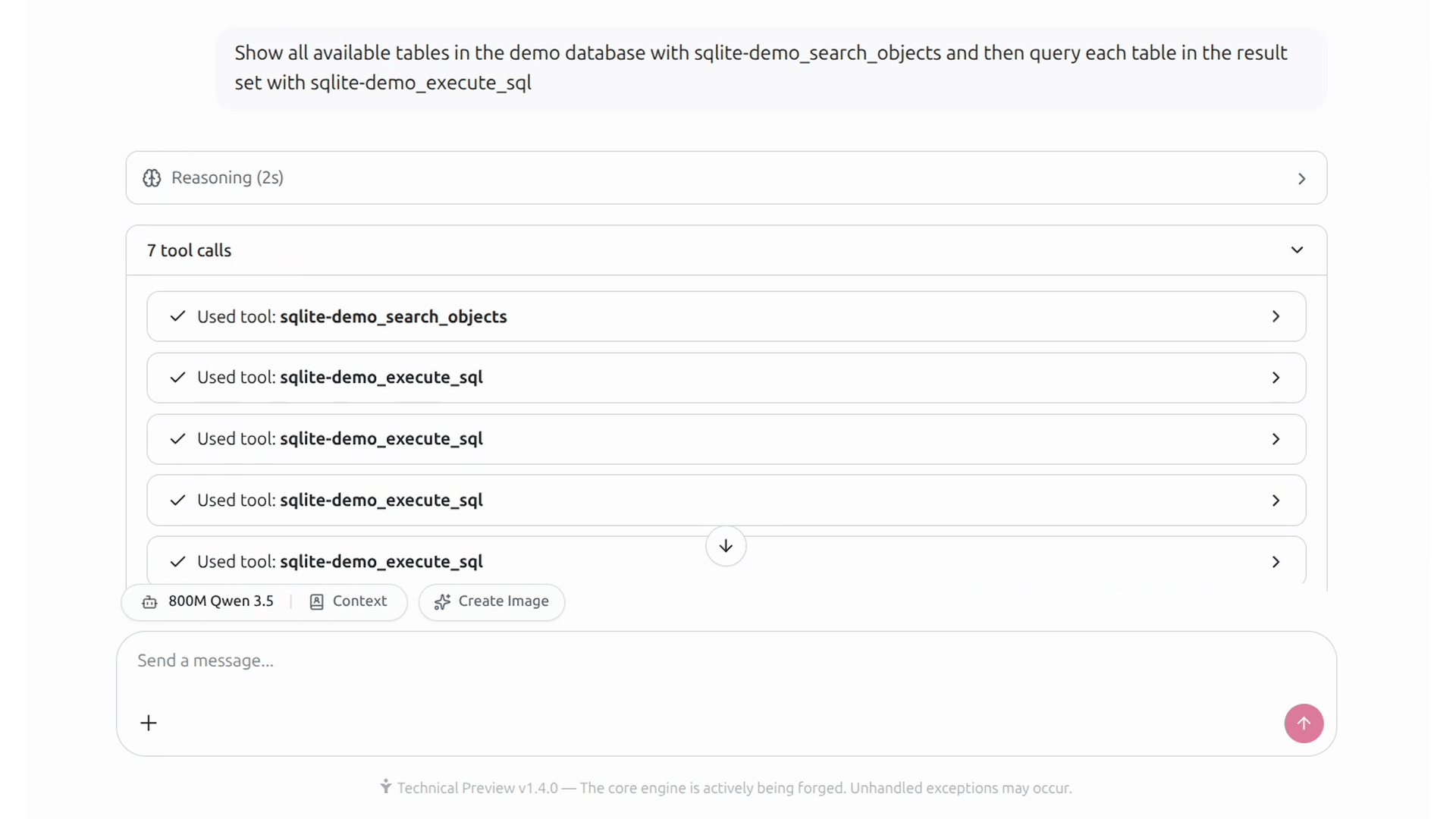
Guided by the Manifold Engine, the 800M Qwen model autonomously chains seven consecutive database MCP tool calls in a single turn—first discovering all six schema tables and then querying each table in sequence without a single loop or syntax error. Even better, teams can teach YPipe stateful operational rules in plain English (such as “If the server is overloaded, detect my system hardware”), where reporting a healthy server triggers nothing and transitioning into an overloaded state automatically fires the hardware diagnostics tool call.
SmartPipes & KnowledgePipes: Chaining Multimodal Workflows into MariaDB Vector & Zero-ETL SQL
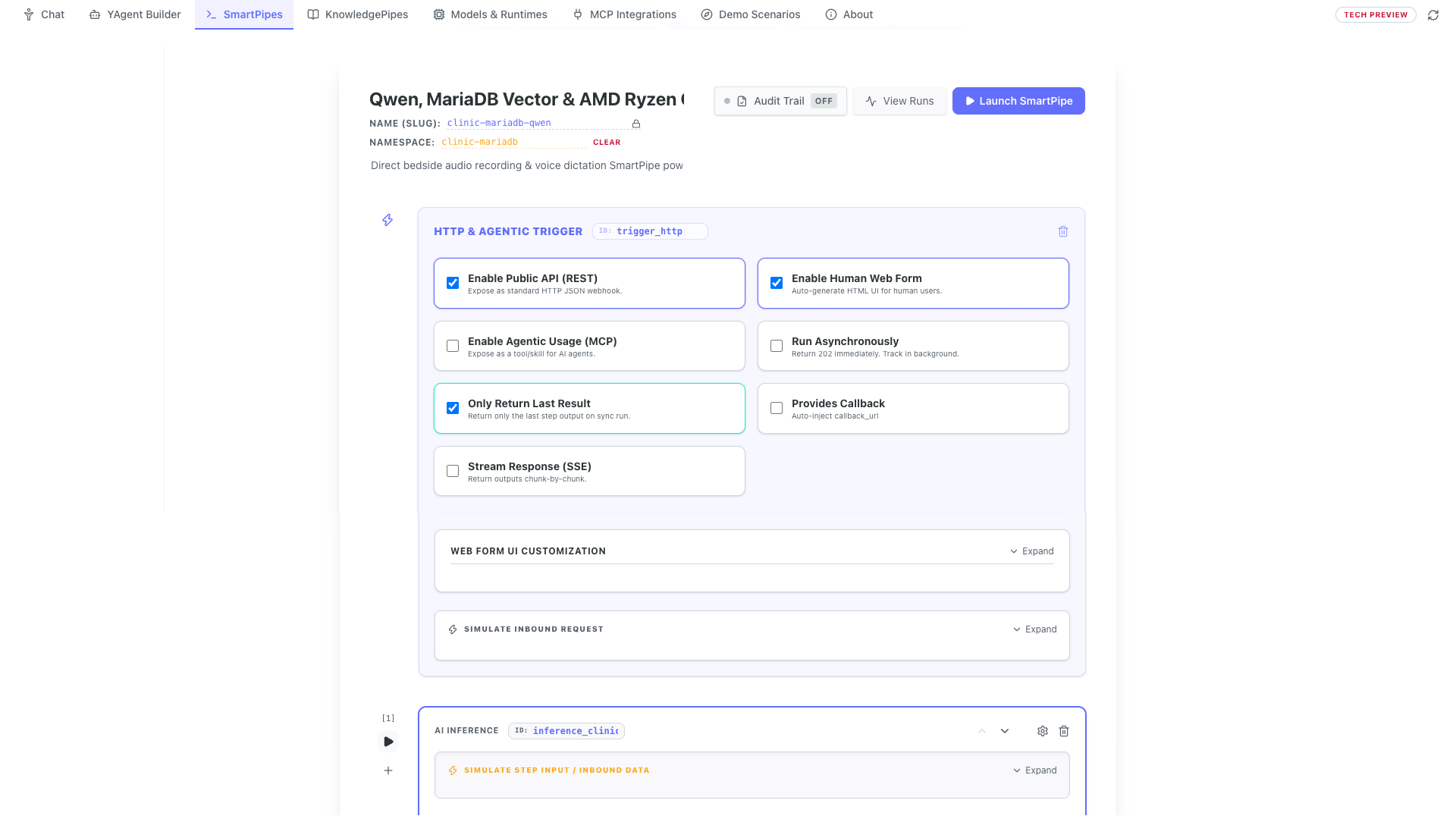
Through YPipe SmartPipes, business and engineering teams visually chain local Whisper speech recognition, Qwen vision OCR, and Qwen language models directly into MariaDB and enterprise endpoints. Every visual pipeline—whether scanning financial invoices into schema-validated JSON or streaming clinical voice notes into a database—is immediately exposed as a human Web Form, a production REST webhook, and a reusable Model Context Protocol (MCP) tool consumable by other AI agents.
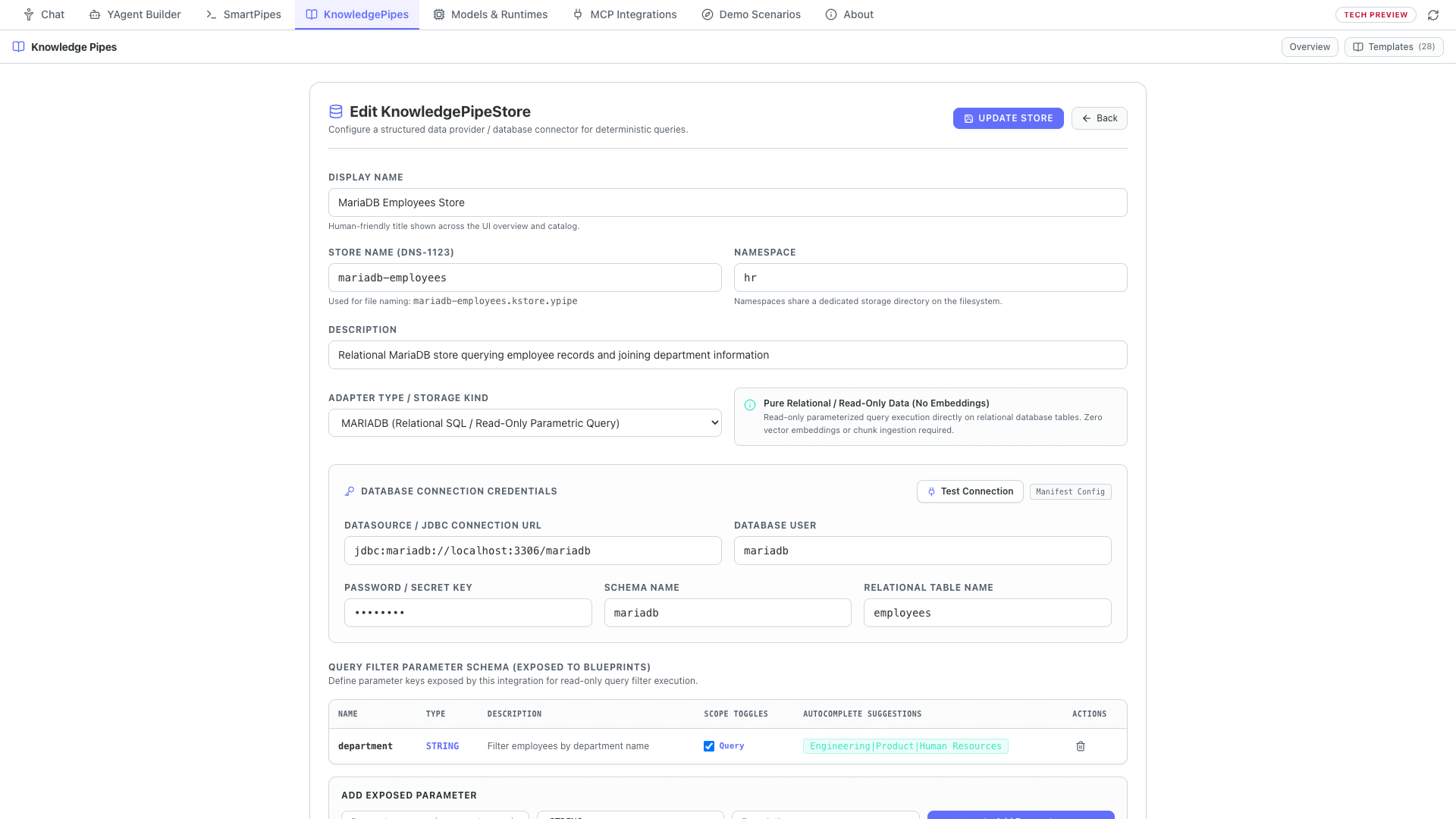
On the data layer, YPipe KnowledgePipes binds Qwen directly to MariaDB through two complementary adapters: the native MariaDB Vector Store adapter (MARIADB_VECTOR using VEC_FromText and VEC_DISTANCE_COSINE) embeds documents and SmartPipe outputs straight into MariaDB vector tables with millisecond search and scoped JSON_VALUE metadata isolation, while the MariaDB Relational adapter (MARIADB_RELATIONAL) lets the Manifold Engine query live operational tables via read-only SQL joins with zero ETL.
End-to-End Enterprise Blueprint: From Hospital Ward Rounds to Manufacturing & Finance
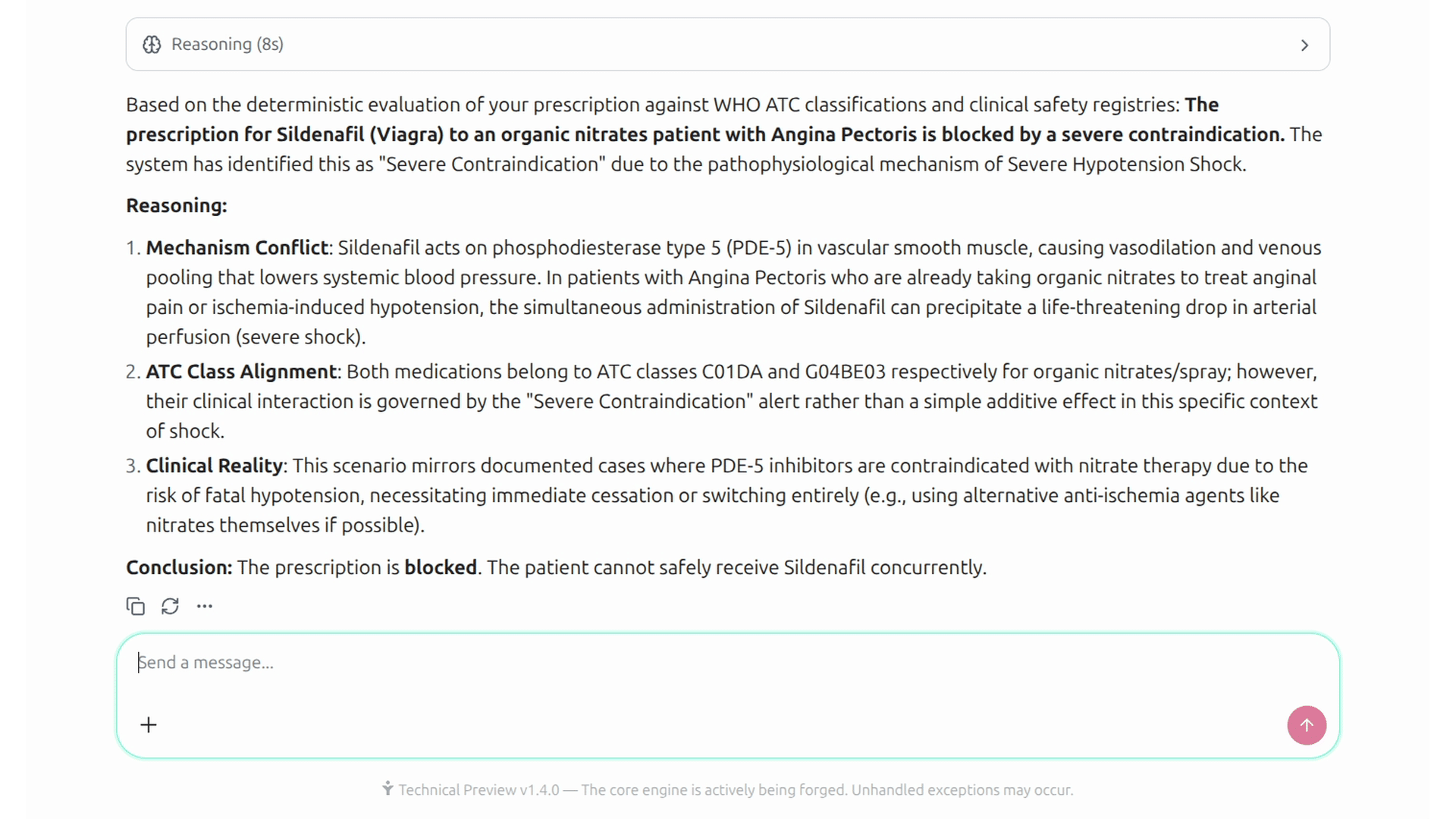
In our joint clinical ward-rounds blueprint, Alibaba Qwen, MariaDB, and AMD Ryzen work together end to end: a physician dictates bedside observations into a SmartPipe that transcribes the audio with Whisper, structures the clinical SOAP note with Qwen 800M, and indexes the vectors straight into MariaDB. A scoped KnowledgePipe Context locks MariaDB vector retrieval to the active patient ID (instantly surfacing Patient 1003’s Penicillin and Ciprofloxacin allergies without mixing patient records), while the Manifold Engine deterministically aligns WHO ATC drug classes to block a life-threatening Nitroglycerin + Sildenafil interaction and catch a cumulative 3,700 mg Paracetamol overdose.
While healthcare serves as the example scenario, the underlying architecture is structurally identical across industries—whether engineering teams are enforcing strict manufacturing tolerances in MariaDB, R&D labs are cross-checking proprietary chemical formulas against safety rules, or finance teams are auditing supplier receipts against cumulative budget limits.
Cloud GPU Silos vs. Sovereign Enterprise AI Stack (YPipe + Alibaba Qwen + MariaDB + AMD Ryzen)
| Architectural Dimension | Conventional Cloud LLM & Vector Silos | YPipe + Alibaba Qwen + MariaDB + AMD Ryzen |
|---|---|---|
| Compute & Hardware Footprint | Requires costly cloud API tokens or dedicated datacenter GPUs | Runs 800M–32B Qwen models + Manifold Engine locally on standard AMD Ryzen CPUs |
| Tool Calling & Reasoning Governance | Probabilistic prompt loops prone to context confusion on compact models | Manifold Engine leads deterministically; Qwen acts as semantic advisor & hypothesis generator |
| Database & Vector Architecture | Separate vector database + fragile ETL sync pipelines | Unified MariaDB Vector (VEC_FromText) + Zero-ETL MariaDB Relational SQL in KnowledgePipes |
| Workflow Operationalization | Custom glue code required for forms, webhooks, and agent tools | SmartPipes exposes every pipeline as a Web Form, REST Webhook & MCP Tool in one click |
Step-by-Step Walkthrough Inside YPipe
Step 1: YPipe + Alibaba Qwen + MariaDB + AMD — Joint Enterprise AI on Everyday CPUs
Building sovereign, on-premise enterprise AI takes the right combination of intelligence, data, and local compute: Alibaba’s Qwen models for compact, high-density language and multimodal intelligence, Maria-D-B as a rock-solid relational and vector database, and AMD Ryzen processors as the local CPU hardware. What makes AMD so great here is that we can run compact Qwen models together with the Y-Pipe Manifold Engine directly on standard CPUs—delivering reliable, deterministic AI without expensive GPU clusters. Y-Pipe by iunera serves as the binding glue that unites Qwen, Maria-D-B, and AMD into a single, turnkey enterprise platform. In Y-Pipe, Alibaba’s Qwen family—scaling from 800-million up to 32-billion parameters—is our primary model lineup, deeply integrated with Maria-D-B’s relational and vector engine. And as this live hardware check shows, the entire joint stack runs smoothly right here on an everyday HP EliteBook powered by an AMD Ryzen 5 with six cores and no dedicated graphics card.
Step 2: YPipe Manifold Engine + Qwen 800M — 7 Chained Tool Calls & Live Rule Learning
What makes this joint architecture so effective is how the Y-Pipe Manifold Engine and Alibaba’s compact 800-M Qwen model work together: Manifold takes the deterministic lead—governing tool selection, parameter formatting, and execution state—while using Qwen as a semantic advisor and hypothesis generator whenever structured data is missing, all running easily on a standard CPU. Watch Manifold guide Qwen L-L-M through seven chained database tool calls in a single turn: first discovering all six schema tables, and then querying each table in sequence without a single loop or syntax error. Even better, Qwen and the Manifold Engine learn stateful operational rules live in plain English: after teaching the rule—if the server is overloaded, detect my system hardware—reporting a healthy server triggers nothing, while transitioning into an overloaded state automatically fires the hardware diagnostics tool call.
Step 3: SmartPipes — Turning Qwen & MariaDB into Web Forms, Webhooks & MCP Tools
Y-Pipe also serves as the workflow backbone that connects Qwen to real business processes through SmartPipes—which we explore in detail in our dedicated SmartPipes videos. In SmartPipes, teams visually chain local Whisper speech recognition, Qwen vision OCR, and Qwen language models directly into Maria-D-B and enterprise endpoints. Whether a finance team is scanning invoices into schema-validated JSON, or a clinical team is streaming voice notes straight into Maria-D-B, Y-Pipe immediately exposes every pipeline as a human Web Form, a production REST webhook, and a reusable MCP tool that can be consumed by other AI agents—resulting in a deterministic local AI chain.
Step 4: YPipe KnowledgePipes + MariaDB — Native Vector RAG & Zero-ETL SQL
On the data layer, Y-Pipe’s Knowledge-Pipes engine—which we cover in depth in our dedicated Knowledge-Pipes videos—is capable of binding Qwen directly to Maria-D-B, one of the world’s most trusted open-source enterprise databases. Through our native Maria-D-B Vector Store integration, Y-Pipe embeds documents and SmartPipe outputs straight into Maria-D-B vector tables and searches them in milliseconds. At the same time, Y-Pipe’s Maria-D-B Relational adapter lets Manifold query live operational tables via read-only SQL joins—uniting semantic vector memory and zero-ETL relational data across local and enterprise Maria-D-B instances.
Step 5: Alibaba Qwen + MariaDB + AMD + YPipe — End-to-End On-Premise Enterprise AI
In our joint clinical ward-rounds blueprint, you see how Y-Pipe brings Alibaba Qwen, Maria-D-B, and AMD Ryzen together end to end. When a physician dictates bedside observations, a SmartPipe transcribes the audio with Whisper, structures the clinical SOAP note with Qwen 800-M, and indexes the vectors straight into Maria-D-B. A scoped Knowledge-Pipe Context then locks Maria-D-B vector retrieval to the active patient ID—instantly surfacing Patient 1003’s Penicillin and Ciprofloxacin allergies without ever mixing patient records. And when checking prescriptions, the Y-Pipe Manifold Engine deterministically aligns W-H-O drug classes to block a life-threatening Nitroglycerin plus Sildenafil interaction and calculate an exact 3,700 milligram cumulative Paracetamol overdose—while Qwen 800-M synthesizes the clear clinical explanation. While healthcare serves as our example scenario here, the underlying logic is structurally identical across other enterprise operations: whether engineering teams are enforcing strict manufacturing tolerances in Maria-D-B, R-and-D labs are cross-checking proprietary chemical formulas against safety rules, or finance teams are auditing supplier receipts for cumulative budget limits. Alibaba Qwen delivers the open-weight intelligence, Maria-D-B delivers the unified vector and relational data engine, AMD Ryzen delivers the local CPU efficiency, and Y-Pipe is the binding glue that turns them into a sovereign enterprise AI platform on everyday business hardware.
Frequently Asked Questions
How do YPipe, Alibaba Qwen, MariaDB, and AMD Ryzen work together? Alibaba Qwen provides the open-weight language and multimodal intelligence (800M to 32B), MariaDB provides the unified relational and vector database engine, AMD Ryzen provides efficient local CPU compute, and YPipe by iunera serves as the binding orchestration platform.
What is Qwen’s role when paired with the ypipe Manifold Engine? The ypipe Manifold Engine takes the deterministic lead—governing tool selection, parameter formatting, and execution state—while using Qwen as a semantic advisor and hypothesis generator whenever structured data is missing.
Can this stack really run on a standard laptop CPU without a dedicated GPU? Yes. Episode 07 is recorded live on an HP EliteBook 845 G10 powered by a 6-core AMD Ryzen 5 PRO 7540U CPU with integrated graphics and zero dedicated GPU VRAM.
How does YPipe integrate with MariaDB for RAG and SQL? YPipe KnowledgePipes includes both a native MariaDB Vector Store adapter (using MariaDB 11.7+ VEC_FromText and VEC_DISTANCE_COSINE with JSON_VALUE metadata filtering) and a zero-ETL MariaDB Relational adapter for read-only parameterized SQL joins.
How does YPipe SmartPipes operationalize Qwen and MariaDB workflows? SmartPipes lets teams visually chain local Whisper audio transcription, Qwen vision OCR, and Qwen LLM inference into MariaDB RAG sinks, automatically exposing each pipeline as a human Web Form, REST webhook, and MCP tool.
How does YPipe prevent cross-patient or cross-department data leaks in MariaDB? Scoped KnowledgePipe Contexts enforce mandatory SQL and JSON_VALUE filter predicates (such as patient_id or department) at the storage adapter layer before any records reach the model.
Related Articles & YPipe Video Series
YPipe by iunera is The Sovereign Local-First AI Platform—running 100% locally on workstations or on-premise on your enterprise and clinic servers with full GDPR, HIPAA, and EU AI Act sovereignty. Explore our related engineering studies on Kraken and the full video series below:
Related Kraken Articles on YPipe & Local AI
- Why an 800M Model Can’t Send an Email: The Context Confusion Problem
- Agentic Loops Explained: Why Modern AI Is No Longer Just a Model
- Why a 9B Local Model Sends Email Perfectly on the First Try
Explore All Episodes in the YPipe Video Series
- Episode 01: YPipe — The Sovereign Local-First AI Platform | Manifold Engine, MCP, SmartPipes & On-Premise RAG
- Episode 02: Re:Think Local AI — 800M Qwen 3.5 & YPipe Manifold Engine: Tool Calling & Reasoning on Laptops
- Episode 03: YPipe SmartPipes — Visual Multi-Model AI Workflows (Whisper, Vision OCR, REST Webhooks & MCP Tools)
- Episode 04: YPipe KnowledgePipes — Declarative Local & On-Premise RAG | Vector DBs, SQL & Scoped Contexts
- Episode 05: Private AI for Hospitals & Clinics — Voice Ward Rounds, Patient Privacy & Drug Safety in YPipe
- Episode 06: Private AI Meeting Minutes & Company Knowledge — Record Confidential Meetings Safely with YPipe
- Episode 07 (This Article): Alibaba Qwen + MariaDB + AMD Ryzen — Sovereign Enterprise AI on Everyday CPUs with YPipe
Official YPipe Resources
- Official YPipe Website: https://ypipe.com
- iunera Company Website: https://www.iunera.com
- GitHub Repository: https://github.com/iunera/ypipe
- Full YouTube Video Series Playlist: https://www.youtube.com/playlist?list=PLIB7VtTuXX3Y