
Large Language Models (LLMs) are hitting a structural ceiling governed by logistic growth and inward technological convergence. Because autoregressive transformers store world knowledge as lossy word-co-occurrence probabilities rather than explicit concepts and relations, scaling models larger yields diminishing returns—leaving fundamental flaws in multi-step logic, relational consistency, and factual verification unresolved.
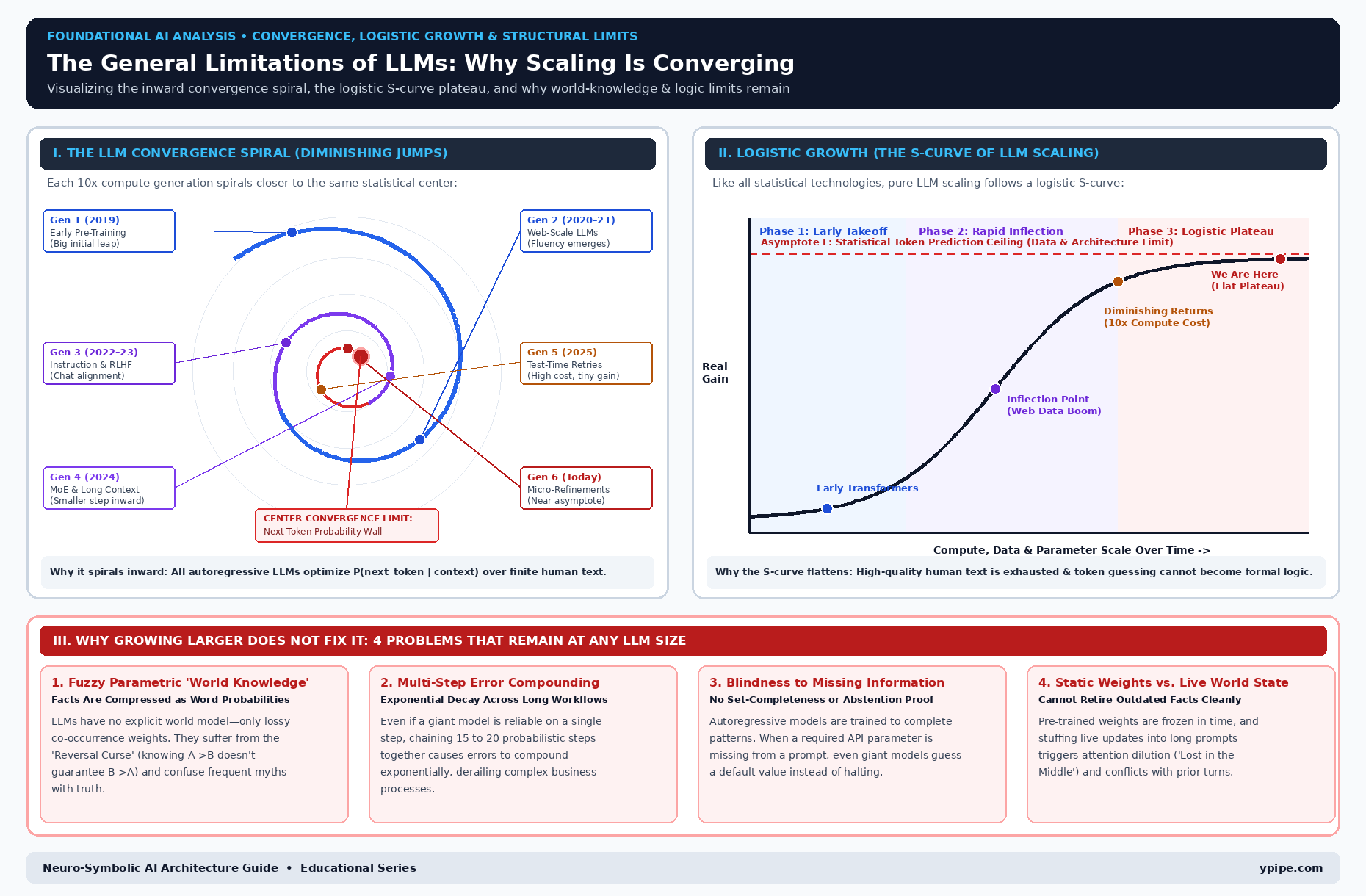
1. The Convergence Spiral & Logistic Growth: Why LLM Scaling Is Flattening
For several years, rapid improvements in natural-language fluency created the impression that scaling neural network parameters and training data would eventually solve every reasoning problem. Today, empirical benchmarks across major model generations reveal two classic mathematical patterns of technological maturity:
- The Inward Convergence Spiral: Early jumps in language modeling—from early transformers to web-scale pre-training and instruction tuning—produced dramatic, visible leaps in text quality. However, each subsequent generation spirals tighter and tighter around the same central limit: the statistical ceiling of next-token prediction (
P(next_token | context)). Spending 10x more compute and energy on a new frontier release now yields only marginal, incremental steps inward rather than a new level of reliability. - The Logistic S-Curve (
f(t) = \frac{L}{1 + e^{-k(t - t_0)}}): Like all statistical learning curves bounded by finite data, pure LLM scaling follows a three-phase logistic curve: Phase 1 (Early Takeoff): Learning basic syntax and grammar. Phase 2 (Steep Inflection): Absorbing the public internet to master human-like prose style and broad trivia. Phase 3 (The Upper Asymptote / Plateau): High-quality human text is largely exhausted, and statistical token approximation hits its structural carrying capacity (L).
2. How LLMs Store “World Knowledge”—And Why It Breaks Even When Models Grow Larger
To understand why bigger LLMs still fail on domain reasoning, we have to look at how an LLM represents knowledge compared to Symbolic AI:
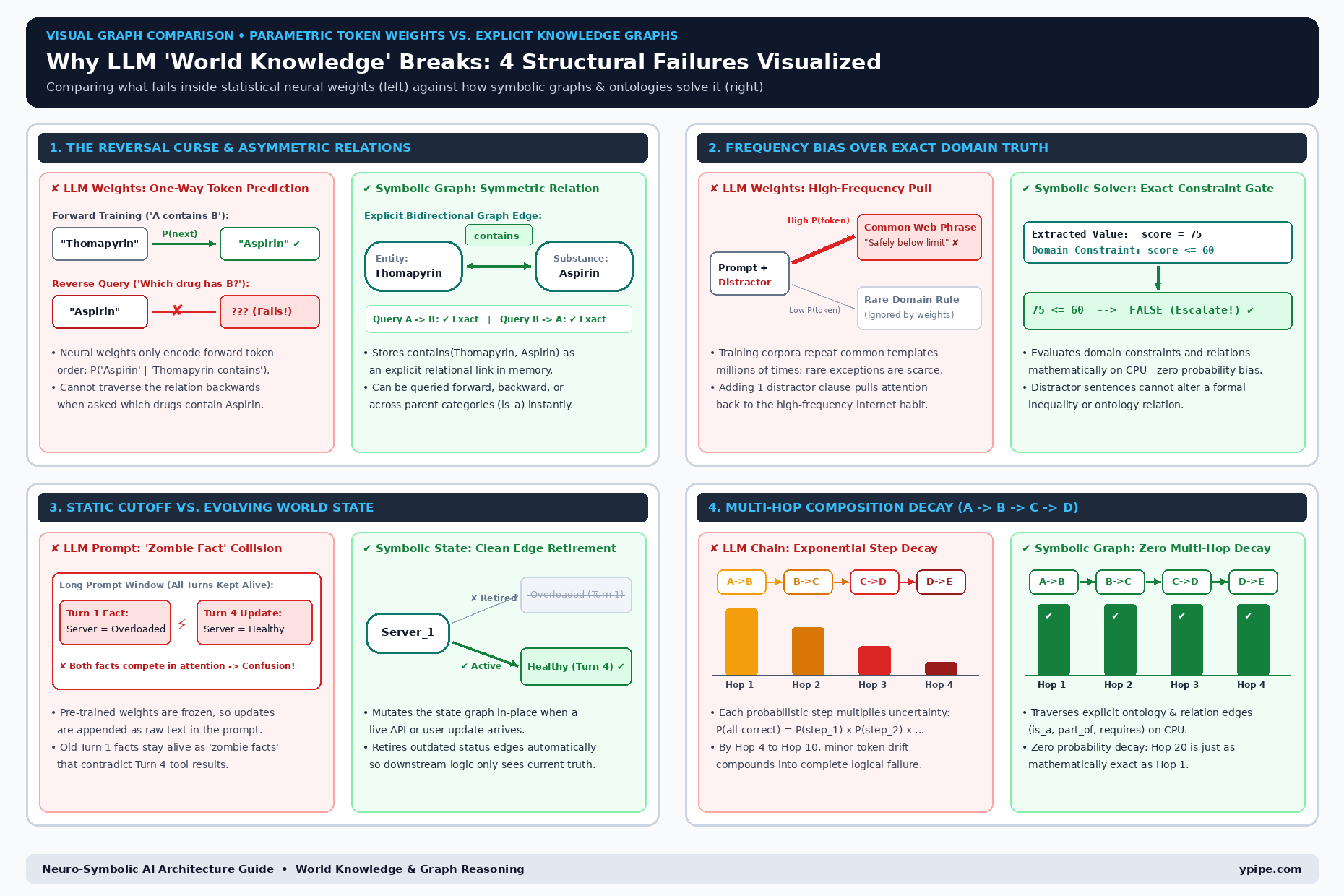
In a symbolic system (such as a knowledge graph or domain ontology), world knowledge is stored as explicit entities, semantic relations, and hierarchies (Aspirin is_a Salicylate is_a NSAID). In a standalone LLM, there are no explicit entities or relations—only billions of continuous floating-point weights trained to compress how often words appear near one another in text.
Even as an LLM grows to hundreds of billions or trillions of parameters, four fundamental limitations of parametric world knowledge remain:
| Limitation of LLM World Knowledge | Why It Happens Inside Neural Weights | Why Growing the Model Larger Does Not Fix It |
|---|---|---|
| 1. The Reversal Curse & Asymmetric Relations | Neural weights learn directional token sequences ("A is the parent of B"), not symmetric logical entities. | Berglund et al. (2023) proved that LLMs trained on “A is B” systematically fail to deduce “B is A” across model sizes because statistical weights are not relational graphs. |
| 2. Frequency Bias Over Domain Truth | Common phrases in training text receive higher probability mass than rare, exact specifications. | If a distractor clause or a common misconception appears frequently on the internet, larger models still drift toward the high-probability phrase template (Apple ML Research, 2024). |
| 3. Static Cutoff vs. Evolving World State | Parametric knowledge is frozen at pre-training time. | When a live tool updates a system’s status mid-conversation, stuffing both old and new states into a long prompt causes attention dilution (“Lost in the Middle”) and stale-fact conflicts. |
| 4. Multi-Hop Composition Decay | Chaining multiple relations (A -> B -> C -> D) requires multiplying probabilities across steps. | As Dziri et al. (2023, Faith and Fate) proved, transformer accuracy decays exponentially as the number of compositional reasoning steps increases. |
3. Why LLM Releases Over Time Hit the Roof on Logic & Relations
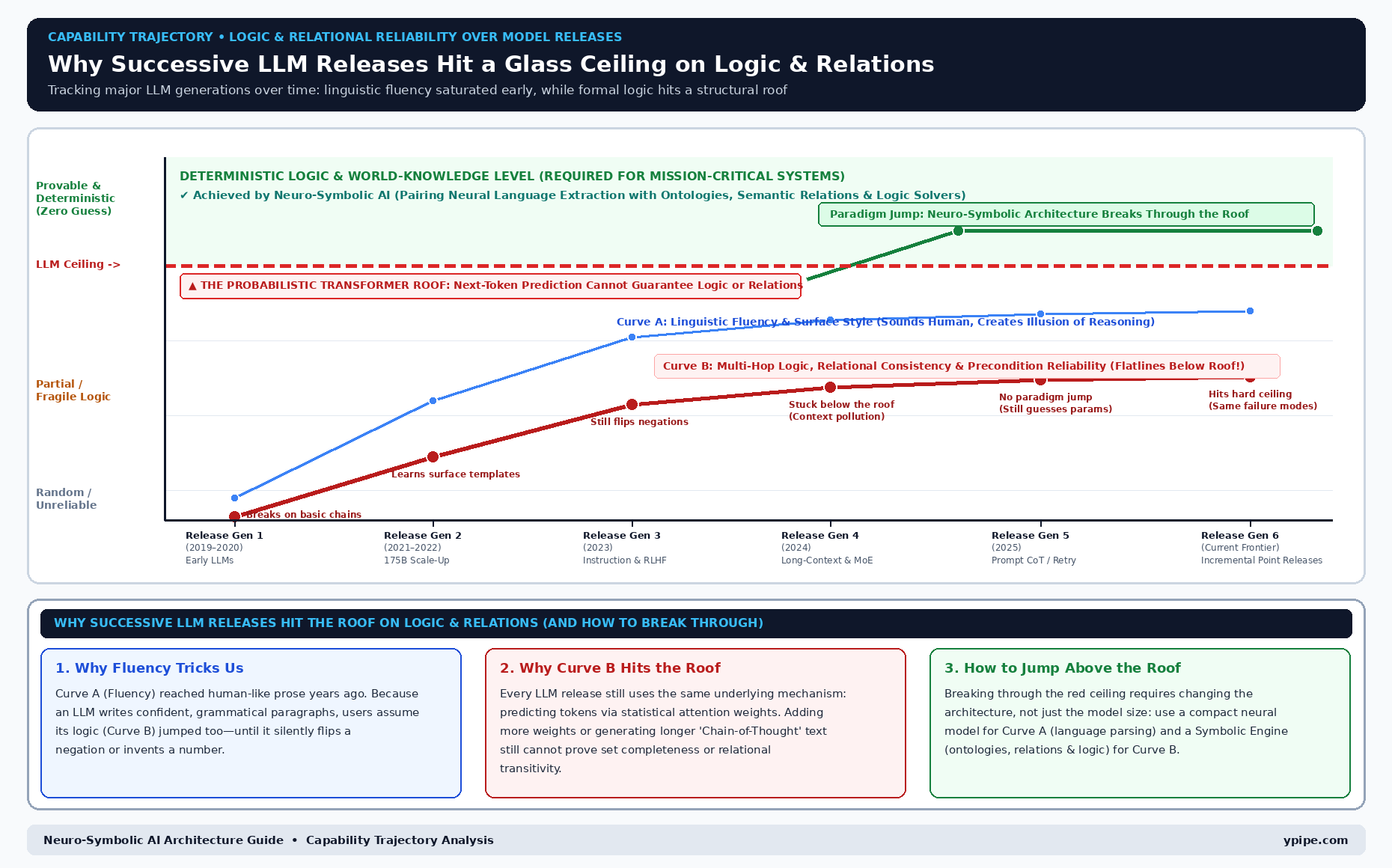
When we plot Linguistic Fluency (Curve A) against True Logical & Relational Reliability (Curve B) across successive LLM releases over time, the gap becomes unmistakable:
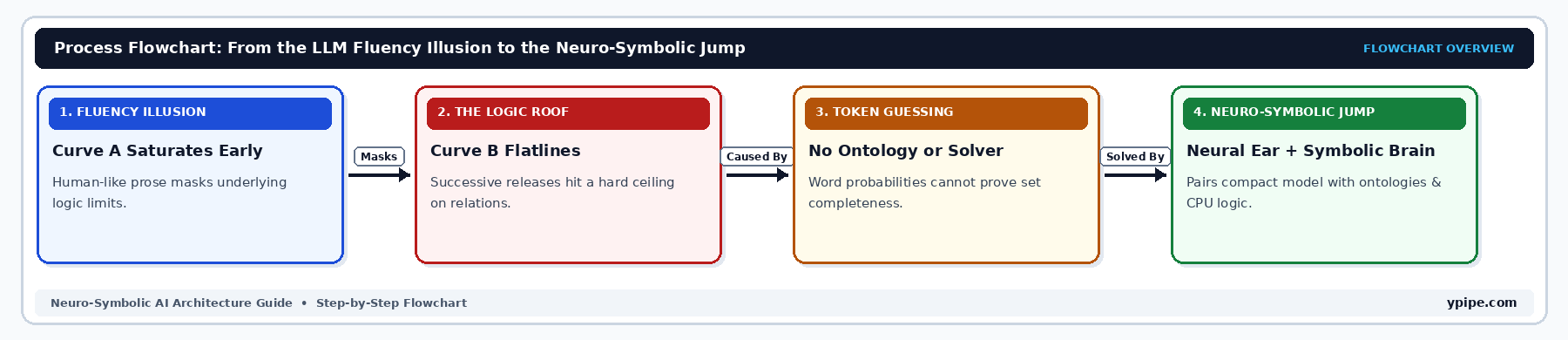
Why Recent Releases Do Not Jump to a New Level on Logic
- Fluency Saturated Early (Curve A): By the third generation of LLMs, prose fluency reached human level. Because the text sounds articulate and confident, users naturally assume the model’s underlying logic is equally strong.
- Logic Flatlines Below the Roof (Curve B): Across recent model releases—including Mixture-of-Experts (MoE), million-token context windows, and test-time token retries—logical and relational reliability hits a hard ceiling: Negation & Exception Flips: On multi-clause documents (“Eligible unless Clause 14 applies, except when…”), standalone LLMs continue to invert conditions. Silent Parameter Fabrication: When connected to 40+ APIs, if a required parameter (like a fiscal quarter) is missing from the user’s prompt, new LLM releases still guess a plausible default (
quarter="Q1") rather than proving set completeness. Last-Mile Numeric Contradictions: Even when an API returns a value of75, a standalone LLM summarizing the result can still write “The score is 75, which is below the limit of 60.”
Excursus: “But LLMs Can Write Code!” — Why Writing Code Syntax and Proving How the LLM Works Are Two Different Things
Whenever engineers see that LLMs hit a ceiling on formal logic, a natural question immediately comes up:
“Wait—if LLMs cannot do formal logic, how are they able to write Python, Java, and C++ code?”
The answer reveals one of the most important distinctions in computer science: translating natural language into code syntax is completely different from proving that logic is correct—or proving how the LLM itself works.
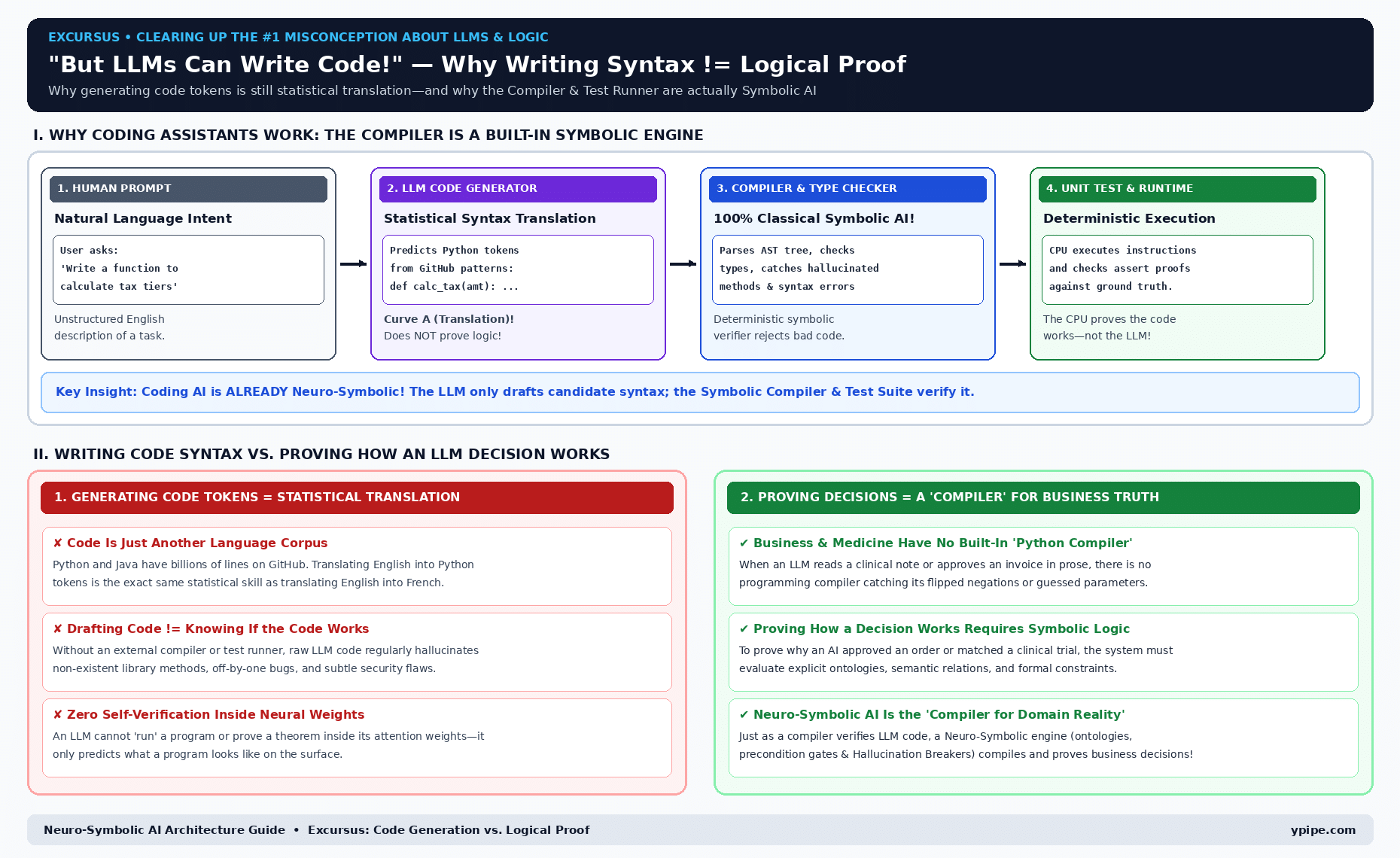
1. Writing Code Is Statistical Language Translation (Curve A)
Programming languages like Python, JavaScript, and SQL have billions of lines of public text on GitHub and StackOverflow. When a user prompts an LLM with “Write a function to sort invoices by date,” the LLM is not executing formal deduction in its head—it is performing statistical sequence translation from English tokens into Python tokens, using the exact same pattern-matching mechanism it uses to translate English into French.
2. Coding AI Only Works Because the Compiler Is a Symbolic Engine!
What happens right after an LLM drafts a block of code? Left alone, raw LLM-generated code frequently contains hallucinated library methods, off-by-one errors, type mismatches, or broken edge cases. The reason AI coding assistants work in practice is that programming languages already have a 100% deterministic Symbolic AI engine built right into the workflow: the Compiler, Type Checker, and Unit-Test Runner.
- The LLM (Neural System 1) drafts a candidate syntax hypothesis.
- The Compiler & CPU Runtime (Symbolic System 2) parses the Abstract Syntax Tree (AST), verifies type relations, executes the assertions deterministically, and proves whether the code actually works.
3. Writing Code != Proving How the LLM’s Own Decisions Work
Even when an LLM can output a Python snippet, the LLM itself remains an unverified black box when making decisions over business documents, clinical guidelines, or live enterprise APIs:
- In everyday business workflows—such as checking whether a patient satisfies 40 clinical trial exclusions or whether an unverified vendor order violates Page 42 of a procurement policy—there is no “Python compiler” checking the LLM’s prose.
- That is why Neuro-Symbolic AI is essential: it acts as the “compiler and theorem prover for domain reality”—symbolizing unstructured text into explicit entities and relations, checking them against domain ontologies and precondition gates, and proving mathematically how every decision was reached.
4. Which Problems Will Remain—And How Neuro-Symbolic AI Breaks Through the Roof
As long as an AI system relies on probabilistic next-token prediction alone to store world knowledge and execute logic, the following problems will remain regardless of how many GPUs are used:
- Zero Mathematical Proof or EU AI Act Audit Trail: Attention weights cannot output a formal proof tree.
- Unpredictable Failure on Edge Cases: Changing a variable name or adding one irrelevant sentence in a prompt can flip the output (GSM-Symbolic, 2024).
- Massive Hardware & VRAM Overhead: Using gigabytes of GPU KV-Cache memory as a slow, lossy database for domain rules.
Breaking Through the Ceiling: The Shift to Neuro-Symbolic AI
Jumping to the green zone above the red ceiling in the chart above does not require waiting for a 10-trillion-parameter LLM. It requires changing the architecture:
- Use a Right-Sized Neural Model for Curve A (Language): Let a compact local language model handle what neural networks already do brilliantly—reading messy human text and extracting entities.
- Use Symbolic AI for Curve B (World Knowledge, Relations & Logic): Offload ontologies (
is_a/part_ofhierarchies), semantic relations, precondition checks, and post-generation Hallucination Breakers to a deterministic CPU engine. You can build this yourself for a single use case with a small local model and Python code, or use a unified neuro-symbolic workspace like YPipe across your organization.
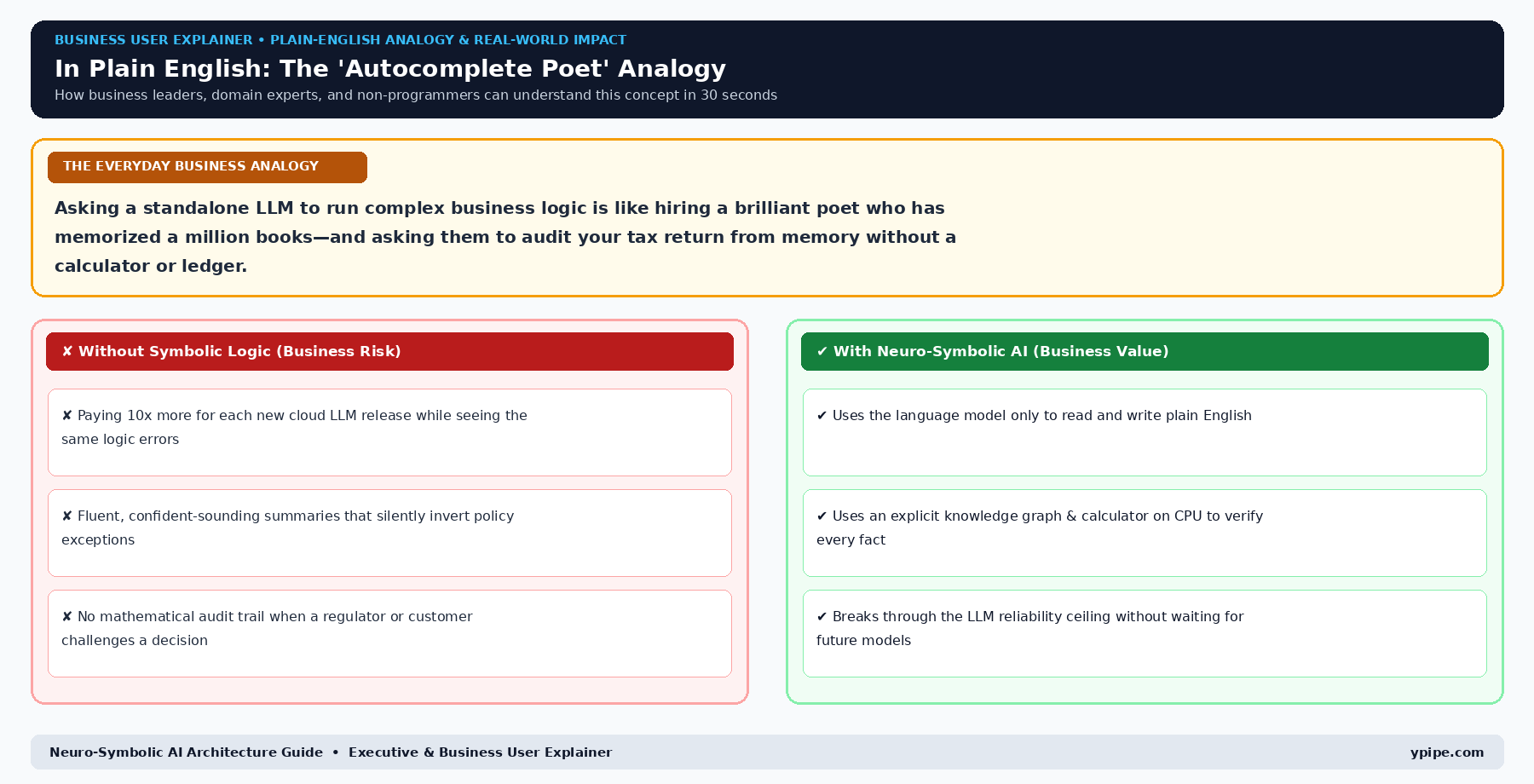
In Plain English for Business Leaders: The ‘Autocomplete Poet’ Analogy
The 30-Second Analogy: Asking a standalone LLM to run complex business logic is like hiring a brilliant poet who has memorized a million books—and asking them to audit your tax return from memory without a calculator or ledger.
For a practical engineering breakdown of why raw model weights alone cannot form a reliable enterprise system—and how outer orchestration loops bridge the gap—see our related analyses on the iunera Kraken Engineering Blog: Why Running a Local LLM Does Not Give You an AI System and Agentic Loops Explained: Why Modern AI Is No Longer Just a Model.
5. Key Takeaways
- LLM Scaling Is Converging: Successive LLM generations follow an inward convergence spiral and a flattening logistic S-curve toward the statistical limit of next-token prediction.
- Parametric World Knowledge Is Lossy: Storing world knowledge as word co-occurrence weights leaves LLMs vulnerable to the Reversal Curse, frequency bias, and stale state conflicts—even as models grow larger.
- Breaking the Logic Roof Requires Symbolic Intelligence: New LLM point releases cannot turn statistical guessing into formal deduction; uniting neural language models with symbolic ontologies, relations, and logic is what breaks through the ceiling.
6. Frequently Asked Questions (FAQ)
Q1: What does it mean that LLM technology is following a “logistic curve” and a “convergence spiral”?
A logistic curve (S-curve) describes a technology that starts slowly, goes through a rapid growth phase as initial data is absorbed, and then flattens out as it approaches its theoretical ceiling. The convergence spiral illustrates that each new generation of frontier models—despite costing 10x more compute—makes a smaller and smaller leap toward the same central limit of statistical token prediction.
Q2: Why doesn’t making an LLM 10x larger fix its world-knowledge and logic errors?
Because the error comes from how transformers represent information, not just how many parameters they have. An LLM represents facts as fuzzy probability distributions over word sequences. As Apple ML Research (GSM-Symbolic, 2024) and Dziri et al. (2023) demonstrated, even frontier models fail when multi-step relational composition or distractor resistance is required.
Q3: What is the “Reversal Curse” in Large Language Models?
Discovered by Berglund et al. (2023), the Reversal Curse shows that if an LLM is trained on the sentence “ouch-reliever X contains active substance Y,” it often cannot answer “Which medications contain substance Y?” because neural weights encode forward token prediction rather than a bidirectional semantic relation. In Symbolic AI, an explicit relation contains(X, Y) is queryable in both directions automatically.
Q4: Why do new LLM releases still hit a ceiling on multi-step logic?
In a multi-step logical chain, a probabilistic model’s reliability multiplies across steps. If a model is 95% accurate on a single step, across a 15-step workflow its probability of completing every step without a single slip drops to 0.95^{15} \approx 46\%. Only a deterministic symbolic engine maintains 100% consistency across arbitrary chain lengths.
Q5: Don’t “Reasoning Models” (Test-Time Compute / Chain-of-Thought) break through the logic roof?
Generating thousands of hidden “thinking tokens” before answering improves performance on self-contained puzzles, but as Kambhampati et al. (2024) showed, internal token sampling is still probabilistic guessing without an external formal verifier. It still fabricates missing API parameters, flips domain exceptions, and burns massive GPU compute on checks that a CPU symbolic solver executes in 2 milliseconds.
Q6: Which tasks are already “good enough” below the LLM ceiling, and which require jumping above it?
Tasks like drafting emails, brainstorming creative copy, translating casual text, and summarizing low-risk notes work well below the ceiling because small logical slips don’t matter. Tasks like clinical trial matching, financial controlling, ERP/API orchestration, and legal compliance require jumping above the ceiling via Neuro-Symbolic AI.
Q7: How can a developer break through the LLM logic ceiling without waiting for future models?
Instead of waiting for the next frontier LLM release, pair a compact local language model with explicit world knowledge and deterministic validation code. Even for a single use case, extracting entities with a small model and checking relations and preconditions in Python/SQL immediately moves your application above the probabilistic ceiling.
Q8: Why are new LLM releases like GPT-5 or Claude not fixing hallucinations completely?
Because all autoregressive LLMs still generate text by predicting the next probable token (P(next_token | context)). While fluency saturated years ago, multi-step logical deduction and relational consistency hit a structural ceiling without an external symbolic verifier.
Q9: Is AI hitting a scaling wall or diminishing returns in 2026?
Yes—pure pre-training scaling follows a logistic S-curve. Now that high-quality public human text is largely exhausted, spending 10x more compute yields diminishing returns on logic, shifting the industry toward Neuro-Symbolic architectures.
Q10: If LLMs can write working Python code, why do they fail on business rules?
AI coding assistants only work because software engineering has a built-in Symbolic AI verifier—the Compiler and Unit-Test Runner—that catches the LLM’s syntax and type bugs. Business prose has no compiler unless you add a Neuro-Symbolic engine.
Further Reading
- Mirzadeh et al., Apple Machine Learning Research (2024): GSM-Symbolic: Understanding the Limitations of Mathematical Reasoning in Large Language Models (
arXiv:2410.05229) - Berglund et al. (2023): The Reversal Curse: LLMs Trained on “A is B” Fail to Learn “B is A” (
arXiv:2309.12288) - Dziri et al. (2023): Faith and Fate: Limits of Transformers on Compositionality (
arXiv:2305.18654) - Kambhampati et al. (2024): LLMs Can’t Plan, But Can Help Planning in LLM-Modulo Frameworks (
arXiv:2402.01817) - Stanford HAI (2024): Hallucinating Law: Legal Mistakes with Large Language Models Are Pervasive
- Garcez & Lamb (2020): Neurosymbolic AI: The 3rd Wave (
arXiv:2012.05876) - **Shumailov et al., Nature (2024):** AI models collapse when trained on recursively generated data
- iunera Kraken Blog — Why Running a Local LLM Does Not Give You an AI System
- iunera Kraken Blog — Agentic Loops Explained: Why Modern AI Is No Longer Just a Model
- iunera Kraken Blog — Sovereign AI in Europe: Why Enterprises Need More Than Consumer AI Platforms
- iunera — Sovereign Enterprise AI & Data Science Consulting