
Why does connecting a cloud LLM to an internal MCP server still expose on-premise data (such as database schemas, query rows, or internal files) to external servers and 7-year safety classifier retention—and how does YPipe by iunera solve it 100% on your own hardware?
YPipe is The Sovereign Local-First AI Platform (and Easy Local AI Client) built for IT-affine business users in controlling, finance, healthcare, and operations collaborating with IT and DevOps. It installs on a vanilla Windows, macOS, or Linux workstation or on-premise server with an embedded model and all llama.cpp CPU/GPU drivers ready out of the box. Powered by the ypipe Manifold Engine and Auto-Gear hardware sizing (800M to 32B parameters), YPipe beats 70B+ parameter models in deterministic scopes while eliminating small-model MCP tool-calling loops.
-
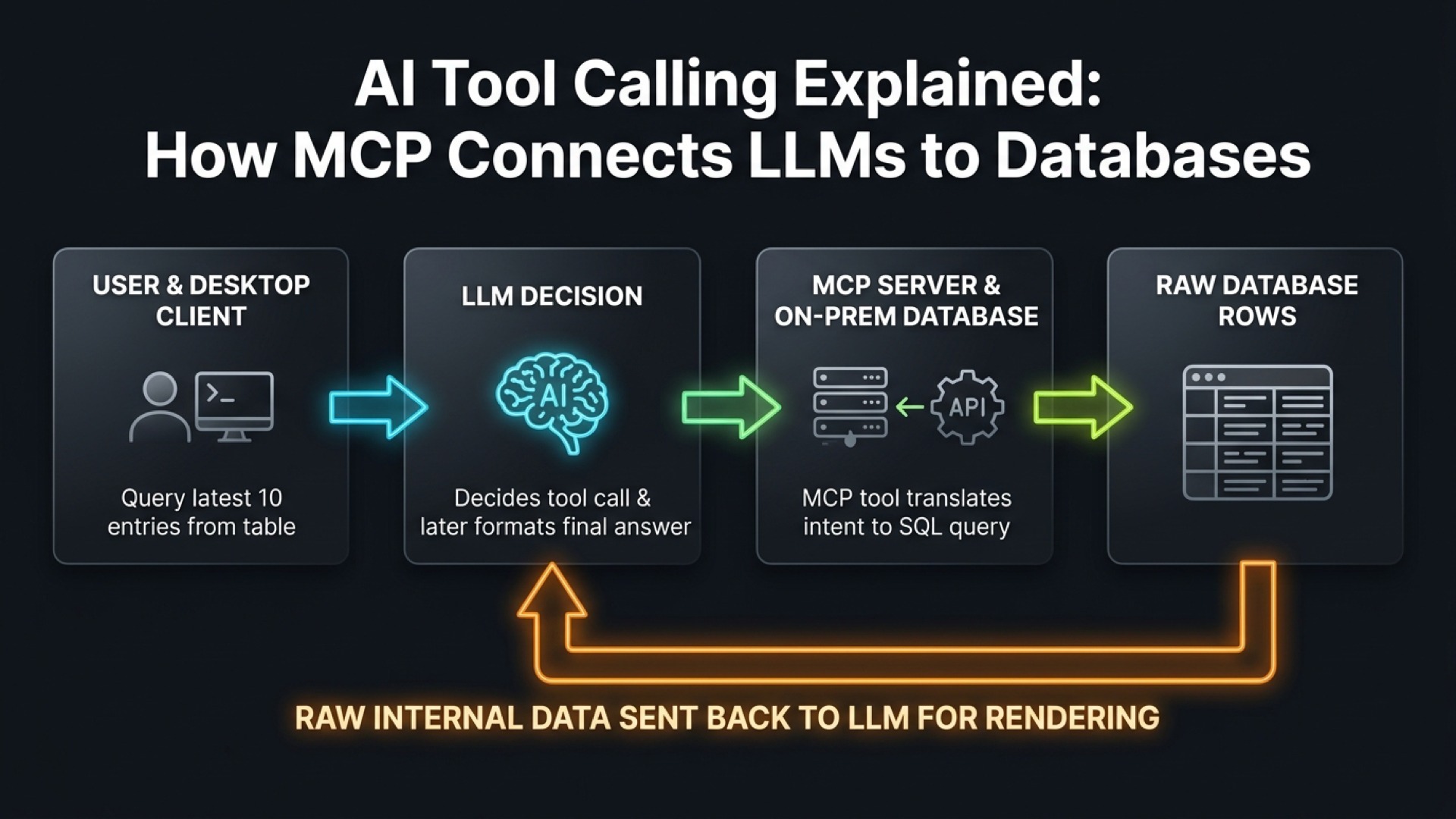
- How Model Context Protocol (MCP) tool results loop raw database rows back into the LLM context window.
https://www.youtube.com/watch?v=w5pob6jJ8N0
Full Video — Episode 01 on YouTube: YPipe — The Sovereign Local-First AI Platform | Manifold Engine, MCP, SmartPipes and On-Premise RAG
Table of Contents
- Key Takeaways
- The Hidden Data Trap of Cloud LLMs and Local MCP Servers
- Out-of-the-Box Runtimes, Auto-Gear Hardware Sizing and The ypipe Manifold Engine
- Solving the Two Biggest MCP Challenges in Couplings
- Visual SmartPipes, Declarative KnowledgePipes RAG and Kubernetes-Style .ypipe YAML Manifests
- Cloud AI + Local MCP vs. Raw Local LLM CLI vs. YPipe Sovereign AI Platform
- Step-by-Step Walkthrough Inside YPipe
- Frequently Asked Questions
- Related Articles and Video Series
Key Takeaways
- The Cloud MCP and Classifier Data Trap: Why cloud LLM tool calling leaks local on-premise data (e.g., database schemas, SQL rows, and internal files) to external servers and up to 7-year trust-and-safety classifier retention.
- Vanilla OS Setup and Auto-Gear Sizing: Bundled llama.cpp drivers (CPU, Metal, CUDA, Vulkan, ROCm) that automatically match 800M–32B models to your hardware.
- ypipe Manifold Engine: Takes the lead over compact models to enforce deterministic execution—beating 70B+ parameter models in focused business scopes.
- Two-Part MCP Server Solution: Ships with bundled Node.js, Python, and Java runtimes plus Manifold Engine parameter and description tuning in Couplings to eliminate tool-calling loops.
- SmartPipes, KnowledgePipes and .ypipe YAML Manifests: Visual multimodal workflows, declarative local and on-premise RAG, and Kubernetes-style manifests for GitOps and headless deployment.
The Hidden Data Trap of Cloud LLMs and Local MCP Servers
Many enterprises assume that running a local Model Context Protocol (MCP) server keeps their on-premise data (such as database schemas, query rows, or internal files) private. As we previously uncovered in The Hidden Data Leakage Risk of MCP Servers, that assumption breaks down the moment the MCP server returns a tool result.
When a user prompts an AI assistant connected to an internal MCP server, the local MCP server executes the tool inside your network—but every tool output (whether database schemas, raw SQL rows, or internal documents) must be transmitted back into the LLM context window so the model can synthesize a natural-language answer. When that LLM is hosted in the cloud, confidential schemas, customer records, financial ledgers, or clinical histories leave your infrastructure on every tool call. Worse still, cloud AI providers run automated trust-and-safety classifiers over prompts and tool outputs, if an opaque classifier flags a session, raw inputs and tool outputs can be retained for up to seven years for human review, while silent overnight model weight updates can break production workflows without warning.
-
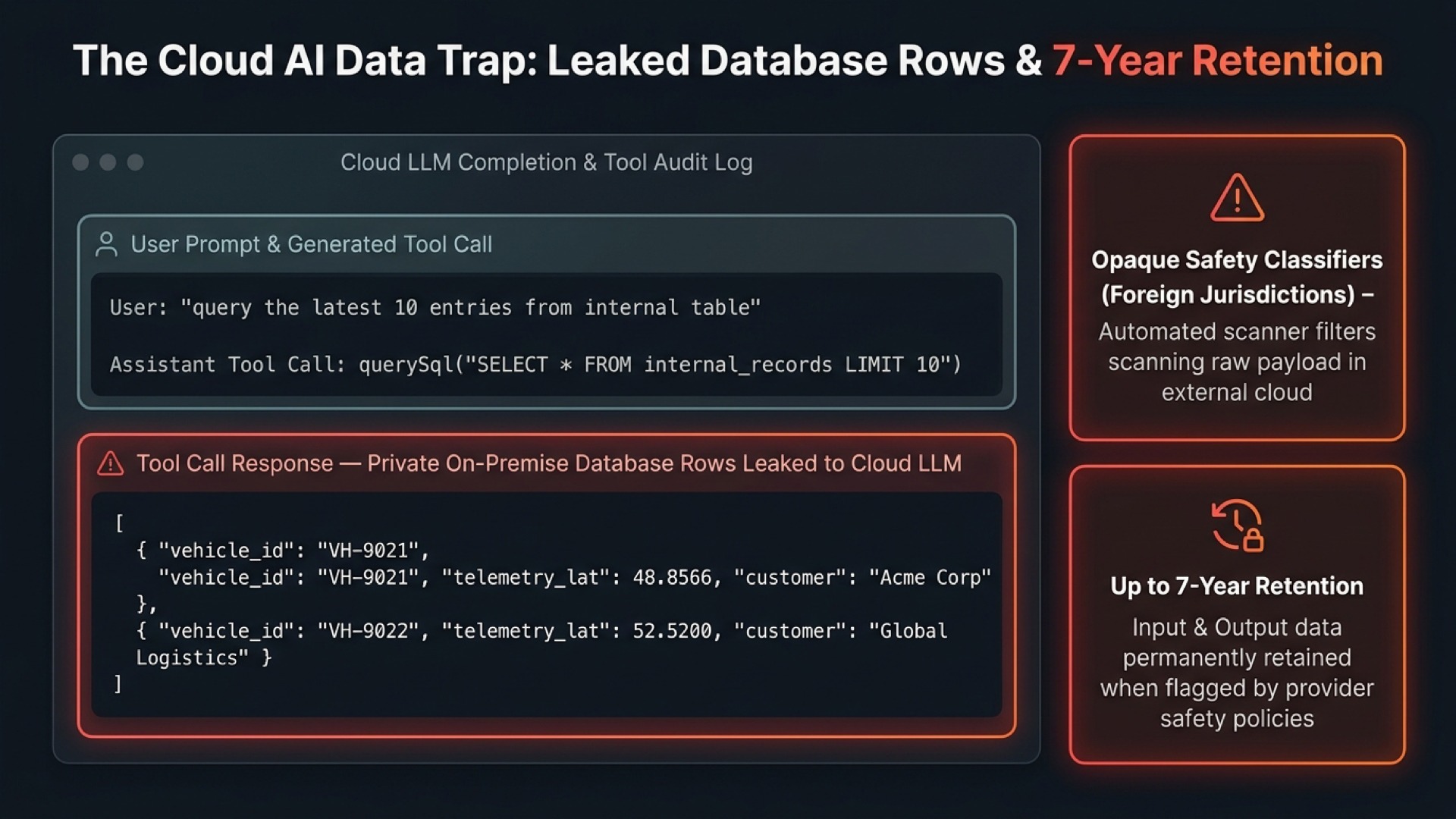
- The Cloud LLM & MCP Data Trap: raw on-premise SQL rows exposed to external servers and up to 7-year safety classifier retention.
Out-of-the-Box Runtimes, Auto-Gear Hardware Sizing and The ypipe Manifold Engine
YPipe by iunera is The Sovereign Local-First AI Platform — Easy Local AI Client engineered for IT-affine business users in controlling, finance, healthcare, and operations collaborating seamlessly with IT and DevOps. Unlike fragmented local LLM wrappers — Why Running a Local LLM Does Not Give You an AI System —, YPipe installs on a vanilla Windows, macOS, or Linux operating system with an embedded model and all llama.cpp CPU and GPU drivers (Metal, CUDA, Vulkan, ROCm, SYCL) included out of the box.
Inside the Engine Foundry, built-in Auto-Gear inspects your workstation or server CPU, system RAM, and GPU VRAM to automatically size and configure models ranging from ultra-fast 800M parameter models up to 32B parameters. Above the raw weights, the ypipe Manifold Engine takes the lead over the models to enforce deterministic execution, structured output validation, and context hygiene—fulfilling YPipe’s core mission to beat 70B+ parameter models in deterministic business scopes.
-
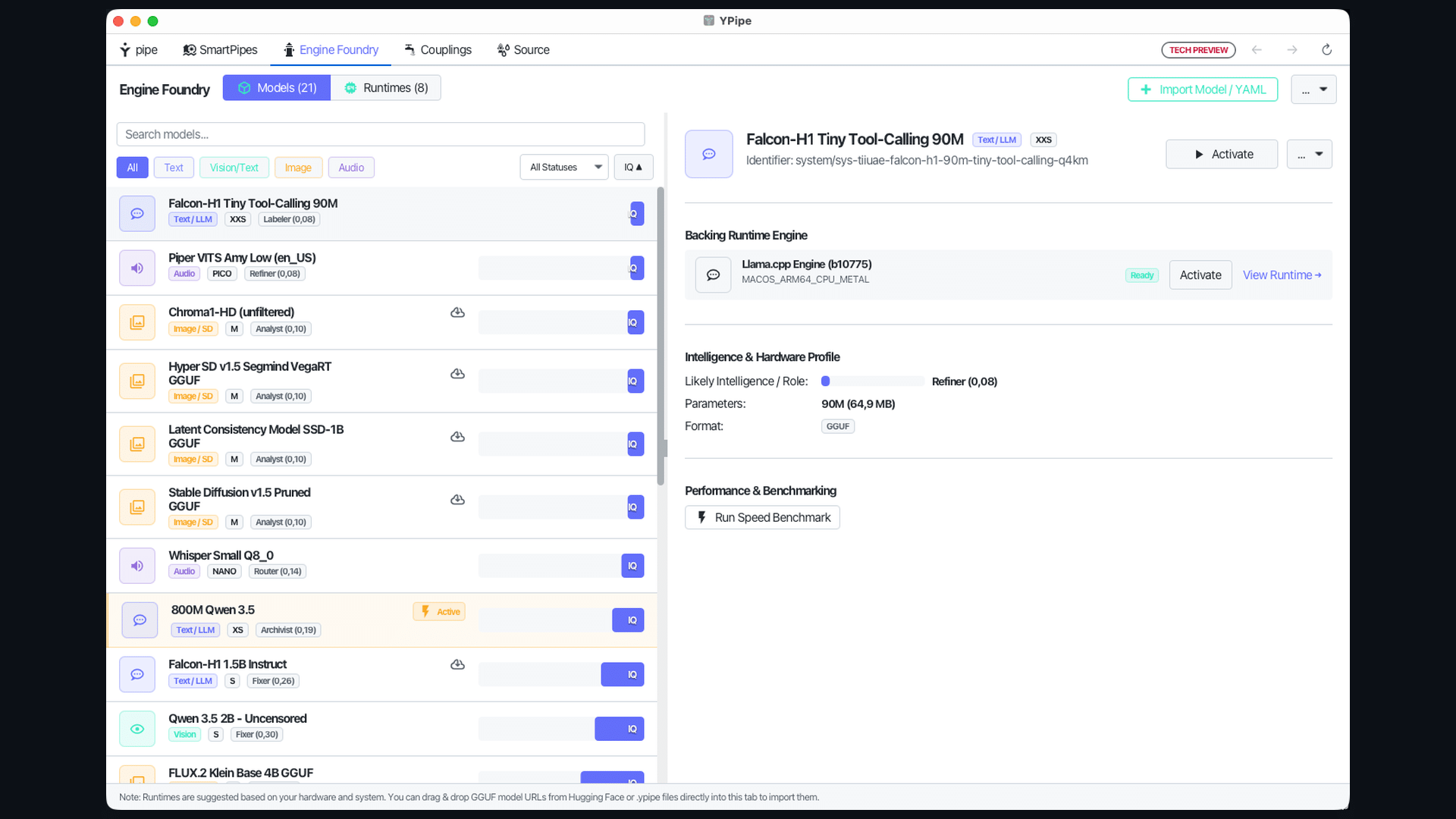
- YPipe Engine Foundry and Auto-Gear sizing 800M–32B models with bundled llama.cpp CPU and GPU drivers out of the box.
Solving the Two Biggest MCP Challenges in Couplings
As detailed in Why Most MCP Servers Are Built Wrong (And How to Fix It), enterprise teams hit two immediate walls with MCP: complex runtime installation and context pollution on compact models.
YPipe solves both in Couplings. First, YPipe ships with bundled Node.js, Python — uv — and Java runtimes and configures MCP servers with a single click—so a controlling or operations specialist never touches terminal commands or JSON config files. Second, the ypipe Manifold Engine takes over model tool calling and lets users selectively enable tools and tune tool parameter descriptions to fit compact context windows, making small-model tool-calling loops history.
-
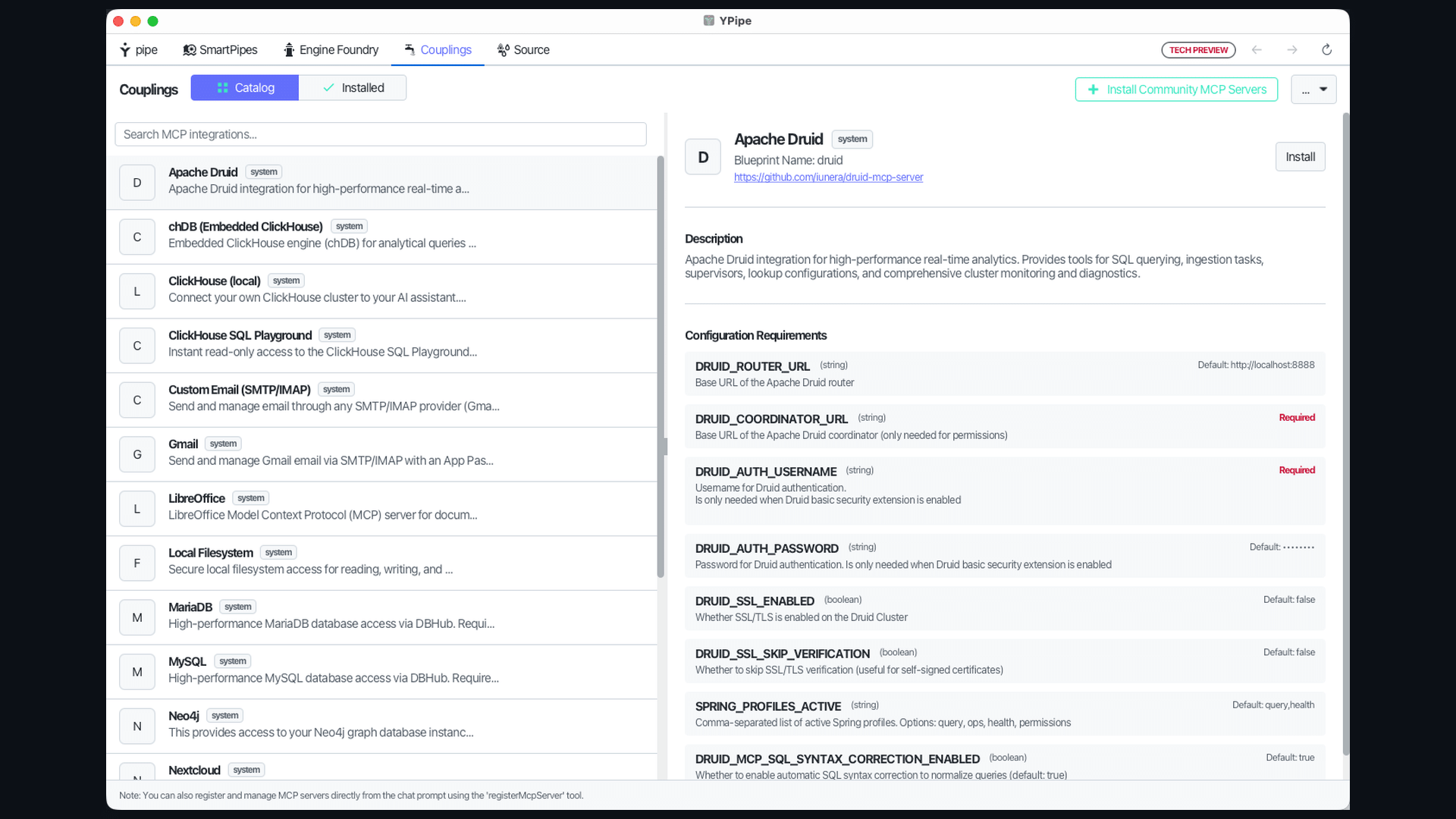
- Two-part MCP solution in YPipe Couplings: bundled Node.js, Python, and Java runtimes plus Manifold Engine parameter tuning.
Visual SmartPipes, Declarative KnowledgePipes RAG and Kubernetes-Style .ypipe YAML Manifests
Beyond interactive chat, YPipe provides SmartPipes for visually chaining local Whisper speech recognition, vision OCR, and compact LLMs into department Web Forms, REST API Webhooks, and reusable MCP Tools. Alongside SmartPipes, KnowledgePipes delivers declarative local and on-premise Retrieval-Augmented Generation (RAG) across embedded H2, PostgreSQL pgvector, MariaDB, and live REST APIs with strict scope isolation.
Crucially, every model configuration, MCP Coupling, SmartPipe workflow, and KnowledgePipes RAG pipeline is persisted as a clean, Kubernetes-style .ypipe YAML manifest. Business analysts can prototype visually on their desktop, hand the .ypipe manifest to IT and DevOps, version it in Git, and deploy the exact same pipeline headlessly on-premise.
-
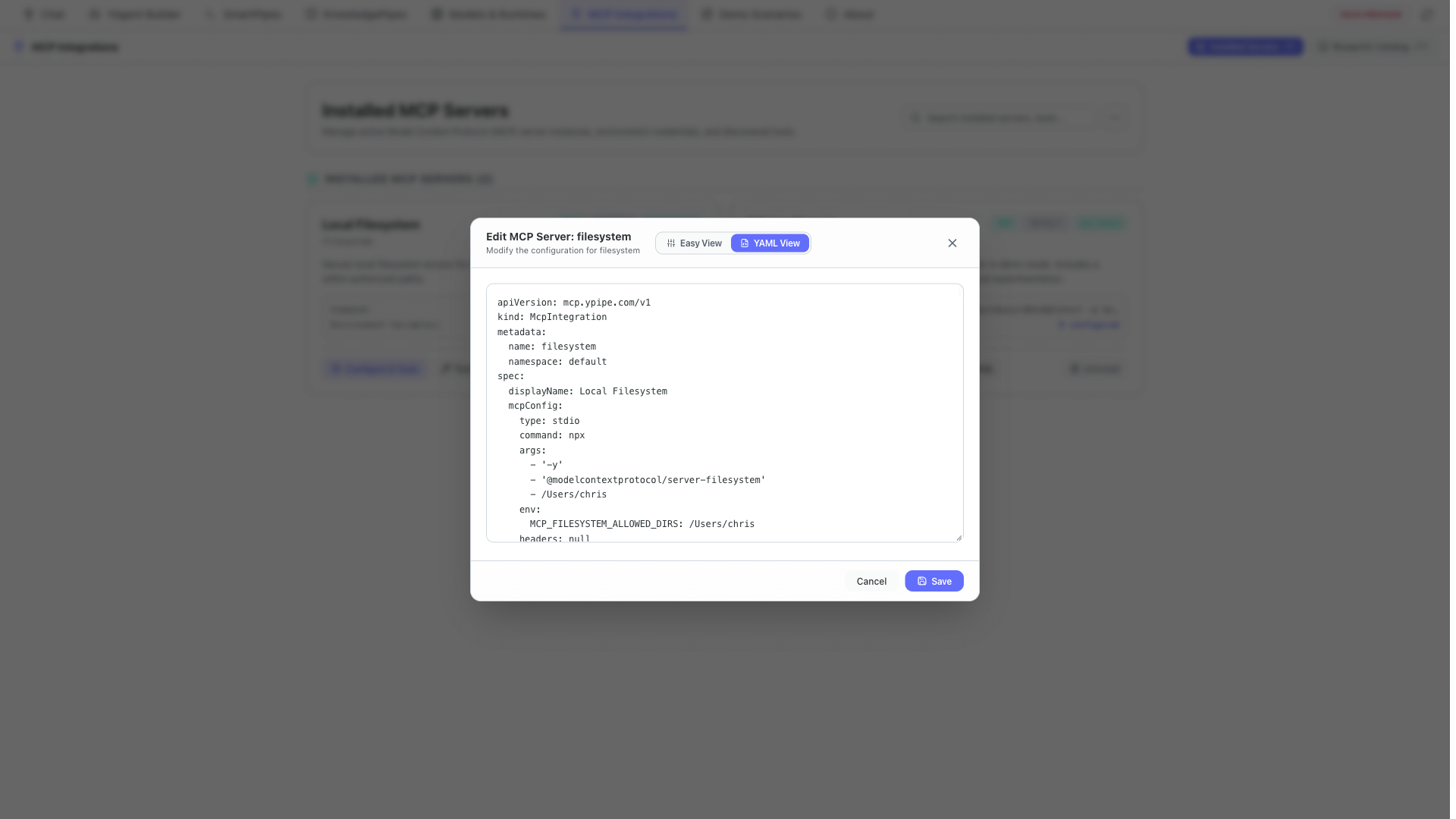
- Declarative Kubernetes-style .ypipe YAML manifests generated automatically for GitOps and headless on-premise deployment.
Cloud AI + Local MCP vs. Raw Local LLM CLI vs. YPipe Sovereign AI Platform
| Capability | Cloud LLM + Local MCP | Raw Local LLM CLI | YPipe by iunera |
|---|---|---|---|
| On-Premise Data and Tool Output Privacy | Leaks on-premise data (e.g., DB schemas, SQL rows, files) to cloud LLM context and up to 7-year safety classifier logs | Local, but requires manual wiring | 100% Local and On-Premise (zero external calls, GDPR/HIPAA/EU AI Act sovereign) |
| Hardware and Driver Setup | Cloud API key required | Manual CUDA/ROCm/Python setup | Vanilla OS installer with bundled llama.cpp drivers and 1-click Auto-Gear sizing |
| MCP Server Runtimes and Reliability | Exposes all tools, high token cost | Small models loop or hallucinate args | Bundled Node.js/Python/Java runtimes + Manifold Engine tool description tuning |
| Workflows, RAG and DevOps Handoff | Proprietary cloud lock-in | Custom Python glue scripts | Visual SmartPipes and KnowledgePipes saved as Kubernetes-style .ypipe YAML manifests |
Step-by-Step Walkthrough Inside YPipe
Step 1: Why Local AI Matters: The Cloud Tool-Call and Classifier Trap
How does AI tool calling actually work under the hood? When you ask an AI assistant a question—like querying the latest ten entries of a company table—the LLM detects your intent and triggers an MCP server connected to your local database. Even though that database sits safely inside your own network, the MCP server sends all the raw database rows right back to the LLM so it can format a human-friendly answer. If that LLM runs in the cloud, your private customer, medical, or telemetry records are immediately exported to external provider logs. Worse yet, every payload in the cloud is scanned by opaque trust-and-safety classifiers trained under foreign jurisdictions—where something perfectly legal in your business can be flagged and retained, along with your inputs and outputs, for up to seven years. Combine that with skyrocketing token costs on repetitive tasks, strict EU AI Act compliance, and silent overnight cloud model updates that break your prompts without warning, and it becomes clear why sovereign local AI is imperative.
Step 2: YPipe: The Sovereign Local-First AI Platform by iunera
That is why iunera built Y-Pipe — the sovereign, local-first AI platform designed to democratize business data access without giving up control. Available free at Y-Pipe dot com for Windows, macOS, Linux, and Java, Y-Pipe installs on a vanilla operating system with an embedded model Ready out of the box—whether you launch the native JavaFX desktop app or the unified browser interface. Every prompt, document, and database query stays one hundred percent on your own hardware with full GDPR and EU AI Act compliance.
Step 3: Engine Foundry: Manifold Engine, Auto-Gear Sizing and Bundled Drivers
Unlike command-line setups that force you to wrestle with Asus ROCK M, CUDA, or Python environments, Y-Pipe ships all runtimes and LLM drivers right out of the box on a vanilla operating system. Its built-in Auto-Gear automatically detects your CPU, RAM, and GPU to size models to your exact hardware—matching anything from compact 800-million up to 32-billion parameter models or drag-and-drop Hugging Face GGUFs to your machine. Even better, Y-Pipe integrates these different models into the new Y-Pipe Manifold Engine, where Manifold takes the lead over the models to enforce deterministic responses—fulfilling Y-Pipe’s mission to beat 70-billion parameter models with local engines in deterministic scopes.
Step 4: MCP Servers: Bundled Node.js, Python and Java Runtimes + Manifold Tool Control
With MCP servers, Y-Pipe solves two major hurdles at once. First, Y-Pipe ships with Node.js, Python, and Java runtimes built in and handles the entire MCP server configuration automatically—so a business user in a controlling department never has to worry about installing Node.js or configuring servers by hand. Second, because smaller models typically struggle with tool calling, the new Y-Pipe Manifold Engine takes over model calling directly while letting you tune tool parameters and descriptions to fit the exact purpose and context window of smaller models. Endless tool-calling loops that plague other harnesses are history with Y-Pipe.
Step 5: SmartPipes and KnowledgePipes: Visual Multi-Model Workflows and Local RAG
Because real enterprise value goes far beyond chat, SmartPipes lets you orchestrate deterministic, multi-expert pipelines visually. Chain specialized small models—for example, local Whisper speech transcription or receipt OCR, followed by structured JSON extraction, JavaScript validation, and KnowledgePipes vector or relational database storage. Every SmartPipe automatically exposes a human web form, a REST endpoint, or even a reusable MCP tool—and in our upcoming SmartPipes and KnowledgePipes deep-dive videos, we walk through building these workflows step by step.
Step 6: K8s-Style YAML Manifests, Headless DevOps and Upcoming Deep-Dives
Under the hood, every model, coupling, store, and workflow in Y-Pipe is saved as a clean, Kubernetes-style YAML manifest—so business teams can prototype locally on the desktop app, version their configurations in Git, and hand them directly to IT for headless server or Kubernetes deployment. Download Y-Pipe free at Y-Pipe dot com, and watch our upcoming videos where we dive into the tiny 800-million parameter Manifold Engine which runs on commodity CPUs, SmartPipes, KnowledgePipes, and our real-world Healthcare, Corporate Architecture, and Enterprise SQL scenarios.
Frequently Asked Questions
Why does connecting a local MCP server to a cloud LLM still leak data? Because the local MCP server only executes the tool locally, it must return the on-premise data (such as database schemas, query rows, or file contents) to the LLM so the model can formulate its answer. If the LLM is hosted in the cloud, that data is transmitted to external servers.
What is the ypipe Manifold Engine? The ypipe Manifold Engine is YPipe’s deterministic orchestration and neuro-symbolic governance layer that guides compact 800M to 32B models, validates tool calls, and enforces domain rules so compact models outperform unassisted 70B+ models in focused business scopes.
Do I need to install Python, Node.js, or GPU drivers before installing YPipe? No. YPipe installs on a vanilla Windows, macOS, or Linux system and bundles all llama.cpp CPU/GPU backends alongside embedded Node.js, Python (uv), and Java runtimes for MCP servers.
How does Auto-Gear hardware sizing work? Auto-Gear inspects your machine’s CPU cores, system RAM, and GPU VRAM and automatically recommends and configures the optimal model quantization, context window, and GPU layer offloading.
How does YPipe prevent small models from looping on MCP tool calls? In YPipe Couplings, the Manifold Engine governs the tool-calling loop and lets you disable unneeded tools and shorten verbose tool and parameter descriptions so compact context windows never suffer from context confusion.
What are SmartPipes and KnowledgePipes? SmartPipes is YPipe’s visual multi-model workflow builder (exposing workflows as Web Forms, REST Webhooks, and MCP Tools), while KnowledgePipes is YPipe’s declarative local and on-premise RAG engine over vector databases, read-only SQL tables, and REST APIs.
Can IT and DevOps deploy YPipe workflows headlessly on-premise? Yes. Every configuration in YPipe is backed by a declarative Kubernetes-style .ypipe YAML manifest that can be version-controlled in Git and deployed headlessly in Docker or Kubernetes.
Where can I download or evaluate YPipe? You can explore YPipe at ypipe.com, inspect the open repository at github.com/iunera/ypipe, or contact iunera at iunera.com for enterprise on-premise deployments.
Related Articles and YPipe Video Series
YPipe by iunera is The Sovereign Local-First AI Platform—running 100% locally on workstations or on-premise on your enterprise and clinic servers with full GDPR, HIPAA, and EU AI Act sovereignty. Explore our related engineering studies on Kraken and the full video series below:
Related Kraken Articles on YPipe and Local AI
- The Hidden Data Leakage Risk of MCP Servers
- Why Most MCP Servers Are Built Wrong (And How to Fix It)
- Sovereign AI in Europe: Why Enterprises Need More Than Consumer AI Platforms
- Why Running a Local LLM Does Not Give You an AI System
Explore All Episodes in the YPipe Video Series
- Episode 01 (This Article): YPipe — The Sovereign Local-First AI Platform | Manifold Engine, MCP, SmartPipes and On-Premise RAG
- Episode 02: Re:Think Local AI — 800M Qwen 3.5 and YPipe Manifold Engine: Tool Calling and Reasoning on Laptops
- Episode 03: YPipe SmartPipes — Visual Multi-Model AI Workflows (Whisper, Vision OCR, REST Webhooks and MCP Tools)
- Episode 04: YPipe KnowledgePipes — Declarative Local and On-Premise RAG | Vector DBs, SQL and Scoped Contexts
- Episode 05: Private AI for Hospitals and Clinics — Voice Ward Rounds, Patient Privacy and Drug Safety in YPipe
- Episode 06: Private AI Meeting Minutes and Company Knowledge — Record Confidential Meetings Safely with YPipe
- Episode 07: Safe On-Premise AI for Company Databases and HR — Controlled Department Data Access with YPipe
Official YPipe Resources
- Official YPipe Website: https://ypipe.com
- iunera Company Website: https://www.iunera.com
- GitHub Repository: https://github.com/iunera/ypipe
- Full YouTube Video Series Playlist: https://www.youtube.com/playlist?list=PLIB7VtTuXX3Y