
1. Introduction
In the architecture of modern enterprise systems, the relational database remains the bedrock of truth. Whether managing user profiles, inventory tracking, or complex application states, structured data stored in RDBMS (Relational Database Management Systems) contains the essential context that Large Language Models (LLMs) need to perform meaningful work.
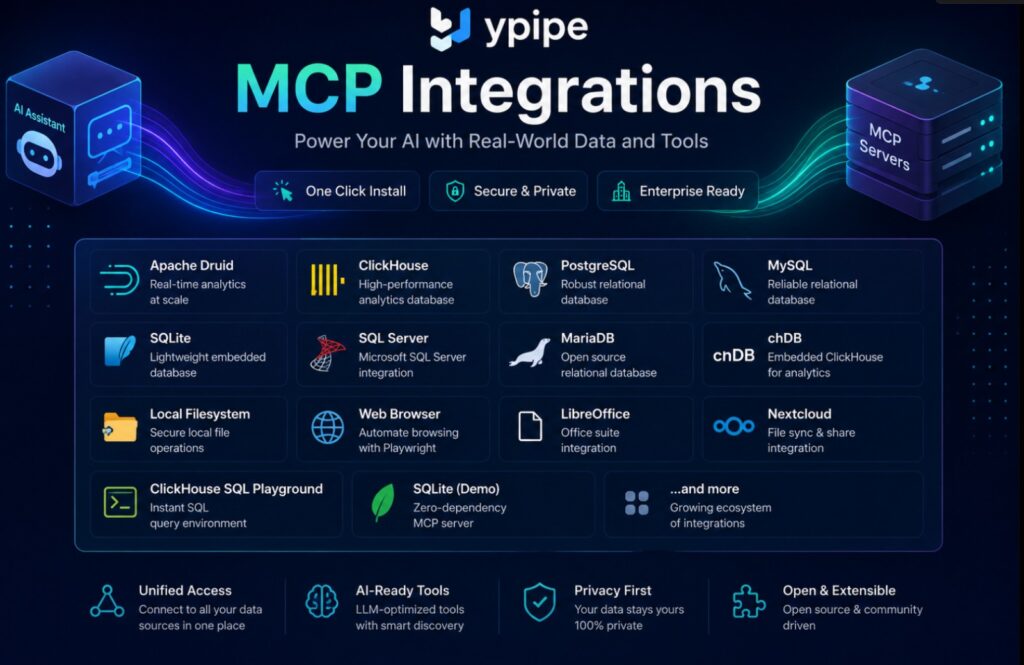
However, simply “connecting” an AI agent to a database is an engineering challenge fraught with risks, from security vulnerabilities to context window limitations. To bridge this gap effectively, we have integrated the MariaDB MCP Server into the Ypipe ecosystem.
This article explores why MariaDB remains a staple in enterprise stacks, the critical role of the Model Context Protocol (MCP) in exposing this data to autonomous agents, and the specific architecture decisions, such as Ypipe’s focus on secure, scoped database access, that empower AI agents to be both productive and safe.
2. What is the MariaDB MCP Server?
MariaDB is a robust, open-source relational database that serves as a community-developed fork of MySQL. It is widely recognized for its high performance, reliability, and support for complex SQL queries, making it a standard choice for both web applications and data-intensive enterprise services.
The MariaDB MCP Server functions as a specialized gateway within the Ypipe platform. It is designed to act as an intermediary, utilizing the Model Context Protocol to translate the abstract goals of an AI agent into precise, executable SQL statements against your database. It ensures that the LLM is not just “guessing” at data access but is interacting with your relational data through a standardized, secure, and predictable protocol.
3. Why Enterprises Use It
Enterprises continue to lean on MariaDB because it balances legacy compatibility with modern scalability needs. When integrated with AI, it offers several key advantages:
- Proven Reliability: With a long history of stability, enterprises trust MariaDB to maintain the integrity of their core application state.
- Advanced SQL Features: MariaDB provides powerful features like JSON support, advanced window functions, and pluggable storage engines, which are invaluable when AI agents need to perform complex analytical queries on operational data.
- Open Ecosystem: Because MariaDB is fully open-source and deeply integrated into the standard Linux/LAMP/LEMP stacks, it allows for easy, cost-effective scaling and seamless integration with existing CI/CD pipelines.
4. Problems It Solves
Without a structured MCP integration, AI agents typically access relational data through “naïve” methods, such as generating raw SQL within a generic code interpreter. This presents significant engineering hurdles:
The Security Vulnerability Problem
Allowing an LLM to generate unchecked SQL and execute it against a live production database is a massive security risk. It opens the door to SQL injection, accidental data deletion, and sensitive data leakage. The MariaDB MCP Server mitigates this by enforcing structured access and providing a controlled interface for the agent.
The Contextual Confusion Problem
An LLM given raw access to a database without schema awareness will often hallucinate table names or column structures. The MariaDB MCP Server addresses this by providing discoverable schema tools, ensuring the agent only attempts to query what it understands and has been granted access to.
5. Architecture Overview
The MariaDB MCP integration within Ypipe is built on a clean, modular architecture:
- The MCP Interface: The Ypipe platform presents tools to the LLM that correspond to database operations (e.g.,
query_data,list_tables,get_schema). - The Driver Layer: The server utilizes the ‘mariadb’ driver package (via DBHub) to establish a performant connection to the MariaDB server.
- The Execution Engine: SQL queries generated by the AI agent are sanitized and executed, with the resulting tabular data formatted into JSON structures that are optimized for the agent’s context window.
6. What is the MCP Server?
The MariaDB MCP Server acts as an intelligent proxy. Its primary purpose is to ensure that when an LLM asks a question requiring database context, the interaction is handled via a secure protocol. It is not merely a “SQL client”; it is an agentic tool that understands the scope, limits, and capabilities of the database it is connected to, providing a reliable channel for structured data retrieval.
7. Why AI Needs This MCP
Autonomous AI agents are increasingly designed to perform end-to-end tasks, from drafting responses to updating CRM records or validating order statuses. These tasks require more than just “search” capabilities; they require “relational understanding.” The MariaDB MCP allows AI to perform lookups across related tables, aggregate metrics, and verify data consistency—actions that are impossible with simple file search or vector-based RAG alone.
8. Why Ypipe Includes It
Ypipe is built to be the central control plane for enterprise AI. By treating database integrations as first-class, deployable “features,” Ypipe provides a consistent developer experience regardless of whether an agent is querying a local database or a distributed cluster. Including the MariaDB MCP is critical because it ensures that Ypipe agents have access to the structured data they need to be truly useful in operational environments.
9. Installation in Ypipe
Deployment of the MariaDB MCP Server is simple for Platform Engineers. Within the Ypipe integrations panel, select “Install Community MCP Servers” and choose the `mariadb` blueprint. This initiates the configuration flow, ensuring that the necessary driver packages are fetched and the environment is provisioned to support your connection requirements.
10. Configuration Explained
Effective database connectivity requires precise configuration. Here is the engineering breakdown for the MariaDB integration:
DB_HOST & DB_PORT
- Type: String
- Defaults:
localhostand3306 - Context: These define the network address for your MariaDB cluster. In a production VPC, these should be configured to point to your internal database proxy or load balancer rather than a raw node IP.
DB_USER & DB_PASSWORD
- Type: String
- Context: These provide the authentication context for the agent. Engineering best practice mandates the use of a dedicated, read-only service account for AI agents, even if your application server uses an account with more broad privileges.
DB_NAME
- Type: String (Required)
- Context: This locks the agent’s initial context to a specific database, reducing schema discovery noise and ensuring the LLM is focused only on the domain of data it needs.
11. Screenshot Walkthrough
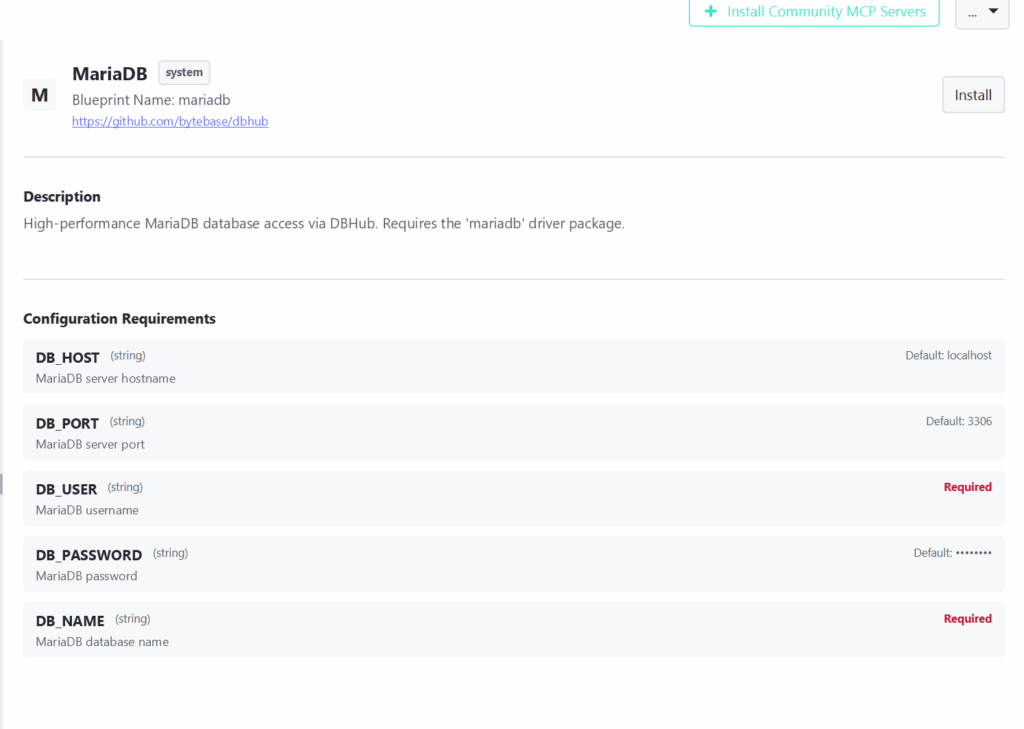
The configuration UI is straightforward but demands precision. The DB_NAME and DB_USER fields are marked as Required to prevent agent failure due to missing context. The design emphasizes that the MariaDB MCP is not a public interface but a specialized tool that must be explicitly configured and secured by platform administrators before an AI can utilize it.
12. Enterprise Use Cases
- Operational RCA (Root Cause Analysis): AI agents can query MariaDB logs or operational tables during an incident to quickly correlate reported errors with database state changes.
- Automated Reporting: Instead of manual SQL reports, an agent can be tasked to generate weekly business performance summaries by querying the MariaDB warehouse directly.
- CRM Data Enrichment: AI agents can automatically retrieve customer history from a relational CRM database to personalize drafted emails or helpdesk tickets.
13. Performance
Performance in an AI-to-Database context is about managing the trade-off between detail and context window. Ypipe ensures performance by:
- Query Sanitization: The MCP server prevents agents from executing poorly formed or Cartesian-product-style queries.
- Result Formatting: The server converts the raw SQL result set into JSON, stripping away irrelevant metadata and ensuring that only the payload required for the agent’s reasoning task is sent back.
14. Security
Security is the top priority for database integrations:
- Dedicated Accounts: Always use database-level roles to limit what the agent can `SELECT`.
- Injection Protection: The MCP protocol itself acts as a buffer, preventing the LLM from executing raw commands that aren’t mediated by the server’s SQL parsing logic.
- Audit Logs: Ypipe tracks every query executed by the agent, providing an audit trail for security teams to monitor for unusual behavior.
15. Best Practices
- Scoped Views: Create specific database views for the agent to query, rather than granting access to raw, un-optimized tables.
- Read-Only Access: Unless the agent is explicitly required to perform data entry, always provide a read-only user account.
- Time-Bound Queries: Train agents to include time constraints in their SQL, ensuring queries return in a timely manner.
16. Common Mistakes
- Granting Superuser Access: Never give the agent access to the `root` or `admin` user account.
- Exposing Sensitive Tables: Ensure that tables containing PII (Personally Identifiable Information) are excluded from the user’s permissions.
- Ignoring Latency: Assuming an agent can query millions of rows without impacting performance is a mistake; prioritize optimized, index-friendly queries.
17. Why This Integration Matters
The MariaDB MCP integration ensures that your AI agents remain grounded in the reality of your structured business data. It provides the necessary security, abstraction, and reliability to turn a standard database into a dynamic, agent-ready tool, allowing your AI to perform complex, multi-step tasks with data you already trust.
18. Related MCP Servers
- Filesystem MCP Server in Ypipe
- PostgreSQL MCP Server in Ypipe
- SQLite MCP Server in Ypipe
- ClickHouse MCP Server in Ypipe
- Apache Druid MCP Server in Ypipe
- What are MCP Servers?
19. Frequently Asked Questions
1. Does this server support non-MariaDB databases?
This blueprint is specifically optimized for MariaDB and requires the mariadb driver package.
2. Can I use this for write operations?
Yes, if the provided DB_USER has the appropriate write permissions. However, it is strongly recommended to use read-only users for safety.
3. How does this compare to a standard database client?
It is an MCP-compliant tool, meaning it is designed to communicate with an LLM rather than a human GUI or CLI user.
4. Is there a risk of SQL injection?
The MCP server acts as an intermediary, and query generation is dictated by the LLM’s logic, which should be constrained by the database user’s permissions.
5. Can I connect multiple MariaDB databases?
Yes, you can install multiple instances of the MariaDB MCP server, each pointing to a different DB_NAME or DB_HOST.
6. Why is DB_PORT optional?
It defaults to 3306, but can be overridden if your MariaDB installation uses a non-standard port.
7. How do I audit the agent’s SQL?
Ypipe tracks the MCP tool invocations, providing a complete log of all queries issued by the agent.
8. Does this support MariaDB JSON types?
Yes, MariaDB’s JSON support is handled natively by the driver and exposed as JSON to the agent.
9. Can I limit the number of rows returned?
Yes, you can incorporate `LIMIT` clauses in your queries, and it is a best practice to do so.
10. Is SSL support available?
The driver supports standard SSL configurations as defined by your database connection requirements.
11. How do I test the connection?
The MCP server will fail to initialize or provide schema information if the connection parameters are incorrect.
12. Why do I need to provide a password?
For authentication purposes, ensuring only authorized agents can access the database.
13. Can the agent view all tables?
Only if the provided DB_USER has access to them in the MariaDB database.
14. Is there a performance hit?
The overhead of the MCP protocol is minimal compared to the time required to execute the SQL query itself.
15. How can I manage secret management?
Ypipe handles configuration secrets securely, ensuring they are not exposed in plaintext within the platform’s UI.
20. Conclusion
Integrating MariaDB with your AI ecosystem via the MariaDB MCP Server is a powerful step toward creating autonomous, data-driven agents. By focusing on secure, scoped, and protocol-standardized access, you can safely empower your AI to interact with your relational data, unlocking new operational efficiencies while maintaining the integrity and security of your core enterprise infrastructure.