
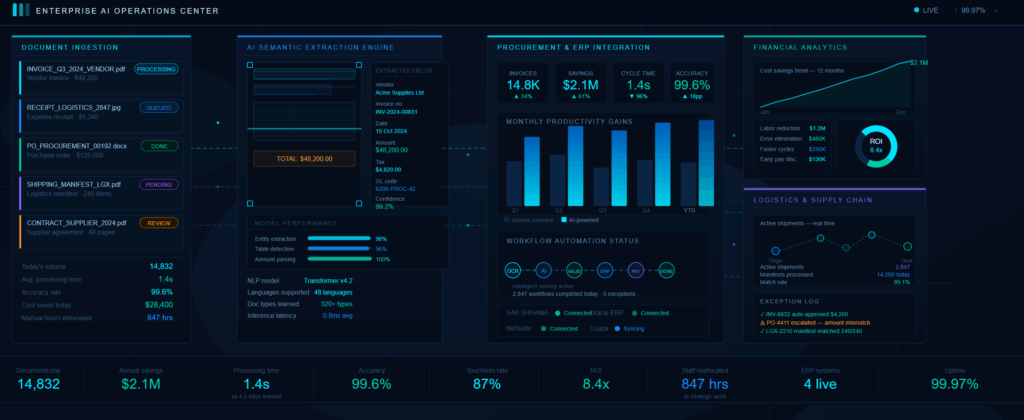
Most discussions around OCR and document AI focus heavily on technology.
Better extraction.
Better models.
Better automation.
But inside businesses, the conversation is usually much simpler: Does it actually save money?
That question is ultimately why AI-powered receipt and invoice digitization became one of the fastest-growing enterprise automation categories over the past few years.
Modern organizations process enormous volumes of financial and operational paperwork every single day. Invoices move through procurement systems. Delivery records flow across supply chains. Expense receipts pass through accounting departments. Purchase orders require reconciliation. Tax documentation must be validated.
At enterprise scale, even small inefficiencies become expensive. This article explores the real financial impact of receipt, invoice, and delivery document digitization, why businesses are investing heavily in AI-powered document workflows, and how modern AI systems are changing the economics of operational paperwork.
Introduction
Most people underestimate how much money businesses lose to paperwork.
Not because paper itself is expensive. But because operational friction is expensive.
A delayed invoice can slow supplier payments.
A missing delivery document can interrupt logistics workflows.
A reimbursement request stuck in approval systems creates accounting delays.
A manually processed procurement record consumes employee time repeatedly.
And when these inefficiencies happen across thousands or millions of documents, operational costs compound very quickly. This is one of the reasons OCR automation quietly became deeply embedded inside modern enterprise systems.
Originally, businesses adopted OCR mainly to reduce manual data entry. But over time, organizations realized something much more important: The real financial value was not simply digitizing documents. The real value was accelerating operational workflows.
Why Document Processing Became Such a Large Cost Center
Every large organization processes operational paperwork continuously.
Finance teams handle:
- invoices
- receipts
- reimbursement forms
- tax records
- procurement documentation
- delivery confirmations
- supplier contracts
Historically, much of this workflow depended on humans manually reviewing, categorizing, validating, and routing documents.
That creates several financial problems simultaneously.
First, manual processing consumes enormous amounts of labor.
Second, humans introduce delays into workflows.
Third, repetitive operational tasks create scaling bottlenecks.
And finally, manual review processes increase the probability of reconciliation errors.
At small scale, these inefficiencies may seem manageable.
At enterprise scale, they become operationally expensive very quickly.
The Hidden Cost of Manual Invoice Processing
Invoice processing is one of the clearest examples.
A traditional accounts payable workflow often involves:
- receiving invoices
- extracting information manually
- validating supplier data
- matching purchase orders
- routing approvals
- reconciling payments
- storing records for compliance
Even when companies partially digitized these systems, humans frequently remained inside critical operational steps.
This created constant workflow friction.
According to research from McKinsey, AI-powered procurement and invoice automation systems can significantly improve productivity while reducing processing delays.
The reason is not only automation itself.
The reason is workflow acceleration.
A document that previously required multiple human interactions can now move automatically across operational systems within seconds.
That changes the economics of financial operations entirely.
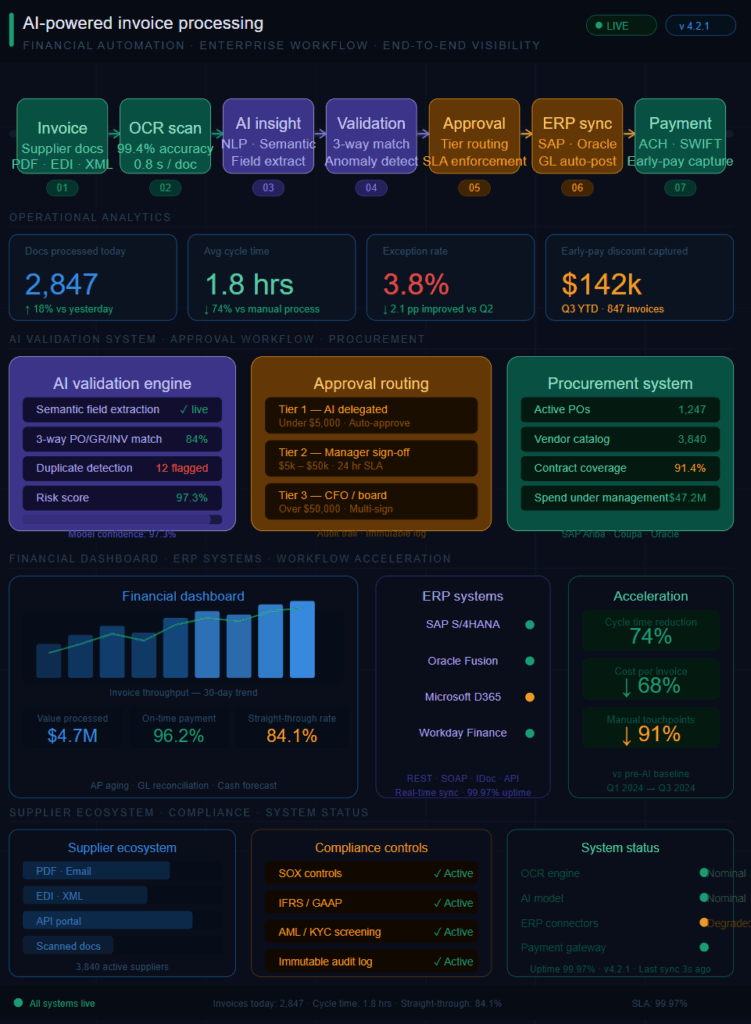
Figure: AI-powered invoice processing and operational workflow automation
Why Speed Matters Financially
One of the most overlooked aspects of document automation is time.
Operational delays create hidden financial costs everywhere.
For example:
- delayed invoice approvals slow supplier payments
- reimbursement delays frustrate employees
- procurement bottlenecks affect supply chains
- delayed reconciliation increases operational overhead
- slow logistics verification interrupts warehouse operations
Businesses increasingly care about reducing operational latency.
This is one reason AI-powered document systems became strategically important.
Modern OCR + AI workflows do not simply digitize paperwork. They compress operational timelines.
And faster operational systems almost always create financial value.
The Procurement Side of the Equation
Procurement operations generate massive volumes of paperwork.
Large organizations continuously process:
- purchase orders
- supplier invoices
- delivery confirmations
- warehouse records
- transportation invoices
- customs documentation
Historically, much of this workflow required repetitive human reconciliation.
A procurement employee might need to manually verify:
- whether a delivery matched an invoice
- whether a purchase order was fulfilled
- whether pricing discrepancies existed
- whether supplier records aligned correctly
At scale, these workflows become extremely expensive.
This is why modern procurement systems increasingly combine:
- OCR
- AI extraction
- semantic reconciliation
- workflow automation
- ERP integrations
According to McKinsey, AI-driven procurement workflows can improve operational efficiency significantly while reducing manual processing overhead.
The interesting part is that businesses are no longer treating document digitization as isolated software.
They are increasingly treating it as operational infrastructure.
Logistics and Delivery Digitization
Logistics operations are another area where document automation creates surprisingly large financial impact.
Global supply chains generate enormous amounts of operational paperwork:
- shipment records
- delivery confirmations
- customs forms
- warehouse receipts
- transportation invoices
- bills of lading
And surprisingly, many logistics workflows still rely heavily on semi-manual reconciliation.
A missing document can interrupt entire operational chains.
This is one reason document digitization became strategically important for logistics companies. AI-powered OCR systems now help organizations:
- verify shipments automatically
- reconcile invoices with deliveries
- process warehouse records faster
- reduce customs paperwork delays
- accelerate supply-chain workflows
McKinsey estimates that digitizing logistics documentation could unlock billions in operational savings globally. At this point, document automation is no longer simply an IT improvement.
It directly affects operational throughput.
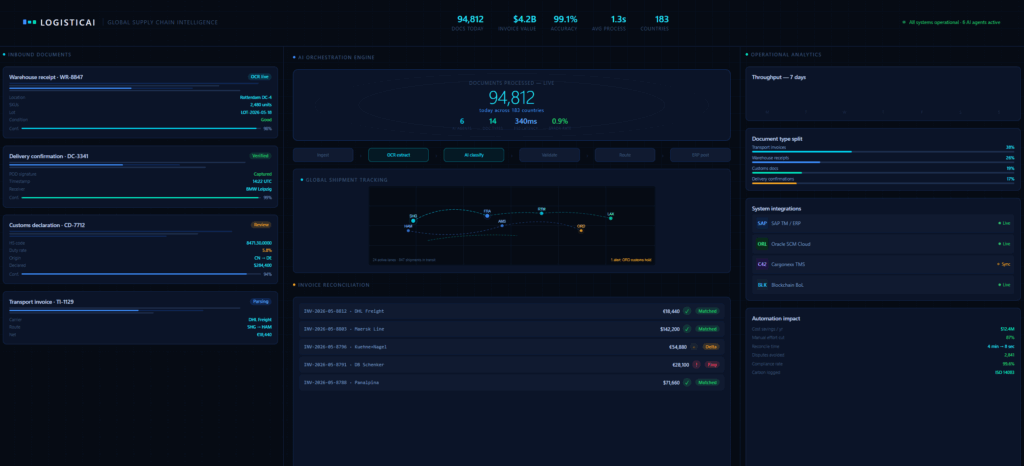
Figure: Financial impact of AI-powered logistics document automation
Why AI Changed the Economics of OCR
Traditional OCR systems already created significant efficiency gains.
But they had limitations.
OCR could extract text.
It could not truly understand documents.
Businesses still needed additional systems and human review for:
- categorization
- validation
- reconciliation
- workflow routing
- fraud detection
- compliance verification
Modern AI systems changed this dynamic significantly. Instead of simply extracting text, AI-powered systems increasingly attempt to:
- understand document structure
- identify semantic relationships
- validate financial information
- automate downstream workflows
This reduced the amount of human intervention required inside operational systems. And reducing human intervention is often where the largest financial gains appear.
The Rise of Intelligent Document Processing
This transition led to the rise of Intelligent Document Processing (IDP).Instead of functioning as standalone OCR tools, modern systems increasingly combine:
- OCR
- AI reasoning
- semantic extraction
- workflow orchestration
- deterministic validation
The workflow evolved from:
Document
→ OCR
→ Extracted Text
into:
Document
→ OCR
→ AI Understanding
→ Validation
→ Workflow Automation
→ Enterprise Systems
That shift fundamentally changed the financial value proposition.
Businesses are no longer paying only for text extraction. They are paying for operational acceleration.

Figure: Evolution from OCR extraction toward AI-powered workflow automation
Cost Savings Are Only Part of the Story
Most discussions about document automation focus heavily on cost reduction.
And yes, businesses absolutely save money through:
- reduced manual labor
- faster workflows
- lower reconciliation overhead
- fewer operational delays
But the larger impact is often scalability. AI-powered document systems allow organizations to process significantly larger operational workloads without scaling administrative teams proportionally.
That changes operational economics completely.
A finance department that previously required dozens of employees to process invoices manually may eventually process much larger volumes using heavily automated systems.
The same applies to:
- procurement
- logistics
- healthcare administration
- insurance processing
- banking operations
The interesting shift is that AI is not only replacing repetitive tasks.
It is increasingly reshaping how operational workflows themselves are designed.
Why Local AI Pipelines Are Becoming Financially Interesting
Most enterprise OCR systems today operate as cloud-based SaaS platforms.
That model works extremely well for many businesses.
However, local AI pipelines are becoming increasingly interesting financially for organizations that care about:
- infrastructure ownership
- recurring API costs
- compliance
- privacy
- offline execution
This is where projects like ReceiptFlow become interesting to experiment with.
Instead of relying on external APIs, the workflow combines:
- local OCR
- local LLM inference
- deterministic validation
- structured extraction
running entirely on CPU hardware.
This creates a very different economic model for document automation.
Instead of paying continuously for external AI processing, businesses increasingly explore whether smaller local models can automate meaningful workflows internally.
That trend is still early.
But it is growing very quickly.
The Bigger Industry Shift
The biggest realization across this entire industry is that businesses were never truly trying to solve document scanning.
They were trying to reduce operational inefficiency.
OCR happened to become one of the first enabling technologies.
Now AI is pushing the industry much further:
from extraction,
to understanding,
to validation,
to automation,
to operational coordination.
And that shift is fundamentally changing how businesses think about operational systems.
Conclusion
The financial impact of AI-powered receipt, invoice, and delivery document digitization extends far beyond simple cost reduction.
Modern document automation systems increasingly affect:
- operational speed
- workflow scalability
- procurement efficiency
- logistics throughput
- accounting operations
- enterprise productivity
Traditional OCR reduced manual data entry.
Modern AI systems are now reducing operational friction itself.
That is a much larger transformation.
And as AI-powered document systems continue evolving, the organizations that automate operational workflows most effectively will likely gain significant advantages in speed, efficiency, and scalability.
The interesting part is that most people still think OCR is mainly about extracting text from documents.
In reality, it quietly became part of the operational infrastructure powering modern enterprises.
Suggested Image Placements
1. Invoice Automation Workflow
Place after:
The Hidden Cost of Manual Invoice Processing
Caption:
Figure: AI-powered invoice processing and operational workflow acceleration
2. Logistics Financial Impact
Place after:
Logistics and Delivery Digitization
Caption:
Figure: AI-powered logistics document automation across supply-chain workflows
3. AI Workflow Automation Diagram
Place after:
The Rise of Intelligent Document Processing
Caption:
Figure: Evolution from OCR extraction toward AI-powered operational automation
References
- https://www.mckinsey.com/capabilities/operations/our-insights/transforming-procurement-functions-for-an-ai-driven-world
- https://aws.amazon.com/textract/
- https://cloud.google.com/document-ai
- https://azure.microsoft.com/en-us/products/ai-services/ai-document-intelligence
- https://www.uipath.com/product/document-understanding
- https://rossum.ai
- https://github.com/tesseract-ocr/tesseract
- https://github.com/ggerganov/llama.cpp
Suggested Internal Links
- Receipt Scanning Is No Longer Just an OCR Problem
- Why AI Receipt Digitization Is Moving Beyond Traditional OCR
- Traditional OCR vs LLM-Based Receipt Extraction
- Processing 100 Receipts Locally with OCR and LLMs on CPU
- How OCR Automation Is Quietly Reshaping Enterprise Operations