
For most people, OCR still sounds like a very old technology problem.
Scan a document.
Extract the text.
Store the result.
Simple.
But behind the scenes, OCR quietly became one of the foundational layers powering modern enterprise operations. Banks process loan documents with OCR. Logistics companies digitize delivery records. Hospitals automate medical paperwork. Governments scan identity documents. Warehouses process shipment labels. Procurement systems reconcile invoices automatically.
And now, with AI entering the picture, OCR is evolving from a basic text extraction tool into something much larger:
an operational intelligence layer for businesses.
This article explores how OCR automation expanded far beyond document scanning, the industries where it is creating real financial impact, and why the future of OCR increasingly looks less like software and more like infrastructure.
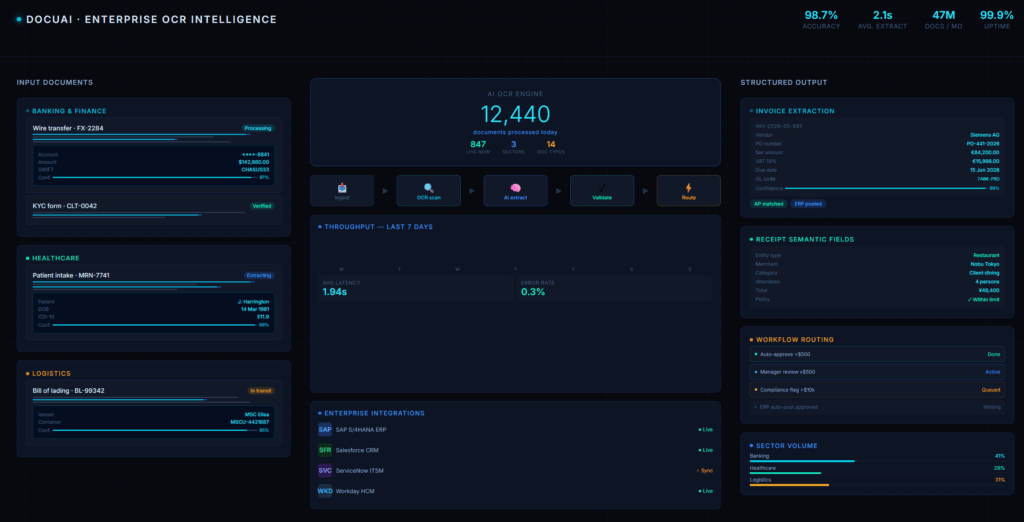
Introduction
Most technologies become invisible once they mature.
OCR is one of them.
People rarely talk about it anymore because it feels old. Almost boring.
But quietly, OCR became embedded inside thousands of operational systems that businesses rely on every single day.
Every time:
- a receipt gets scanned
- a shipment gets verified
- an invoice gets reconciled
- a passport gets processed
- a bank form gets digitized
- a customs document gets validated
there is usually some form of OCR running underneath the workflow.
What changed over the past few years is not only the quality of OCR itself.
What changed is the role OCR plays inside business operations. OCR is no longer simply helping companies digitize documents.
It is increasingly helping businesses automate entire workflows. And that shift is much bigger than most people realize.
OCR Started as a Digitization Problem
Originally, OCR systems solved a fairly narrow problem:
converting printed documents into machine-readable text.
The workflow was straightforward:
Physical Document
→ OCR Engine
→ Extracted Text
→ Database / Manual Workflow
For many years, this alone created massive productivity gains.
Businesses no longer needed employees manually typing information from:
- invoices
- receipts
- paper forms
- procurement documents
- contracts
- shipping records
into digital systems.
Even basic OCR dramatically reduced repetitive administrative work. And at enterprise scale, repetitive administrative work becomes very expensive.
The Real Cost of Manual Paperwork
One thing that becomes very obvious inside large organizations is how much operational friction paperwork creates. Manual document handling slows everything down:
- approvals
- reimbursements
- procurement
- logistics
- compliance
- customer onboarding
The problem is not only labor costs. It is operational delay.
A shipment delayed because paperwork was not reconciled on time can affect entire supply chains. A procurement invoice stuck in approval workflows can delay payments. A bank manually reviewing identity documents creates onboarding bottlenecks.
And when these delays happen across thousands or millions of documents, even small inefficiencies become financially significant.
That is why OCR automation quietly became one of the most valuable operational technologies businesses adopted over the past two decades.
Banking and Financial Services
One of the earliest industries to aggressively adopt OCR was banking.
Banks process enormous amounts of documentation:
- loan applications
- identity verification forms
- account opening records
- tax documents
- payment records
- checks
- financial statements
Historically, large teams manually reviewed and entered much of this information. OCR dramatically reduced that workload.
But modern financial systems are now moving far beyond simple text extraction. Today, banks increasingly combine OCR with:
- AI document understanding
- fraud detection systems
- automated verification workflows
- compliance validation
- risk analysis
This changes OCR from a digitization tool into part of a larger financial intelligence system.

Figure: OCR automation in banking and financial operations
Healthcare Quietly Became One of the Biggest OCR Markets
Healthcare organizations process extraordinary amounts of paperwork every day.
Hospitals and clinics handle:
- patient intake forms
- prescriptions
- medical invoices
- insurance claims
- procurement records
- laboratory reports
Much of this information still arrives in semi-structured or paper-based formats.
Without automation, administrative overhead becomes enormous.
OCR systems helped healthcare organizations reduce repetitive manual data entry, but AI-powered document systems are now pushing this much further.
Modern healthcare workflows increasingly use OCR combined with AI for:
- patient record digitization
- insurance validation
- automated claim processing
- prescription extraction
- medical workflow automation
This reduces operational friction while allowing medical staff to spend less time on administrative tasks.
Logistics Turned OCR Into Operational Infrastructure
Logistics may be one of the most underestimated OCR-heavy industries in the world.
Modern supply chains generate massive volumes of operational documents:
- shipment labels
- delivery confirmations
- customs records
- warehouse receipts
- transportation invoices
- bills of lading
A surprising amount of global trade still depends on paperwork moving correctly through operational systems. This is one reason OCR became deeply integrated into logistics infrastructure.
Companies now use OCR systems to:
- digitize shipment records
- verify deliveries
- automate customs processing
- reconcile invoices
- track warehouse operations
According to McKinsey, digitizing logistics documentation alone could unlock billions in operational savings globally.
At this point, OCR is no longer just helping logistics operations.
It is becoming part of logistics infrastructure itself.
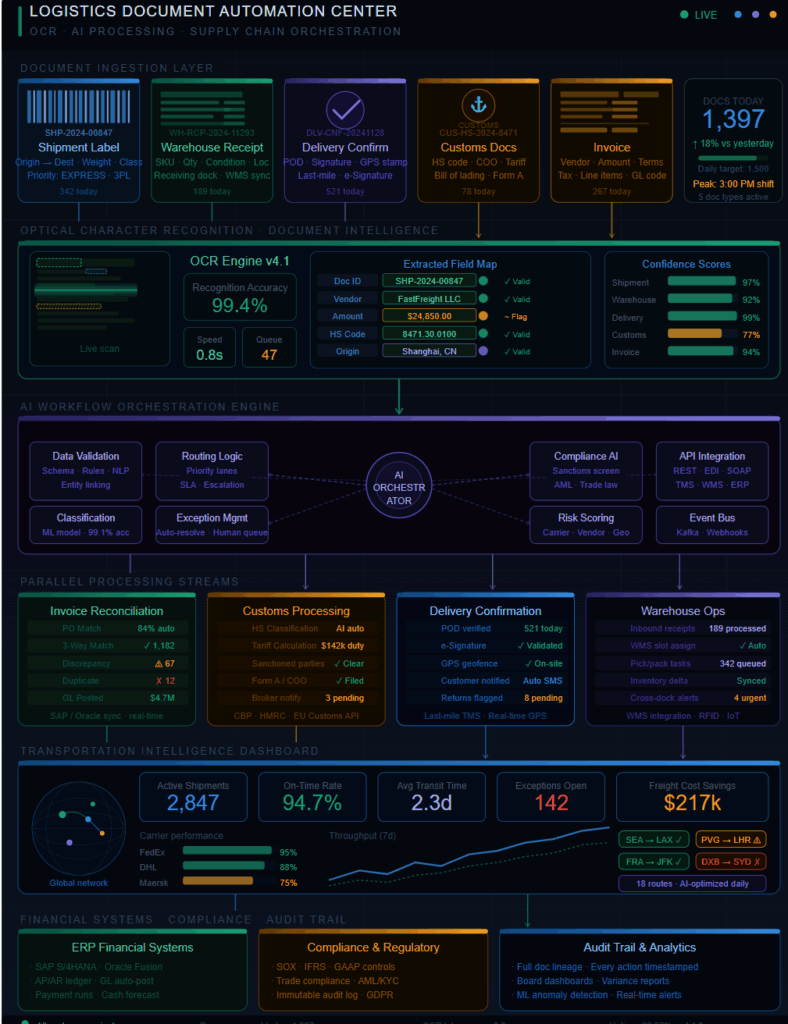
Figure: OCR-powered document automation across logistics workflows
Government and Identity Verification Systems
Governments process extraordinary amounts of documentation:
- passports
- visas
- tax forms
- permits
- identity cards
- legal records
Manual processing at national scale is extremely expensive and slow.
OCR systems became foundational for digitizing government workflows, especially in:
- border systems
- customs
- taxation
- citizen onboarding
- compliance verification
More recently, governments have increasingly combined OCR with AI-powered identity verification systems capable of:
- document authenticity analysis
- fraud detection
- biometric matching
- automated compliance validation
This is another example of OCR evolving into a much larger operational layer.
Why AI Changed OCR So Significantly
Traditional OCR systems were good at extracting characters.
They were not good at understanding documents.
That distinction became increasingly important as businesses attempted to automate larger workflows.
For example, a traditional OCR engine might extract text from an invoice correctly, but businesses still needed additional systems to understand:
- which number represented the total
- whether taxes were correct
- which supplier issued the invoice
- whether the invoice matched procurement records
- whether the payment had already been processed
Modern AI systems increasingly handle these semantic tasks automatically.
This is where OCR evolved from:
text extraction
into:
document understanding
And that transition fundamentally changed the economic value of OCR systems.
OCR Quietly Became a Financial Efficiency Layer
One of the most interesting aspects of OCR automation is that its impact often becomes invisible once workflows mature.
Nobody celebrates when:
- invoices process correctly
- deliveries reconcile automatically
- warehouse labels scan successfully
- procurement systems validate documents instantly
But operational efficiency compounds over time.
Even small reductions in:
- processing delays
- reconciliation errors
- administrative overhead
- manual labor
can create enormous financial impact at enterprise scale.
This is why businesses continue investing heavily in document automation infrastructure.
The value is not only technological.
It is operational.
The Rise of Intelligent Document Processing
The next evolution of OCR is increasingly being called Intelligent Document Processing (IDP).
Instead of only extracting text, modern systems combine:
- OCR
- AI reasoning
- workflow automation
- validation systems
- semantic extraction
The pipeline now looks much more like this:
Document
→ OCR
→ AI Understanding
→ Validation
→ Workflow Automation
→ Operational Systems
This is a major conceptual shift.
OCR is no longer being treated as standalone software.
It is increasingly becoming one component inside larger AI operational systems.
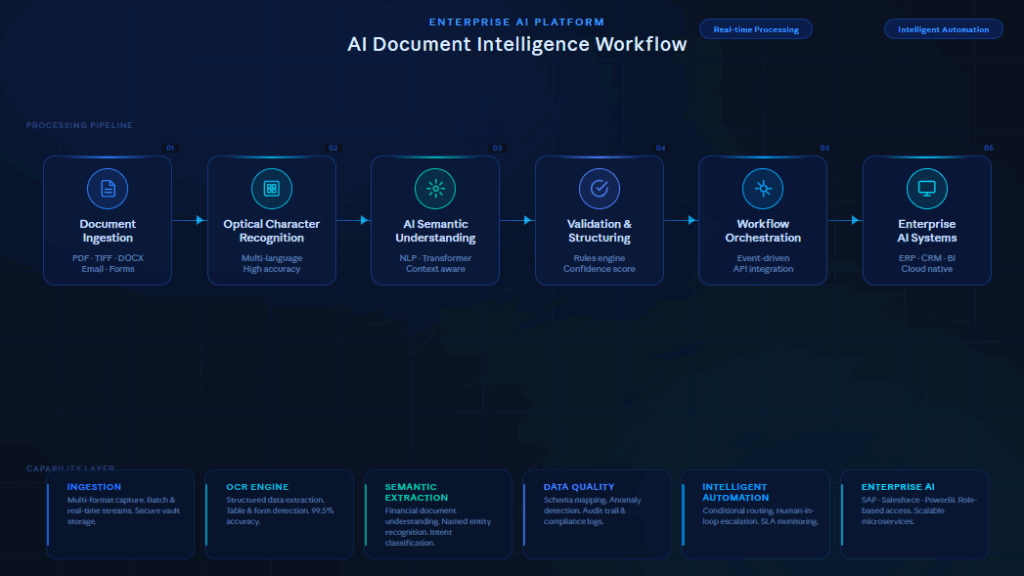
Figure: Evolution from OCR toward AI-powered document intelligence systems
Where Local AI Pipelines Become Interesting
Most enterprise OCR systems today operate as cloud-based SaaS platforms.
However, local AI workflows are becoming increasingly attractive for organizations concerned about:
- privacy
- compliance
- infrastructure ownership
- offline execution
- operational cost control
Projects like ReceiptFlow explore how local OCR + LLM systems can perform meaningful document automation entirely offline.
Instead of relying on cloud APIs, the pipeline combines:
- OCR
- local language models
- deterministic validation
- structured extraction
running directly on local CPU hardware.
This demonstrates an important industry trend:
small local AI systems are rapidly becoming operationally useful.
The Bigger Shift Happening Behind the Scenes
The biggest realization from studying OCR systems is that businesses were never truly trying to solve document scanning. They were trying to solve operational inefficiency.
OCR happened to become one of the first layers enabling that transformation.
Now AI is pushing the industry further:
from extraction,
to understanding,
to automation,
to coordination.
And that shift is turning document processing into something much larger than most people expected.
Conclusion
OCR automation quietly became one of the foundational technologies behind modern enterprise operations.
What started as simple text extraction evolved into:
- workflow automation
- operational intelligence
- document understanding
- financial efficiency systems
- AI-powered business infrastructure
Today, OCR is deeply embedded across:
- banking
- healthcare
- logistics
- procurement
- finance
- government systems
And with AI now entering the picture, the next generation of OCR systems will likely function less like scanning software and more like operational agents coordinating complex enterprise workflows.
The interesting part is that most people still think OCR is only about extracting text from paper.
In reality, it has already become much bigger than that.
References
- https://www.mckinsey.com/capabilities/operations/our-insights/transforming-procurement-functions-for-an-ai-driven-world
- https://aws.amazon.com/textract/
- https://cloud.google.com/document-ai
- https://azure.microsoft.com/en-us/products/ai-services/ai-document-intelligence
- https://www.uipath.com/product/document-understanding
- https://rossum.ai
- https://github.com/tesseract-ocr/tesseract
Suggested Internal Links
- Receipt Scanning Is No Longer Just an OCR Problem
- Why AI Receipt Digitization Is Moving Beyond Traditional OCR
- Traditional OCR vs LLM-Based Receipt Extraction
- Processing 100 Receipts Locally with OCR and LLMs on CPU