
For years, receipt digitization was treated as a relatively small OCR problem. Businesses scanned receipts, extracted text, stored the output, and moved on. But modern enterprise workflows have changed the nature of the problem entirely.
Today, organizations process enormous volumes of invoices, receipts, procurement records, delivery confirmations, and financial documents across highly interconnected operational systems. The challenge is no longer only about extracting text from paper. It is about understanding financial relationships, validating information, automating workflows, integrating with ERP systems, and reducing operational friction at scale.
This article explores how businesses are actually using AI-powered receipt and invoice digitization in real workflows, why traditional OCR systems are no longer enough on their own, and how modern AI systems are transforming document processing into a much larger automation layer.
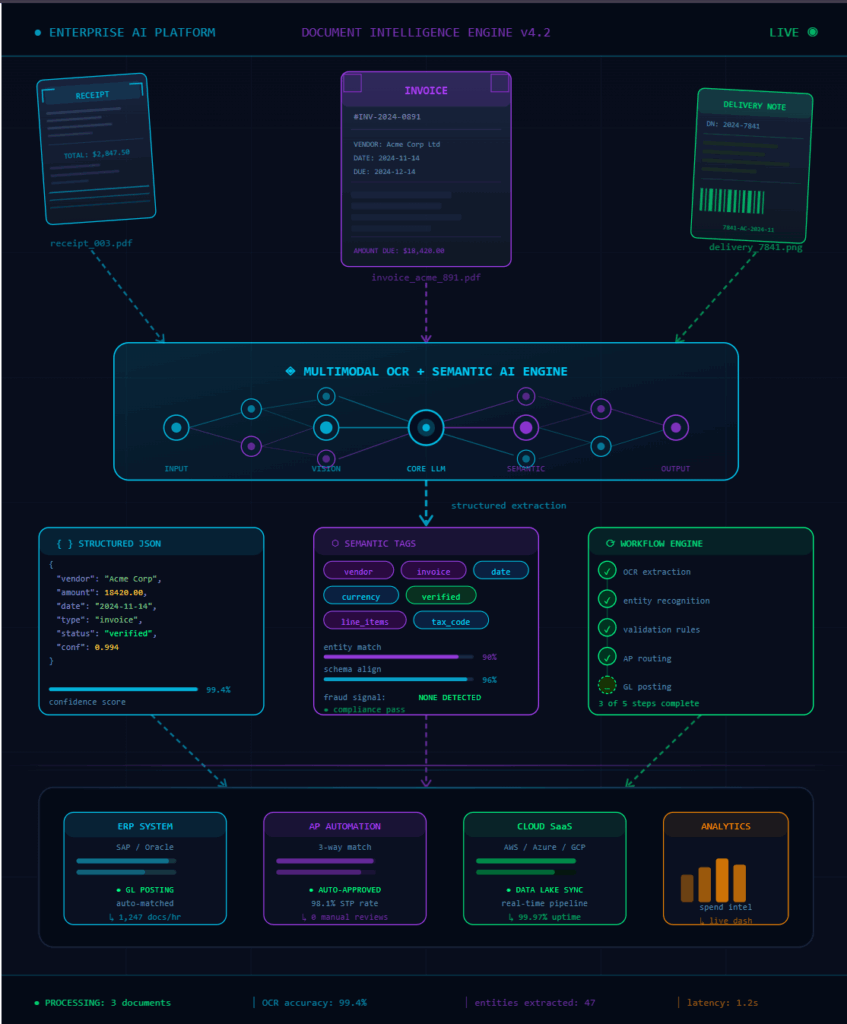
Introduction
When most people hear “receipt scanning,” they usually imagine a fairly simple process.
Take a photo of a receipt.
Run OCR.
Extract the text.
Store the result.
At first glance, the problem looks almost solved.
But once document processing moves into real enterprise environments, things become significantly more complicated.
Receipts rarely arrive in perfect conditions. Thermal paper fades. Layouts differ between vendors. Discounts appear in inconsistent formats. Taxes are represented differently across countries. Delivery records often need reconciliation against invoices. Procurement systems need validation against purchase orders. Accounting workflows require structured categorization.
And suddenly, OCR alone stops being enough.
The real difficulty begins after text extraction.
Businesses are not actually trying to extract characters from paper. They are trying to automate operational processes built around those documents.
That distinction changes everything.
The Original Promise of OCR
Traditional OCR systems such as Tesseract OCR were designed primarily for character recognition.
The workflow was relatively straightforward:
Receipt Image
→ OCR Engine
→ Raw Text
→ Manual Parsing
→ Accounting System
For many years, this approach worked reasonably well for small-scale automation tasks.
If the goal was simply to digitize text from documents, OCR systems were already useful enough to reduce large amounts of manual data entry.
This became especially important in industries handling repetitive paperwork:
- finance
- accounting
- procurement
- logistics
- insurance
- healthcare
The productivity gains from digitization alone were already significant.
But businesses eventually encountered a much larger operational problem.
OCR could extract text.
It could not understand documents.
Why OCR Alone Started Breaking Down
One of the biggest misconceptions around receipt digitization is that the difficult part is recognizing characters correctly.
In practice, the harder problem is structure.
A receipt is not just random text. It contains relationships:
- totals belong to line items
- discounts affect products
- taxes modify subtotals
- delivery records map to invoices
- invoices connect to procurement systems
Traditional OCR systems do not understand these relationships semantically.
They only extract visible characters.
That creates a huge amount of downstream engineering complexity.
Even when OCR outputs look “correct” visually, businesses still need to:
- validate totals
- categorize expenses
- reconcile records
- detect duplicates
- route workflows
- integrate with ERP systems
- verify procurement operations
And much of that traditionally required human review.
The Shift Toward Intelligent Document Processing
This limitation led to the rise of what is now commonly called Intelligent Document Processing (IDP).
Modern systems increasingly combine:
- OCR
- machine learning
- semantic extraction
- workflow automation
- validation systems
- AI reasoning
The pipeline evolved from simple OCR into something much larger:
Receipt Image
→ OCR + AI Understanding
→ Structured Extraction
→ Validation
→ Workflow Automation
→ ERP / Finance Systems
The important shift here is that the goal is no longer simply digitization.
The goal is operational automation.
This is a fundamentally different category of problem
Figure: Evolution from OCR extraction toward AI-powered business workflow automation
Why Businesses Care About This So Much
Modern enterprises process extraordinary volumes of financial and operational paperwork every day.
A large organization may handle:
- supplier invoices
- procurement records
- travel receipts
- warehouse confirmations
- delivery documents
- tax records
- reimbursement claims
at massive scale.
And surprisingly, many of these workflows are still partially manual.
That creates operational friction everywhere:
- repetitive accounting tasks
- approval bottlenecks
- reconciliation delays
- compliance overhead
- expensive human review processes
According to McKinsey & Company, AI-powered procurement and invoice automation systems are increasingly becoming strategic operational priorities for enterprises.
The reason is simple:
document workflows are expensive when humans need to stay inside every step.
Expense Management Became an Automation Layer
One of the earliest large-scale business applications of receipt digitization was expense management.
Initially, these systems focused mainly on reducing manual bookkeeping work.
Employees uploaded receipts manually.
Finance teams reviewed them manually.
Accounting systems categorized them manually.
Modern platforms such as:
now automate large parts of these workflows using AI extraction systems.
Instead of simply extracting text, modern expense platforms now attempt to:
- identify merchants
- detect expense categories
- validate totals
- calculate taxes
- integrate directly with accounting systems
At scale, this dramatically reduces repetitive operational work.

Figure: AI-powered expense digitization workflow
Procurement and Accounts Payable Became Much Larger Problems
The operational impact becomes even more significant inside procurement workflows.
Large companies process enormous numbers of supplier invoices every month.
That creates constant operational pressure around:
- invoice validation
- purchase order matching
- reconciliation
- approvals
- compliance tracking
Historically, much of this involved repetitive manual review.
Modern AI systems are now increasingly handling:
- invoice extraction
- supplier matching
- semantic reconciliation
- workflow routing
- exception handling
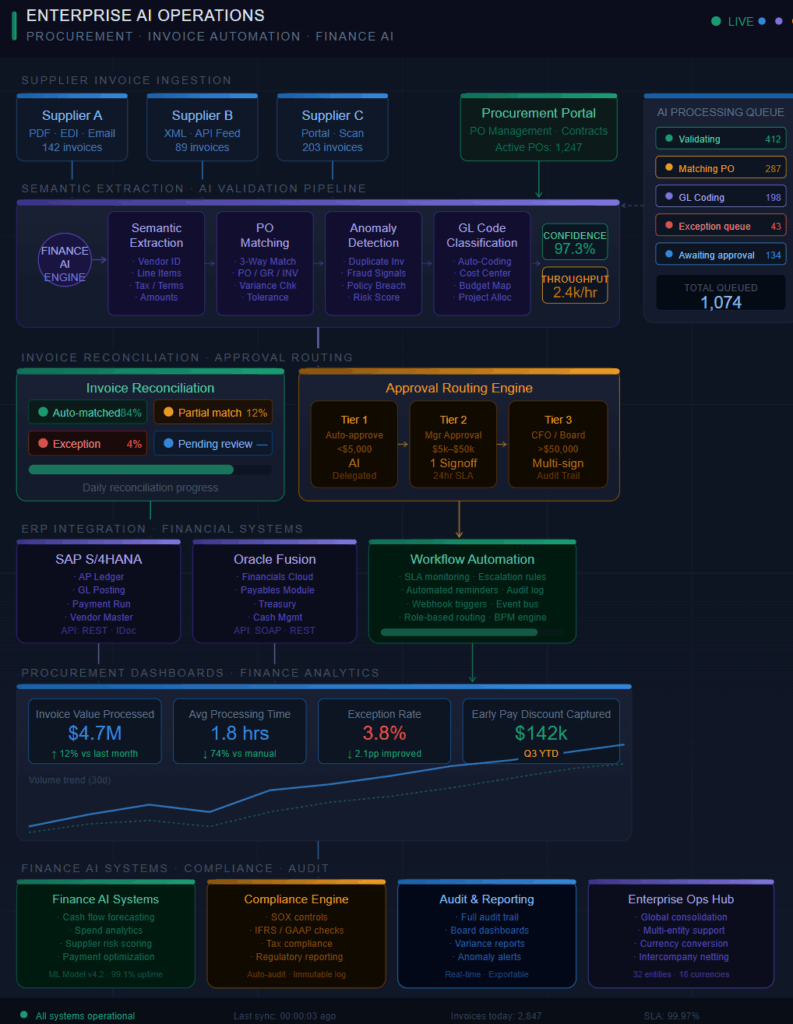
Platforms such as:
are increasingly positioning document digitization not as OCR software, but as enterprise workflow infrastructure.
That is a very important shift.
Logistics Turned Document Processing Into an Operational Challenge
One surprisingly important area for document AI is logistics.
Supply chains generate enormous amounts of paperwork:
- bills of lading
- shipment confirmations
- delivery receipts
- warehouse records
- customs forms
- transportation invoices
These documents need constant reconciliation across operational systems.
A delivery confirmation might need validation against:
- warehouse records
- supplier invoices
- procurement systems
- transportation contracts
At this scale, document digitization becomes deeply connected to operational efficiency.
AI systems are increasingly being used to:
- verify shipments
- automate reconciliation
- reduce supply-chain paperwork
- accelerate logistics workflows

Figure: AI-powered document automation in logistics systems
The Interesting Shift: OCR Is Quietly Becoming Secondary
One of the most interesting things happening in this industry is that OCR itself is slowly becoming less important as a standalone feature.
OCR is increasingly becoming just one component inside much larger automation systems.
The real value now comes from:
- semantic understanding
- workflow coordination
- validation
- operational intelligence
- automation layers
Businesses no longer only want text extraction.
They want systems that can participate in operational workflows.
That changes how these systems are engineered completely.
The Rise of Agentic Workflows
This is where the industry becomes particularly interesting.
Modern AI systems are beginning to move beyond extraction into coordination.
Instead of only reading invoices, AI systems are increasingly being designed to:
- route approvals
- reconcile procurement records
- validate expenses
- coordinate workflows
- trigger downstream operations
McKinsey describes this shift as the rise of “agentic workflows.”
In these systems, AI behaves less like OCR software and more like an operational assistant capable of coordinating business processes.
This is one of the reasons AI receipt digitization has become strategically important far beyond accounting departments.

Figure: Evolution toward agentic enterprise finance workflows
Where Local AI Pipelines Start Becoming Interesting
Most large document AI systems today operate as cloud SaaS platforms.
That model works extremely well for many organizations.
However, there is growing interest in local AI document processing pipelines for industries that care heavily about:
- privacy
- compliance
- infrastructure ownership
- offline execution
- cost control
This is where projects like ReceiptFlow became interesting to experiment with.
Instead of relying on cloud APIs, the pipeline processes receipts locally using:
- OCR
- local LLM inference
- deterministic validation
Pipeline example:
Receipt Image
→ LightOnOCR
→ Qwen via llama.cpp
→ JSON Extraction
→ Cleaning
→ Validation
→ Structured Financial Output
The entire workflow runs locally on CPU hardware.
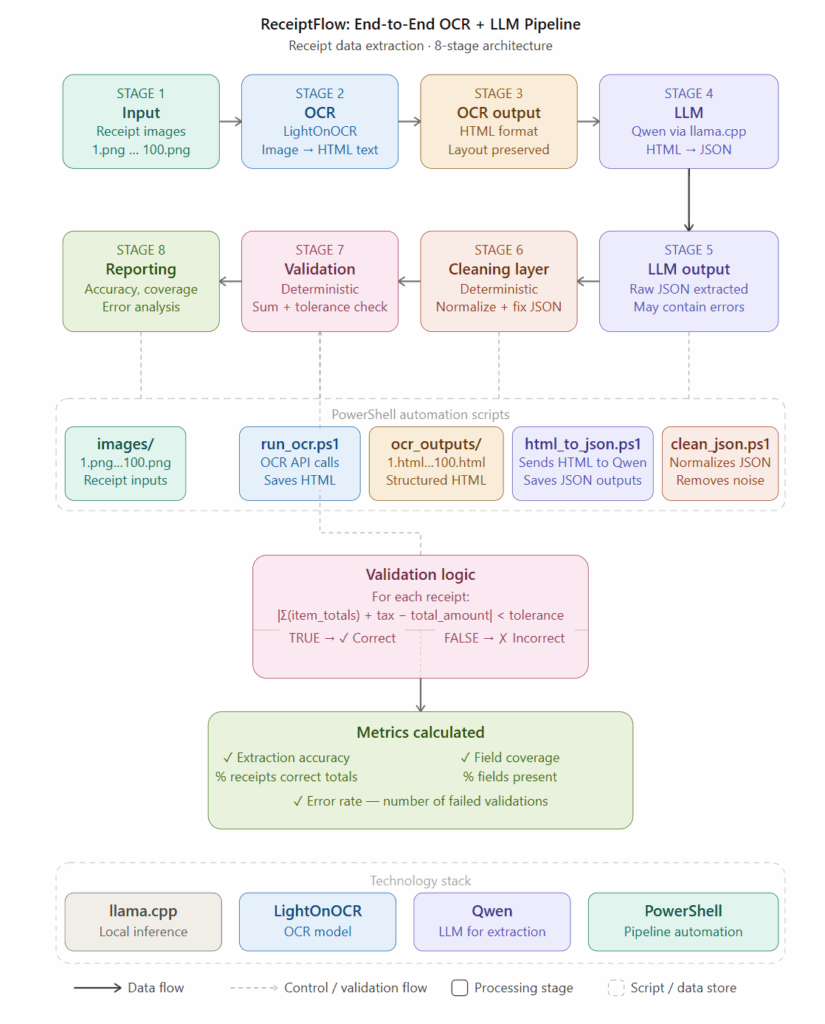
That demonstrates something very important:
small local models are already becoming usable for meaningful document automation workflows.
Figure: Local OCR + LLM receipt processing architecture
The Real Insight
The biggest realization from studying this space is that receipt digitization was never only an OCR problem.
It was always an operational workflow problem disguised as OCR.
OCR extracts characters.
Businesses need systems that:
- understand relationships
- validate information
- automate workflows
- reduce operational friction
- integrate across systems
That is where AI fundamentally changes the equation.
Conclusion
Receipt and invoice digitization is rapidly evolving into a foundational operational automation layer for modern businesses.
The industry is moving far beyond:
- isolated OCR tools
- manual parsing
- simple extraction workflows
toward:
- intelligent automation
- semantic understanding
- validation systems
- workflow orchestration
- agentic operational AI
Traditional OCR still matters.
But increasingly, the systems creating the most business value are the ones combining:
- OCR
- AI understanding
- workflow automation
- deterministic validation
into larger operational ecosystems.
And this transition is only beginning.
References
- McKinsey Procurement AI Research
- Rossum AI
- UiPath Document Understanding
- Google Document AI
- AWS Textract
- Azure AI Document Intelligence
- SAP Concur
- Veryfi
- llama.cpp
- Qwen Models
Suggested Internal Links
- Receipt Scanning with Traditional OCR (Tesseract)
- AI Receipt Scanning Platforms: Comparing Modern SaaS OCR Solutions
- How AI Changes Receipt Scanning Beyond Traditional OCR
- Processing 100 Receipts with OCR and LLMs on CPU