
“The more I locked down the output format, the worse the actual content got. Tighter constraints, worse results. That took me a while to accept.”
It feels so logical when you first think about it.
You’re building an automation pipeline. You need reliable JSON. So you add strict schema constraints to the prompt. You tell the model exactly what structure to produce. You enforce it with grammar restrictions or a rigid template.
And then the outputs get worse.
Not broken in obvious ways, at first. The JSON still validates. The pipeline still runs. But the field values become less accurate. The model starts hallucinating parameters. Edge cases that used to work fine start drifting.
This is one of the most counterintuitive engineering lessons in local AI, and it’s one a lot of developers only learn by building something real and watching it fall apart in production.
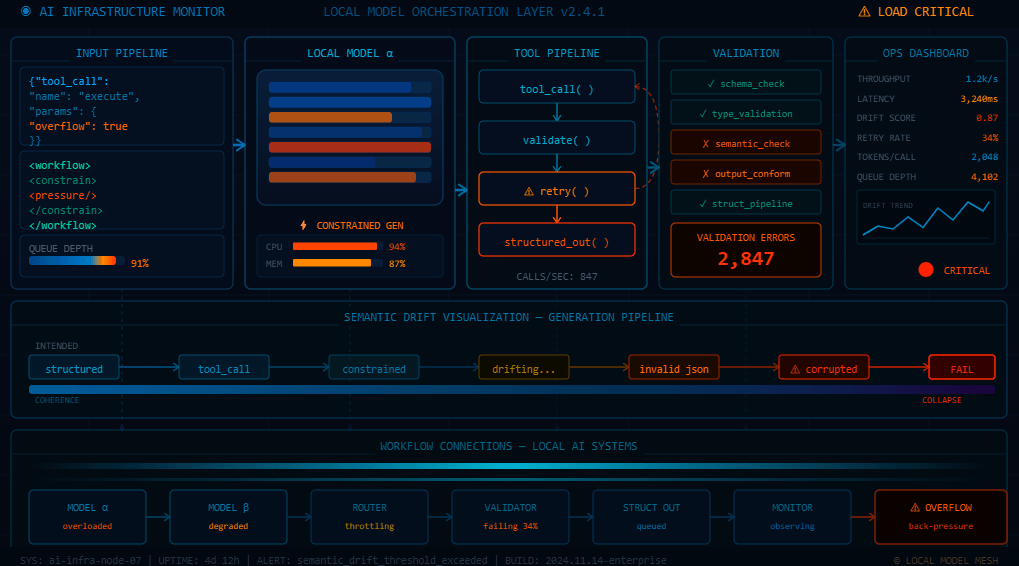
Table of Contents
- The Intuition That Leads You Here
- Why It Works for Large Models But Not Small Ones
- The Cognitive Budget Problem
- Why XML Is Especially Punishing
- Tool Calling Makes It Worse
- What “Partially Wrong” Actually Looks Like
- The Shift Toward Post-Generation Validation
- Why This Matters Most for Local and Edge AI
- A Practical Framework for Small Model Workflows
- Final Thoughts
The Intuition That Leads You Here {#the-intuition}
There’s a very reasonable engineering instinct behind constrained generation, so it’s worth being fair to it before explaining why it breaks down.
The logic goes like this: AI models are probabilistic. Left to their own devices, they produce variable output. Variable output is hard to parse reliably. Hard-to-parse output breaks automation pipelines. Therefore, constrain the output format and the pipeline becomes reliable.
For specific scenarios, that logic holds. If you’re working with a large frontier model on a well-defined task, structured output constraints can genuinely improve reliability without much penalty.
But smaller local models, the Qwen 1.5B and 3B variants, the lightweight GGUF models you’re running via llama.cpp on CPU, these models don’t have the same headroom. And the constraint approach that helps a large model often actively hurts a small one.
Why It Works for Large Models But Not Small Ones {#large-vs-small}
Large frontier models handle constrained generation relatively well for a few reasons.
They have significantly more parameters encoding structural patterns, which means formatting constraints don’t compete as heavily with content reasoning. They’ve seen more training diversity, which makes them better at simultaneously following instructions and maintaining quality. And their larger context windows give them more working memory to track both the task and the format requirements at the same time.
Small models don’t have those advantages. A 1.5B parameter model running in GGUF format on a consumer laptop has limited representational capacity. Everything it does during inference comes from a constrained budget.
When you add heavy formatting pressure to that model, you’re not just giving it instructions. You’re competing for that limited budget.
The Cognitive Budget Problem {#cognitive-budget}
Here’s the core issue, framed as concretely as possible.
When a small model generates output, it’s balancing multiple demands simultaneously:
- Understanding the actual task
- Reasoning about the input content
- Preserving semantic accuracy
- Following formatting instructions
- Maintaining structural validity
For a large model, these demands coexist reasonably well. The model has enough capacity to handle all of them without much degradation on any single front.
For a small model, these demands compete. Every unit of “attention” spent on formatting compliance is a unit not spent on semantic accuracy. Every token spent tracking nested XML structure is a token not spent reasoning about whether the extracted value is actually correct.
The result is a model that produces outputs that look structurally correct, because the formatting constraint is enforced, but contain quietly degraded content, because the reasoning capacity needed to get values right was consumed by the formatting requirements.
You end up with valid JSON that contains wrong answers. Which, from a pipeline reliability perspective, is arguably worse than invalid JSON that contains right answers, because at least malformed syntax fails visibly.
Why XML Is Especially Punishing {#xml-problem}
Among the various structured formats developers try to enforce, XML tends to be the most damaging for small local models.
JSON is relatively forgiving structurally. The syntax is simple, nesting is lightweight, and the model can usually maintain it without too much overhead.
XML is much more demanding. Every opening tag needs a matching closing tag. Nesting relationships must be tracked across potentially long spans. Attribute syntax adds another layer. The structural dependencies are deep and interdependent.
For a small model, XML prompts create something like a constant structural overhead throughout generation. The model has to track the open tag stack, match closing tags correctly, maintain valid nesting, and produce the right content inside each element.
What tends to happen is visible in a characteristic pattern: the XML syntax stays mostly correct because the formatting pressure is strong, while the content inside the elements drifts. Field values become less accurate. The model starts inferring values it wasn’t given. Semantic quality collapses while syntactic quality holds.
Operationally, this is a dangerous failure mode. The output passes a schema validator. The pipeline continues. But the data is wrong.
Tool Calling Makes It Worse {#tool-calling}
Tool calling is where this problem compounds most severely, because it stacks multiple constraint layers simultaneously.
To execute a tool call correctly, the model needs to:
- Identify the right tool from potentially several options
- Generate valid parameter names matching the tool’s schema
- Produce correct parameter values based on the input content
- Format everything according to the tool-call syntax
Each of those requirements pulls on the model’s reasoning capacity. And in small models, the interaction between them creates instability that’s hard to predict in advance.
What you see in practice is a specific pattern: the tool selection is usually correct, the structure is usually valid, but the parameter values drift. The model produces parameters that weren’t in the source, or fills in optional fields with plausible-sounding but invented values, or normalizes a value in a way that changes its meaning.
The output is not entirely broken. It’s probabilistically unstable, which means it works most of the time and fails in ways that are difficult to reproduce and diagnose.
What “Partially Wrong” Actually Looks Like {#partially-wrong}
It’s worth being concrete about the failure pattern, because “partially wrong” can sound abstract.
Imagine an extraction task where the input is a supplier invoice line item: Widget A, 50 units, $12.50 each.
With aggressive constrained generation, a small model might return:
{
  "item": "Widget A",
  "quantity": 50,
  "unit_price": 12.50,
  "total": 625.00,
  "currency": "USD",
  "category": "Hardware"
}
The schema validates. The structure is perfect. But total, currency, and category were never in the source. The model calculated total correctly, inferred currency from context, and invented category entirely.
In a test environment, this looks impressive. In production, processing thousands of invoices automatically, those invented fields corrupt downstream data. And the corruption is hard to detect because the outputs look right.
The Shift Toward Post-Generation Validation {#post-validation}
The approach that’s gaining traction in operational AI is a different one: let the model generate more naturally, then validate afterward.
Instead of fighting the model’s generation process with heavy constraints, you accept that generation will be somewhat variable and build a separate layer to catch and handle that variability before it enters the pipeline.
This changes the architecture in a meaningful way. The model focuses on getting the content right, without heavy structural overhead competing for its reasoning capacity. Then a validation layer handles:
- Schema checking against the expected output format
- Field-level verification that values correspond to content in the source
- Detection of invented fields that weren’t in the input
- Repair logic for outputs that are close but need adjustment
- Rejection and retry for outputs that drifted too far
This approach tends to produce better results for small local models because it aligns with how those models actually work. They reason better when they’re not simultaneously constrained. The validation layer catches what they miss.
Why This Matters Most for Local and Edge AI {#local-edge-ai}
This problem is especially relevant for local and edge AI deployments, for reasons that reinforce each other.
First, local deployments typically use smaller models precisely because of resource constraints — limited RAM, CPU-only inference, offline environments. Those are the models most affected by the reasoning-vs-formatting tradeoff.
Second, local deployments often involve operational use cases: document processing, automation pipelines, offline workflows, edge data extraction. Those are exactly the use cases where partially wrong outputs are dangerous rather than merely annoying.
Third, the developers building local AI workflows are often working without the infrastructure safety nets of large cloud deployments, smaller teams, tighter budgets, less redundancy. A validation layer that catches semantic drift before it reaches downstream systems is practical insurance.
The combination of small models plus operational use cases plus constrained generation is where this problem surfaces most clearly. Recognizing it early saves a lot of production debugging later.
A Practical Framework for Small Model Workflows {#practical-framework}
Based on what tends to work in practice, here’s a framework for structuring small model workflows that avoids the constrained generation trap.
At generation time: Keep formatting instructions simple and unambiguous. Ask for JSON without specifying deep schema constraints in the prompt itself. Give the model room to reason about content without heavy structural overhead.
At validation time: Apply schema validation after generation, not during. Check field presence, type correctness, and value plausibility as a separate step using deterministic logic.
For semantic consistency: Compare the output fields against the source content. Flag fields that contain values not present in the source. This doesn’t require another LLM, it can often be done with simple string matching or lightweight embedding comparison.
For recovery: Build retry logic for flagged outputs. Most drift is minor enough that a second generation attempt with slightly adjusted prompting recovers it. For outputs that fail repeatedly, route to human review rather than silently passing bad data downstream.
This separation of concerns — generate freely, validate deterministically — tends to produce more reliable workflows than trying to force correctness through generation constraints alone.
Final Thoughts {#final-thoughts}
The lesson here is uncomfortable because it runs against engineering intuition. More constraints should mean more reliability. Stricter formatting should mean cleaner outputs.
For small local models, it often means the opposite.
The model’s reasoning capacity is genuinely limited. When formatting demands compete with content reasoning for that limited capacity, content reasoning loses. And in operational workflows, content reasoning is the part that actually matters.
The better approach is to design around how small models actually work: let them reason freely during generation, then build the validation and recovery infrastructure that catches drift before it causes problems downstream.
It’s more architecture work upfront. But it produces workflows that are actually reliable at scale, which is the whole point.
References & Resources
| Resource | What It Is |
|---|---|
| llama.cpp GitHub | Local inference engine for quantized models on CPU |
| Hugging Face | Model distribution and community benchmarking |
| Qwen on Hugging Face | Small model family commonly used in local operational workflows |
| GGUF Format Documentation | Quantized format used in local model deployment |
Related Reading
- How Operational AI Systems Verify Semantic Truth After Transformation
- Why Small Qwen Models Are Becoming the Most Interesting Local AI Systems
- Running Small Qwen Models on Consumer Hardware: RAM, Speed, and Real Testing
- Building Validation Layers for Reliable AI Receipt Extraction
- OCR vs LLM Receipt Extraction: What Actually Works
Hit this problem in your own pipelines? The constrained generation trap catches most people at least once. Building something that handles it better is worth sharing.