
“The pipeline didn’t crash. The JSON was valid. The workflow completed. And the data was quietly wrong the whole time.”
If you’ve spent enough time building AI-powered automation, you’ve probably had this experience at least once.
Everything looks fine on the surface. No exceptions thrown. No failed steps. The output schema validates. Downstream systems process the results without complaint.
Then someone audits a sample of records and finds fields that were never in the source. Values that were inferred rather than extracted. Parameters that the model invented because they seemed contextually appropriate.
The pipeline didn’t fail. It succeeded at producing structured, plausible-looking nonsense.
This is the validation problem in operational AI, and it’s one of the more important engineering challenges that doesn’t get enough direct attention. Here’s how to think about it, and what actually helps.
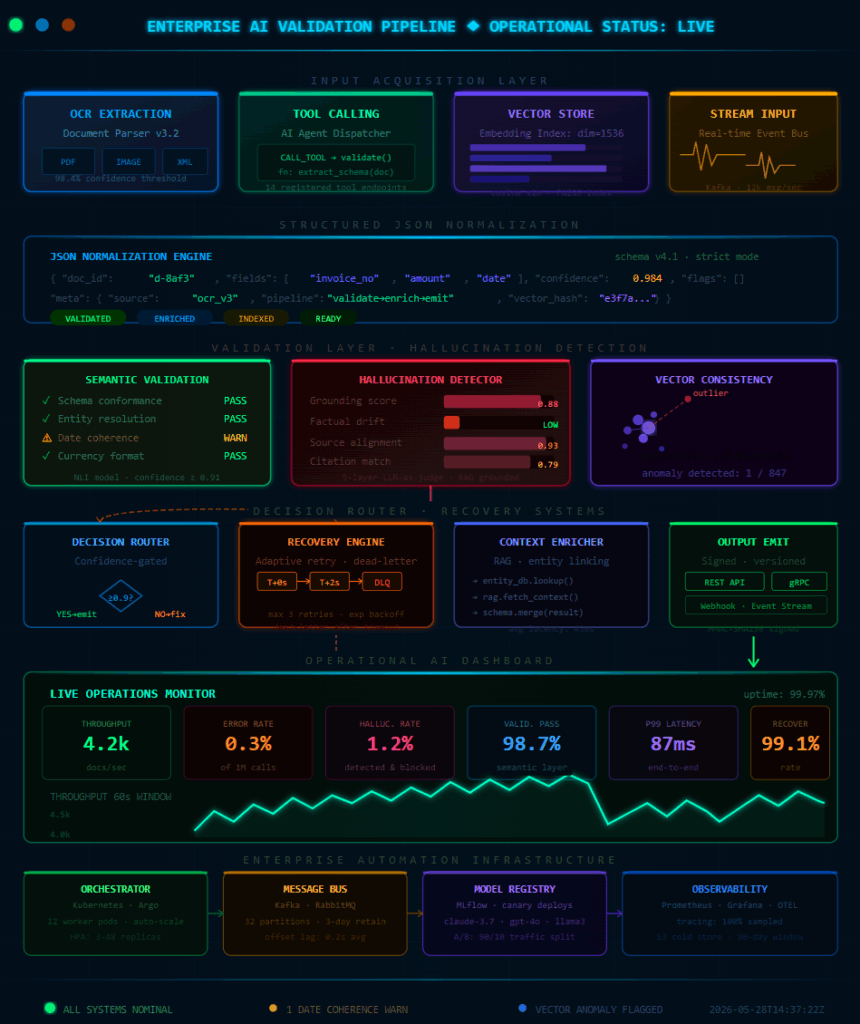
Table of Contents
- Why “Mostly Correct” Is the Dangerous Failure Mode
- OCR Pipelines and Why They’re Especially Exposed
- Tool Calling Adds Another Layer of Risk
- Why Using Another LLM to Validate Doesn’t Solve It
- The Shift to Lightweight Validation Layers
- Why Recovery Matters as Much as Rejection
- Vector Consistency as an Alternative Approach
- Why This Matters Especially for Local AI
- A Practical Architecture for Validation Pipelines
- Final Thoughts
Why “Mostly Correct” Is the Dangerous Failure Mode {#mostly-correct}
There’s a useful mental model for thinking about operational AI failures: complete failures are easy, partial failures are expensive.
A complete failure is visible. The model returns malformed JSON, the parser throws an exception, the pipeline halts, an alert fires, someone investigates. It’s disruptive but recoverable because you know something went wrong.
A partial failure is invisible. The model returns valid JSON with mostly correct fields and one invented parameter. The schema validates. The pipeline continues. The bad data propagates through every downstream system that touches it. By the time someone notices, it’s been multiplied across hundreds of records and the cleanup is a significant project.
This is the real shape of the operational AI validation problem. You’re not primarily worried about catastrophic failures. You’re worried about outputs that are correct enough to pass automated checks but wrong enough to silently corrupt your data.
The gap between “structurally valid” and “semantically trustworthy” is where the problem lives.
OCR Pipelines and Why They’re Especially Exposed {#ocr-pipelines}
OCR workflows are where this problem shows up most clearly, for a structural reason that’s worth understanding.
An OCR engine extracts raw text from a document. That raw text is imperfect, unstructured, and contextually sparse. The LLM transformation layer then turns that sparse text into structured data — clean field names, consistent formats, normalized values.
The model is doing real work here. It’s filling gaps, inferring structure, and making the output usable. Most of the time, this is exactly what you want.
The problem is that “filling gaps” and “hallucinating” exist on the same continuum. When the model normalizes a date format, that’s useful. When it infers a product category that wasn’t in the source text, that’s fabrication. When it calculates a total from line items, it’s helpful. When it invents a quantity because the line item looked incomplete, it’s wrong.
All of these behaviors produce valid JSON. None of them are detectable by a schema validator. And in a batch of several hundred documents, you’ll usually see a mix of all of them.
The validation challenge is building a layer that can tell the difference between helpful inference and quiet fabrication.
Tool Calling Adds Another Layer of Risk {#tool-calling}
Tool-calling systems face the same core problem with an added dimension of complexity.
When a model executes a tool call, it has to simultaneously:
- Select the correct tool from potentially several options
- Generate parameter names that exactly match the tool’s schema
- Populate values that correctly reflect the user’s intent
- Format everything according to the tool-calling syntax
For large frontier models on well-defined tasks, this usually works well. For smaller local models on operationally complex inputs, each of those steps is a potential source of drift.
The characteristic failure pattern in tool calling isn’t usually catastrophic. The model picks the right tool. The structure is valid. But somewhere in the parameters, something slips. An optional field appears that wasn’t requested. A parameter value gets normalized in a way that changes its meaning. An unsupported key gets added because the model thought it was relevant.
The workflow executes with the wrong parameters. If your downstream system silently ignores unexpected keys, you might not notice for a while.
This is why validation at the parameter level, not just the structural level, matters for production tool-calling systems.
Why Using Another LLM to Validate Doesn’t Solve It {#llm-validators}
The instinctive solution is to add another model to the pipeline: have one LLM generate the output, have a second LLM check it. Reasonable in theory. Problematic in practice.
The fundamental issue is that an LLM validator has the same properties as an LLM generator. It’s probabilistic. It’s generative. It’s non-deterministic. It can hallucinate a “correct” verdict for an output that drifted, or flag a “problem” with an output that was fine.
You’ve added cost and latency to the pipeline without adding the determinism you actually needed. And for high-volume operational workflows, the cost compounds fast. Two LLM calls per document instead of one, to produce a result that’s still probabilistically uncertain.
Beyond cost, there’s a deeper issue: LLM validators tend to be good at checking whether something sounds plausible and poor at checking whether it’s faithful to a specific source. An output that contains a well-formatted, contextually reasonable fabricated field will often pass an LLM review. That’s exactly the failure case you’re trying to catch.
The Shift to Lightweight Validation Layers {#lightweight-validation}
The approach that’s gaining ground in operational AI engineering is narrower and more deterministic: instead of asking another model whether the output seems right, build specific checks that test specific properties.
These layers typically include some combination of:
Schema validation, which checks that required fields are present, types are correct, and no unexpected fields appeared. Deterministic, fast, and catches a meaningful class of drift.
Field provenance checking, which verifies that values in the output actually appear in or are derivable from the source. This can often be done with straightforward string matching or lightweight similarity checks without needing another LLM.
Range and plausibility checks, which apply domain-specific rules. Prices should be positive. Dates should be parseable. Quantities should be integers. These catch normalization errors that schema validation misses.
Consistency scoring, which checks whether the output as a whole is coherent with the input. More complex than the others, but increasingly tractable with embedding-based approaches.
The philosophy shift is important: these layers don’t try to understand the output. They test specific hypotheses about how it could be wrong. That narrower scope is what makes them deterministic and operationally reliable.
Why Recovery Matters as Much as Rejection {#recovery}
One of the more practically valuable insights in this space is that not every drifted output needs to be rejected. Many are recoverable.
If a tool call contains one hallucinated optional parameter, removing it may be sufficient to make the call valid. If a JSON output has an extra field that wasn’t requested, stripping it may be enough. If a date was formatted incorrectly but the value is correct, normalization fixes it.
Building recovery logic into the validation layer, rather than just pass/fail checking, changes the operational economics significantly. Instead of a pipeline that rejects 8% of documents and routes them to manual review, you might have a pipeline that recovers 6% automatically and routes only 2% to human review.
At scale, that’s a meaningful difference. Recovery logic that handles common drift patterns reduces manual review burden, improves throughput, and keeps the pipeline moving without sacrificing accuracy for the cases where recovery isn’t possible.
The practical implication: design validation layers with three outcomes, not two. Pass, recover, or reject, rather than just pass or reject.
Vector Consistency as an Alternative Approach {#vector-consistency}
An emerging direction worth understanding is treating validation as a vector consistency problem rather than a language reasoning problem.
The core idea: if you can embed both the original input and the transformed output into a shared vector space, semantic drift becomes a geometric distance problem. Outputs that preserve the original meaning stay close to the source in embedding space. Outputs that drift far from the source are flagged for review.
This doesn’t require another generative model. It requires embeddings and a distance threshold, both of which are cheap to compute at scale.
The limitation today is that standard embedding models are optimized for natural language, not for structured operational formats like JSON, tool-call representations, or key-value schemas. Generic embeddings may not reliably capture whether a specific field was faithfully extracted versus invented.
If specialized embeddings were developed for structured operational formats, this approach could become significantly more powerful. At that point, something as simple as cosine similarity could serve as a lightweight semantic drift detector for most operational use cases.
This is still an active area of development, but it’s a direction that a number of people working on production AI infrastructure are watching closely.
Why This Matters Especially for Local AI {#local-ai}
The validation problem is universal in operational AI, but it’s especially acute for local deployments using smaller models.
Smaller models, the Qwen 1.5B and 3B variants running via llama.cpp on consumer hardware, drift more than large frontier models. They’re more likely to fill gaps with plausible inventions, normalize values in unexpected ways, and add fields that seemed contextually relevant.
At the same time, local deployments typically can’t afford the computational cost of running a second large model for validation. The economics of local AI are built on small, fast, efficient components. A validation layer that requires a 7B parameter model defeats the purpose.
This is exactly why lightweight validation, deterministic checks, field provenance verification, and vector-based consistency scoring are so relevant to the local AI stack. They provide meaningful protection against the failure modes that smaller models are most prone to, without adding the infrastructure overhead that would make local deployment impractical.
The GGUF-quantized model ecosystem on Hugging Face is evolving fast, and validation tooling designed specifically for small local model workflows is one of the most underserved areas in the ecosystem right now.
A Practical Architecture for Validation Pipelines {#practical-architecture}
Here’s a concrete architecture that handles the main failure modes without requiring heavy infrastructure:
Stage 1, structural validation: Parse the output and validate against the expected schema. Check field presence, types, and format. This catches malformed outputs and obvious structural drift.
Stage 2, field provenance: For each extracted field, verify that the value appears in or is derivable from the source text. String matching works for exact values. Fuzzy matching handles normalization. Flag fields where no source correspondence exists.
Stage 3, domain rules: Apply any domain-specific plausibility checks. Price fields should be numeric and positive. Date fields should parse to valid dates. Required fields shouldn’t be empty. These are fast and catch a meaningful class of errors.
Stage 4, recovery: For outputs that failed Stage 1 or 2, attempt recovery before routing to rejection. Remove unexpected fields. Normalize format errors. Re-run generation with adjusted prompting for outputs that failed provenance checks.
Stage 5, routing: Outputs that pass all stages proceed. Outputs that pass after recovery proceed with a flag for audit sampling. Outputs that can’t be recovered route to human review.
This architecture is implementable without any additional LLM calls for the first three stages. Recovery in Stage 4 may involve a retry, but only for a subset of outputs. The result is a pipeline that’s both reliable and efficient at scale.
Final Thoughts {#final-thoughts}
The validation layer is not the glamorous part of operational AI. Generation gets the attention, benchmarks, and product announcements. Validation is the unglamorous infrastructure work that determines whether what gets generated can actually be trusted.
But in production systems, the validation layer is often where reliability is actually won or lost. A generation model that’s 95% accurate with no validation produces pipelines with invisible errors propagating through every downstream system. The same model with a well-designed validation layer produces something you can actually depend on.
As AI moves deeper into operational infrastructure, building the generation layer will become increasingly commoditized. The differentiation will increasingly come from the surrounding systems: validation, recovery, monitoring, and audit. The teams that invest in that infrastructure now are building a foundation that will matter for a long time.
References & Resources
| Resource | What It Is |
|---|---|
| llama.cpp GitHub | Local inference engine for running small models on CPU |
| Hugging Face | Model and tooling ecosystem for local AI deployment |
| Qwen on Hugging Face | Small model family commonly used in operational local pipelines |
| GGUF Format Documentation | Quantized model format for efficient local inference |
Related Reading
- How Operational AI Systems Verify Semantic Truth After Transformation
- Why Constrained Generation Hurts Small Local Models
- Why Small Qwen Models Are Becoming the Most Interesting Local AI Systems
- Running Small Qwen Models on Consumer Hardware: RAM, Speed, and Real Testing
- OCR vs LLM Receipt Extraction: What Actually Works
Building validation layers for OCR or tool-calling pipelines? The architecture patterns here are starting points, not final answers. The field is still working out what actually holds up at scale.