
“The model didn’t fail. The output looked perfect. But the data it returned never existed in the original document.”
This is the kind of bug that takes a while to even recognize as a bug.
You’re running an OCR pipeline. The model produces clean JSON. The schema validates. The workflow continues. Downstream systems process the output without complaint.
Then someone manually checks a record and notices a field that was never in the source document. The model didn’t hallucinate nonsense, it hallucinated something plausible. A category that made sense. A quantity that seemed reasonable. Structured, valid, and completely invented.
That’s the problem this article is about, and it’s one of the most underappreciated challenges in serious operational AI.
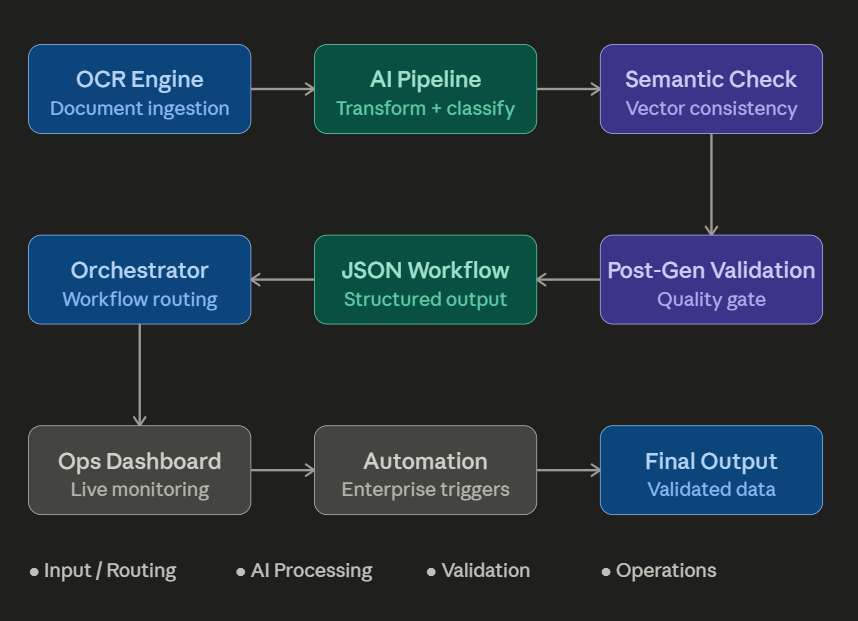
Table of Contents
- Why Operational Hallucinations Are Different
- A Concrete Example of Semantic Drift
- Why This Becomes Dangerous at Scale
- Why Constrained Generation Often Backfires
- The Shift Toward Post-Generation Validation
- Why LLMs May Not Be the Right Validators
- Treating It as Structural Drift Detection
- Why Structured Embeddings Could Change This
- What the Validation Layer of the Future Looks Like
- Final Thoughts
Why Operational Hallucinations Are Different {#operational-hallucinations}
Most conversations about AI hallucinations are framed around chatbots giving wrong answers. Someone asks a factual question, the model confidently states something false, the user gets bad information.
That’s a real problem. But it’s also a relatively visible one. A person is in the loop. The wrong answer gets noticed, questioned, corrected.
Operational AI hallucinations are different in a way that makes them harder to catch and more damaging when they slip through.
In operational AI, models aren’t answering questions for humans. They’re transforming information from one representation to another, inside automated pipelines, where no human reads the output before it gets acted upon.
The question is no longer “did the model say something wrong?” It’s something harder:
Did the transformed output still preserve the semantic truth of the original input?
That’s the core problem. And it doesn’t have a clean answer.
A Concrete Example of Semantic Drift {#semantic-drift-example}
Here’s something that happens in real extraction pipelines.
An OCR system processes a receipt and produces this:
{
  "item": "Milk",
  "price": "4.50"
}
The LLM transformation layer processes that output and returns this:
{
  "item": "Milk",
  "price": "4.50",
  "category": "Dairy",
  "quantity": 2
}
Syntactically: valid JSON. Schema validation: passes. Workflow status: continues without error. Actual problem: the model invented two fields that never appeared in the source document.
This is what semantic drift looks like in practice. Not broken outputs. Not malformed structure. Plausible, well-formed additions that quietly diverge from the original representation.
The model didn’t hallucinate garbage. It hallucinated something structurally appropriate, which is precisely what makes it hard to catch automatically.
Why This Becomes Dangerous at Scale {#dangerous-at-scale}
In a one-off test, this kind of drift is easy to spot. You look at the output, compare it to the source, notice the discrepancy.
In a pipeline processing thousands of documents automatically, it becomes an infrastructure problem.
A hallucinated parameter inside a tool call can trigger the wrong workflow branch. An invented field in an extraction pipeline can corrupt a downstream database. A normalized value that the model decided to “helpfully” infer can cause an API call to fail in ways that are difficult to trace back to the original cause.
What makes this particularly difficult to handle is that the outputs are only partially wrong. The model often gets:
- The structure right
- Most fields correct
- The syntax valid
while quietly introducing:
- Additional assumptions it wasn’t asked to make
- Values it inferred rather than extracted
- Parameters that seemed contextually reasonable but weren’t present in the source
You can’t catch this with a JSON schema validator. The output passes. You need something that checks whether the output is semantically consistent with what went in, not just structurally well-formed.
Why Constrained Generation Often Backfires {#constrained-generation}
The instinctive engineering response to this problem is to constrain the model more aggressively during generation. Enforce strict output formats. Use grammar-constrained decoding. Lock the schema down so the model literally cannot produce fields that weren’t specified.
In theory, this is elegant. In practice, especially with smaller local models, it often creates a different problem.
Smaller models in particular seem to face a real tension between reasoning quality and formatting compliance. The more formatting pressure you apply during generation:
- The more unstable the outputs become in edge cases
- The more the model’s reasoning quality degrades
- The more semantic accuracy collapses even when structural accuracy improves
It’s as if the model has a limited attention budget, and when it’s spending that budget on strict format compliance, it has less capacity left for getting the content right.
Many developers running local AI pipelines with Qwen variants or similar small models have hit this. You can get the model to produce perfectly formatted JSON. But the values inside that JSON become less reliable as the formatting constraints tighten.
This is part of why the field is slowly moving away from “constrain generation to force correctness” and toward “allow flexible generation, then validate after.”
The Shift Toward Post-Generation Validation {#post-validation}
The alternative approach, which is gaining traction in operational AI engineering, is to let the model generate freely and then validate the output afterward.
Instead of fighting the model’s generation process, you treat the model’s output as a draft that needs to be checked before it’s trusted.
This approach preserves:
- The model’s reasoning flexibility during generation
- Inference speed and throughput
- Output quality for most cases
And then catches problems through a separate validation layer that asks a more specific question: did this output drift too far from the source?
Several directions are emerging here, including factual consistency scoring, lightweight semantic validation, JSON schema checking combined with field-level verification, and repair systems that can fix malformed or drifted outputs before they enter downstream pipelines.
The goal isn’t a perfect model that never drifts. It’s a system that reliably detects and handles drift when it happens.
Why LLMs May Not Be the Right Validators {#llm-validators}
Here’s a question that’s becoming more active in operational AI discussions: if you’re validating an LLM’s output, should you use another LLM to do the validation?
It sounds logical at first. LLMs are good at understanding language and structure. Why not use one to check another?
The problem is that an LLM validator is still:
- Probabilistic rather than deterministic
- Generative rather than analytical
- Subject to its own hallucination patterns
You could end up in a situation where the validator model confidently approves output that drifted, or flags output that was actually correct. You’ve added cost and latency without adding reliability.
This is pushing some engineers toward validation approaches that don’t rely on language reasoning at all. Instead of asking “does this text seem correct?”, the system asks a more geometric question: “how far did this representation move from the original?”
That’s a fundamentally different approach, and potentially a more reliable one.
Treating It as Structural Drift Detection {#structural-drift}
The idea here is to reframe the validation problem entirely.
Instead of treating it as a language understanding task, treat it as a structural measurement task.
If both the original OCR output and the transformed LLM output can be embedded into a meaningful vector space, the validation question becomes much more classical from a machine learning perspective:
How far did this representation move from the original?
You’re not asking whether the text sounds right. You’re measuring geometric distance in an embedding space. That shifts the problem from probabilistic language reasoning to something much closer to deterministic consistency checking.
This creates interesting possibilities:
- Vector similarity comparisons between source and output
- Angular drift detection that flags outputs that moved too far
- Lightweight classifiers trained on “acceptable drift” vs. “semantic corruption”
- Deterministic scoring that doesn’t require another generative model in the loop
Whether this approach becomes practical depends heavily on the quality of the embeddings used. And that’s where a separate challenge emerges.
Why Structured Embeddings Could Change This {#structured-embeddings}
Standard embedding models are optimized for natural language semantics. They’re trained on text, and they’re good at capturing the meaning relationships in text.
But operational AI workflows aren’t natural language. They’re JSON structures, XML representations, tool-call formats, key-value transformations. These behave very differently from ordinary prose.
Generic NLP embeddings may not reliably capture:
- Whether a JSON field was present in the source or invented
- Whether a value was extracted or inferred
- Whether the structural relationships between fields are preserved
- Whether a transformation is consistent with the original schema
If specialized embeddings were developed specifically for structured operational formats, semantic consistency validation could become dramatically more tractable. At that point, relatively simple techniques — distance comparisons, drift scoring, lightweight classifiers — might become operationally reliable.
This is still an open research area, but it’s one of the more interesting directions in operational AI validation.
What the Validation Layer of the Future Looks Like {#future-validation}
Putting this all together, the picture that’s emerging for serious operational AI isn’t a single brilliant model that never makes mistakes. It’s a layered system:
Generation layer: A capable LLM produces transformed output, allowed to reason freely without excessive formatting constraints.
Structural validation: Schema checking, field verification, syntax repair for malformed outputs.
Semantic consistency checking: Vector-based or embedding-based comparison between source and output, flagging cases where the representation drifted too far.
Recovery logic: Workflows that handle flagged outputs, whether by retry, human review, or graceful degradation.
Each layer handles a different class of failure. No single layer handles everything. The system as a whole becomes more reliable than any individual component.
This is, notably, how good software systems are built in general. Not through a single perfect component, but through layered checking, recovery, and observability.
As AI becomes infrastructure, the surrounding validation architecture may ultimately matter more than the generation model itself. The model produces candidates. The infrastructure determines which candidates are trustworthy.
Final Thoughts {#final-thoughts}
Semantic drift in operational AI is one of those problems that’s easy to miss until it causes something expensive. The outputs look fine. The pipeline runs. The validation passes. And somewhere downstream, a decision gets made on data that was quietly invented by a probabilistic system trying to be helpful.
The field is early in figuring out the right approaches here. Post-generation validation, structural drift detection, specialized embeddings for operational formats — these are active areas of exploration, not settled solutions.
But the direction is clear. Operational AI needs infrastructure around generation, not just better generation. The generation model produces output. The surrounding system determines whether that output can be trusted.
That surrounding system is the next frontier in making AI actually reliable at scale.
References & Resources
| Resource | What It Is |
|---|---|
| llama.cpp GitHub | Local inference engine enabling CPU-based operational AI |
| Hugging Face | Model and tooling ecosystem for open-source AI |
| Qwen on Hugging Face | Small model family commonly used in local operational pipelines |
| GGUF Format Documentation | Quantized model format used in local deployments |
Related Reading
- Why Small Qwen Models Are Becoming the Most Interesting Local AI Systems
- Running Small Qwen Models on Consumer Hardware: RAM, Speed, and Real Testing
- OCR vs LLM Receipt Extraction: What Actually Works
- Building Validation Layers for Reliable AI Receipt Extraction
- Testing OCR and AI Models for Structured Receipt Extraction
Working on validation systems for operational AI pipelines? The problems described here don’t have clean solutions yet, and the people building in this space are figuring it out together.