
Meta Description: Agentic loops are the engine behind modern AI agents. Discover how planning, tool use, memory, and reflection combine to create autonomous AI workflows, and what this means for enterprise deployments in 2026.
Target Keywords: agentic loops explained, AI agents 2026, agentic AI enterprise, LLM tool calling, AI agent workflow, autonomous AI systems, MCP agent orchestration, local AI agents, agentic loop architecture, enterprise AI orchestration
The AI You Are Using Today Is Not the AI From Two Years Ago
Ask a chatbot a question in 2023. It answers. You read the answer. The interaction is over.
Ask an AI agent the same question in 2026. It thinks about whether it needs to look something up first. It queries your internal database. It checks the result against a second source. It writes a draft. It reviews the draft for errors. It formats the output to match your company template. It sends it to the right person.
You did not type seven prompts. You typed one.
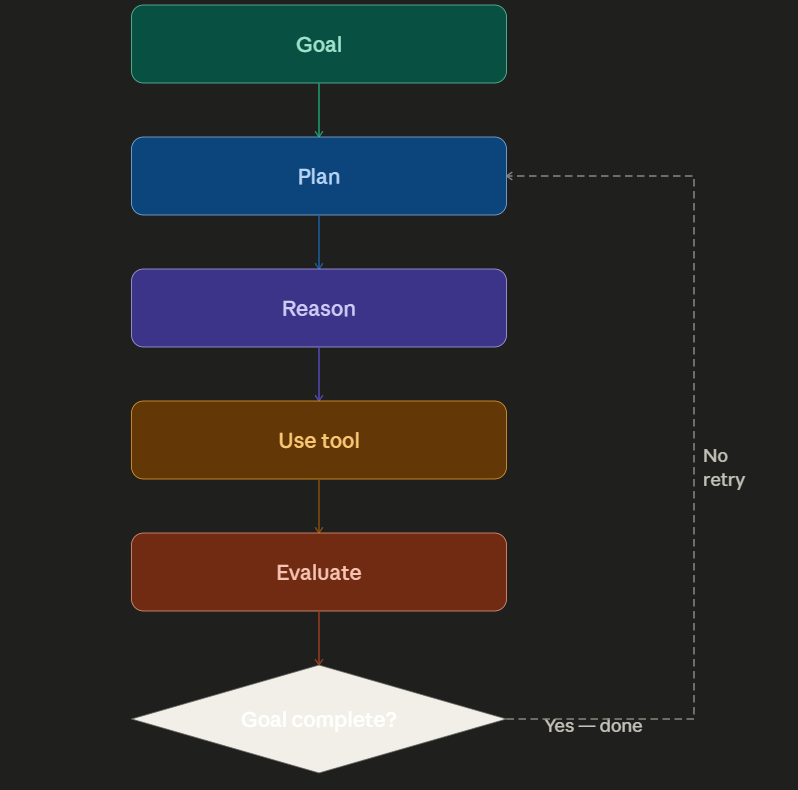
This is not a product feature. It is a fundamental architectural shift in how AI systems work. The underlying mechanism is called an agentic loop, and understanding it is now one of the most important things anyone building, buying, or governing enterprise AI needs to understand.
From Prompt to Purpose: The Architectural Shift
The classic large language model interaction follows a structure so simple it barely needs a diagram:
User Prompt > Language Model > Single Response > Done
This architecture is useful for many things. It is genuinely impressive at generating text, summarizing documents, answering questions, and explaining concepts. But it has a hard ceiling: it can only do what fits in one response, and it cannot take actions in the world.
Agentic systems break that ceiling. Instead of producing a single response and stopping, an agent continuously asks itself: what should happen next?
Goal Received
     |
     v
Plan Next Action
     |
     v
Execute Action (tool call, database query, code execution, API call)
     |
     v
Evaluate Result
     |
     v
Goal Complete? --> Yes --> Return Final Output
     |
     No
     v
Plan Next Action (loop repeats)
The model becomes one component inside a larger intelligent system, not the whole system itself. This distinction is what separates a chatbot from an agent, and it is what makes agentic AI so significantly more capable and so significantly more complex to govern.
What Is an Agentic Loop, Precisely?
An agentic loop is the repeated planning-execution-evaluation cycle that allows an AI system to pursue a goal across multiple steps without requiring human intervention at each step.
Each iteration of the loop contains:
1. Goal Interpretation
The agent receives an objective and breaks it into what needs to happen first. ReAct prompting, chain-of-thought reasoning, and tree-of-thought frameworks are common techniques for this planning step.
2. Action Selection
The agent decides what action will move it closer to the goal. Options include generating text, calling a tool, querying a database, executing code, searching documents, or asking a clarifying question.
3. Tool Execution
The agent invokes the selected action. This is where tool calling and Model Context Protocol (MCP) integrations become essential. The agent is no longer just predicting tokens. It is interacting with real systems.
4. Result Evaluation
The agent assesses whether the action produced useful output, whether an error occurred, and whether the original goal has been achieved.
5. Loop or Terminate
If the goal is not yet achieved, the loop repeats from step 2 with updated context. If the goal is achieved or a termination condition is met, the agent returns its final output.
The key insight: an agent running five iterations of this loop has effectively performed five coordinated steps of work that a traditional model would need five separate prompts to accomplish, and would still do less effectively because it lacks the ability to act on intermediate results.
The Six Core Components Every Agentic System Needs
Understanding agentic loops requires understanding the building blocks that make them work. Most serious implementations combine all six.
1. Reasoning Engine
The foundation is a capable large language model. Models with strong instruction-following and reasoning capabilities are essential because the agent must decompose ambiguous goals into concrete action sequences. Top choices for local agentic deployments include Qwen 3 14B, Llama 3.3 70B, Mistral Large, and Gemma 3 12B.
2. Planning System
The agent needs a structured approach to breaking complex goals into steps. Approaches range from simple chain-of-thought prompting to sophisticated multi-agent planning systems like those in AutoGen and CrewAI. LangChain’s agent executor and LlamaIndex’s agent framework are widely used implementations.
3. Memory System
Agents need to remember what they have already done within a task (short-term memory) and potentially what they have learned across tasks (long-term memory). Implementations range from simple context window management to vector database storage using Chroma, Qdrant, Weaviate, or Milvus for semantic retrieval across large knowledge bases.
4. Tool Use and Integrations
This is the component that lets agents act in the world rather than just describe actions. Tool calling allows models to invoke external functions with structured parameters. The Model Context Protocol (MCP) by Anthropic has emerged as the industry standard for defining these integrations, enabling agents to connect to databases, APIs, file systems, web browsers, and enterprise systems in a standardized, governed way.
5. Reflection and Self-Correction
Sophisticated agents review their own outputs before presenting them. Reflexion, Self-RAG, and Constitutional AI approaches allow models to catch errors, identify gaps in reasoning, and correct course before a human sees the output. This is what separates reliable enterprise agents from demos that work only under ideal conditions.
6. Orchestration Layer
Something must coordinate all of the above: manage the loop, route tool calls, handle errors, enforce access controls, log interactions, and ensure the agent stays within defined boundaries. This orchestration layer is where most production agentic deployments either succeed or fail, and it is the component that inference runtimes like Ollama and vLLM do not provide.
Real Enterprise Applications Running Agentic Loops Today
Agentic AI is not a future concept. Organizations are running production agentic workflows right now across every major industry.
Software Engineering
GitHub Copilot Workspace runs agentic loops to plan, implement, and test code changes across repositories. OpenDevin and SWE-agent handle complete software engineering tasks autonomously. Aider manages git-aware coding loops locally.
Cybersecurity Operations
SOC analysts use agentic workflows to investigate alerts: the agent queries SIEM data, checks VirusTotal, correlates MITRE ATT&CK techniques, and produces incident summaries without manual tool switching between each step.
Legal and Compliance
Document review agents at firms using Harvey AI and CoCounsel run agentic loops across contract databases, flagging clauses against policy libraries, cross-referencing regulations, and producing structured risk summaries.
Financial Analysis
Agents at financial institutions connect to market data via Bloomberg API, query internal portfolio databases, run Python analysis via code interpreter, and generate regulatory reports under DORA and MiFID II requirements.
Enterprise Knowledge Management
Internal AI assistants run RAG loops over document repositories using LlamaIndex or LangChain, retrieving, synthesizing, and verifying information across multiple internal sources before responding.
The Frameworks Powering Agentic Loops
The open-source ecosystem for building agentic systems has matured rapidly. Key frameworks include:
LangChain: The most widely used agentic framework. Provides agent executors, tool integrations, memory modules, and LangSmith for tracing and observability.
LlamaIndex: Focused on data-connected agents with strong RAG and document retrieval capabilities. Powers many enterprise knowledge management agents.
AutoGen: Microsoft Research’s framework for multi-agent conversations where specialized agents collaborate on complex tasks.
CrewAI: Role-based multi-agent orchestration where different agents take on defined responsibilities within a shared workflow.
Semantic Kernel: Microsoft’s enterprise-focused SDK for integrating LLMs into existing applications with .NET and Python support.
DSPy: Stanford NLP’s framework for programmatic LLM pipelines that optimize prompts automatically.
Flowise and LangFlow: Visual, no-code workflow builders for teams that want to build agentic pipelines without writing framework code.
The Governance Problem Nobody Talks About Enough
Here is where most agentic AI discussions go wrong: they focus entirely on capability and almost entirely ignore governance.
An agentic loop running autonomously can:
- Access and modify internal databases
- Send emails or messages on behalf of employees
- Execute code with real system effects
- Call external APIs that trigger real-world actions
- Process sensitive documents without human review at each step
Every one of these actions needs to be authorized, logged, and auditable. The EU AI Act Article 14 requires meaningful human oversight for high-risk AI applications. NIS2 requires security documentation. GDPR Article 5 requires data processing accountability.
A standard inference runtime running a capable model with tool integrations satisfies none of these requirements. The governance layer must be built separately, which is why most enterprise agentic deployments that started with Ollama plus LangChain have discovered they need much more infrastructure than they anticipated.
Read our guide on the hidden governance gap in local AI for a full breakdown of what enterprise agentic deployments actually require.
The Role of MCP in Modern Agentic Systems
The Model Context Protocol (MCP) by Anthropic has become the de facto standard for how agentic systems connect to external tools and data sources. Understanding MCP is essential for anyone building or evaluating enterprise agentic systems.
Before MCP, every tool integration was custom. A LangChain agent calling a database used a different integration pattern than one calling an API, which used a different pattern than one reading files. Maintaining these integrations was complex and fragmented.
MCP standardizes this. Every MCP server exposes tools through a uniform interface. An agent using MCP can connect to PostgreSQL, Slack, GitHub, Apache Druid, Google Drive, and hundreds of other systems through the same protocol, with consistent tool discovery, parameter validation, and error handling.
The MCP ecosystem has grown rapidly, with community servers covering databases, file systems, web browsers, communication tools, and enterprise platforms. Claude Desktop, Continue.dev, and Ypipe all support MCP as a first-class integration mechanism.
Ypipe: Built for Production Agentic Loops
Ypipe by iunera is a Java-native local AI client and MCP orchestration engine designed specifically for the challenges that production agentic deployments introduce.
Where most agentic frameworks focus on capability, Ypipe focuses on the operational and governance layer that makes agentic AI safe to deploy in enterprise environments.
The Agentic Gearbox
Ypipe’s Agentic Gearbox routes different steps in an agentic loop to appropriately sized models. A lightweight Falcon H1 model handles intent classification and tool routing. A mid-size Qwen 3 14B handles analysis tasks. A larger Qwen 3 32B handles final synthesis and complex reasoning. This is the Intelligence Switchboard approach: match compute to the specific step in the loop, not the entire loop.
See our breakdown of how Falcon H1’s tiny tool-calling model fits into multi-model agentic workflows.
Governed MCP Integrations
The Couplings dashboard provides structured management of every MCP integration. Agents access only explicitly authorized tools. Database connections, file system access, and API integrations are all governed, versioned, and auditable. There are no ungoverned agent-to-system connections.
Complete Audit Trail
Every step of every agentic loop is logged. Which model handled which step. Which tool was called with which parameters. What the result was. At what time. Under which configuration. This is the audit infrastructure that EU AI Act, NIS2, and ISO 27001 compliance requires and that most agentic frameworks provide no mechanism for.
Zero Data Exfiltration
Every agentic loop runs entirely on organizational hardware. Prompts, intermediate reasoning steps, tool results, and final outputs never leave the machine. For agentic workflows processing sensitive business data, this is not optional.
Java-Native Stability
No Python dependency conflicts breaking production agentic workflows. Ypipe fits into existing enterprise DevOps and CI/CD pipelines the way every other Java enterprise system does.
Start instantly with JBang:
jbang ypipe@iunera/ypipe
For the full picture on enterprise agentic AI governance, read our guide on why local AI does not automatically make you EU AI Act compliant.
The Engineering Challenges You Need to Plan For
Building reliable production agentic systems requires solving problems that capability demos rarely encounter.
Hallucination in Multi-Step Loops
Errors compound. A small hallucination in step two of a ten-step loop can make every subsequent step confidently wrong. Reflection mechanisms, tool-based verification, and human checkpoints at defined stages are necessary mitigations. LangSmith and Weights and Biases provide tracing and observability to catch these failures.
Tool Reliability and Error Handling
External tools fail. APIs return unexpected responses. Databases have connection issues. A production agentic system needs explicit error handling, retry logic, and fallback behaviors at every tool call, not just at the top level.
Permission Management
Agents operating under the permissions of the user who launched them can accidentally (or maliciously, via prompt injection) perform actions beyond their intended scope. Principle of least privilege applied to tool access is essential. MCP‘s tool-level authorization model is designed for exactly this.
Memory Consistency
Long-running agents accumulate context that can become contradictory. Managing what an agent remembers and forgets, and ensuring memory does not introduce incorrect assumptions into later loop iterations, is a non-trivial engineering problem. MemGPT, Zep, and LangMem address different aspects of this challenge.
Latency in Multi-Step Workflows
An agentic loop with ten steps and four tool calls can take seconds to minutes. For interactive applications this requires careful UX design: streaming intermediate results, progress indicators, and clear communication about what the agent is doing. LangChain’s streaming and LlamaIndex’s event system provide hooks for this.
Human Oversight Integration
Production enterprise agents need clear escalation paths: conditions under which the agent pauses and asks a human before proceeding. LangGraph’s interrupt mechanism and AutoGen’s human-in-the-loop patterns are common approaches. Under EU AI Act Article 14, these oversight mechanisms are not optional for high-risk applications.
The Future of Agentic AI: What Comes Next
Agentic loops are already the dominant architecture for serious AI applications. The trajectory points toward several developments that will define the next two years:
Multi-Agent Systems at Scale
Rather than a single agent with many tools, systems of specialized agents will collaborate on complex objectives. AutoGen, CrewAI, and CAMEL are early implementations of this architecture. Orchestrating multiple agents reliably and safely is an unsolved governance challenge.
Persistent Agents With Long-Term Memory
Agents that maintain context across sessions, remember user preferences, and build organizational knowledge over time. MemGPT and projects building on vector databases are exploring this space.
Physical World Integration
Agents connected to IoT sensors, robotics systems, and physical infrastructure. Boston Dynamics and Figure AI represent early examples of this direction.
Standardization of Agentic Protocols
MCP has already standardized tool integration. Agent-to-agent communication protocols are an active research area. As the ecosystem matures, standardization will enable interoperability between agents built on different frameworks.
Conclusion: The Model Is the Engine, Not the Car
Modern AI is not a chatbot that got smarter.
It is an orchestration architecture where a language model serves as the reasoning engine inside a system that can plan, act, remember, reflect, and improve. The agentic loop is the mechanism that makes this work, and understanding it is foundational to building, buying, or governing AI systems in 2026.
The organizations that understand agentic architecture, and invest in the orchestration and governance infrastructure it requires, will build AI systems that compound in capability over time. Those that treat AI as a chat interface with a smart autocomplete engine will find themselves perpetually surprised by both the capabilities and the failures of the systems they deploy.
Agentic loops are not the future of AI. They are the present. And governing them properly is the challenge that will define enterprise AI success for the next decade.
Frequently Asked Questions
What is an agentic loop in AI?
An agentic loop is the repeated planning-execution-evaluation cycle that allows an AI agent to pursue a multi-step goal autonomously. Instead of producing a single response and stopping, the agent continuously decides what action to take next, executes it, evaluates the result, and loops until the objective is achieved. Frameworks like LangChain, LlamaIndex, and AutoGen implement this pattern.
What is the difference between an AI chatbot and an AI agent?
A chatbot produces a single response to a single prompt. An agent can take multiple actions across multiple steps to achieve a goal, using tools, querying databases, executing code, and verifying results along the way. The ReAct framework is the foundational architecture for most modern agents.
What is the Model Context Protocol (MCP) and why does it matter for agents?
MCP by Anthropic is an open standard for connecting AI agents to external tools and data sources. It standardizes how agents discover available tools, call them with structured parameters, and handle results. Ypipe uses MCP as its primary integration mechanism for connecting local agents to enterprise databases and systems.
What are the main risks of deploying agentic AI in enterprise environments?
The primary risks are hallucination compounding across loop iterations, prompt injection attacks that redirect agent behavior, ungoverned tool access enabling unintended actions, lack of audit trails for compliance, and insufficient human oversight for high-stakes decisions. The EU AI Act Article 14 requires documented human oversight mechanisms for high-risk AI applications.
Which local models work best for agentic workflows?
Models with strong instruction-following and structured output capability are essential. Top local choices include Qwen 3 14B for balanced performance, Llama 3.3 70B for maximum local capability, and Qwen Agent variants specifically fine-tuned for tool calling. Small models like Falcon H1 can handle routing and classification steps efficiently. Read our guide on top 10 Qwen uncensored models in 2026 for detailed model selection guidance.
How does Ypipe support agentic workflows?
Ypipe provides the orchestration and governance layer for production agentic deployments: role-based model routing across model sizes via the Agentic Gearbox, governed MCP integrations to enterprise systems, complete audit logging of every loop step for compliance, and zero data exfiltration through fully local execution. It is Java-native, requires no Python dependency management, and supports Kubernetes for enterprise scale.
Enterprise agentic AI with governance built in: Ypipe | Developed by iunera