
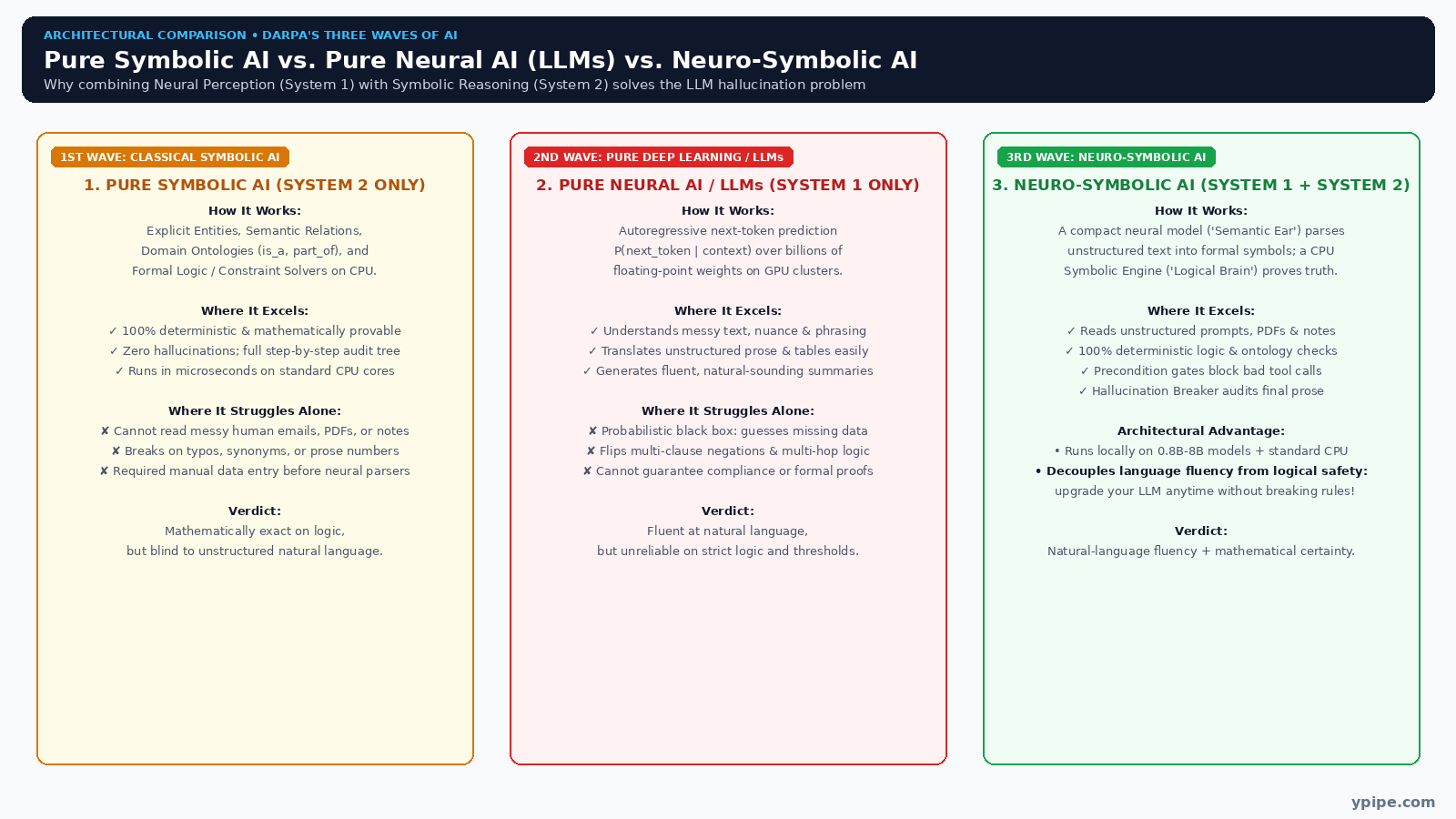
Pure Neural AI (such as standalone Large Language Models) learns statistical patterns to read and write unstructured human text fluently, but guesses logic and math via word probabilities. Classical Symbolic AI executes exact logical deduction over structured ontologies and relations, but breaks on free-form text. Neuro-Symbolic AI combines both: neural models translate messy language into formal concepts, and symbolic engines verify relations and logic.
1. The Cognitive Analogy: System 1 (Fast Intuition) vs. System 2 (Deliberate Logic)
Nobel laureate Daniel Kahneman (see Thinking, Fast and Slow ) explained that human thought operates through two complementary modes:
- System 1 (Fast, Intuitive, Associative): Instantly recognizes faces, reads the tone of a sentence, and completes familiar phrases by association—but jumps to conclusions on math or complex logic problems.
- System 2 (Slow, Deliberate, Logical): Carefully checks facts, follows step-by-step logical relations, verifies constraints, and calculates exact numbers.
As AI researchers Garcez & Lamb (2020) and Henry Kautz (2020) showed, the three major paradigms of artificial intelligence map directly to System 1 and System 2:
| Feature | Classical Symbolic AI (System 2 Only) | Pure Neural AI / Normal LLMs (System 1 Only) | Neuro-Symbolic AI (System 1 + System 2) |
|---|---|---|---|
| How Knowledge Is Stored | Explicit symbols, semantic relations, and hierarchical ontologies | Billions of continuous numerical weights learned from text corpora | Structured ontologies and symbolic state paired with neural language weights |
| Reading Messy Human Text | Poor: Crashes on typos, informal synonyms, or unstructured notes | Excellent: Understands free-form emails, PDFs, and conversational nuances | Excellent: Uses a neural model to translate natural language into symbols |
| Multi-Step Logic & Relations | Exact: Deterministic, mathematically provable deduction | Fragile: Can flip negations, miss exceptions, or guess missing parameters | Exact: Evaluates relations, hierarchies, and thresholds deterministically |
| Arithmetic & Inequalities | Exact: Computed by deterministic operators | Approximate: Predicted via token probabilities (drifts on complex numbers) | Exact: Delegated to the symbolic solver |
| Explainability & Audit Trail | Full logical proof tree | Black-box attention weights; post-hoc rationalizations | End-to-end verifiable proof trace from extracted text to final verdict |
| Hardware Footprint | Runs in milliseconds on standard CPUs | Often requires massive GPU VRAM for giant weights and long contexts | Compact local model on GPU/NPU + fast symbolic solver on CPU |
2. Side-by-Side Walkthrough: All 3 Approaches on the Same Task
To see the practical difference, imagine a healthcare application reading an unstructured physician’s note:
“The patient’s renal filtration rate dropped to twenty-five.”
The system must determine whether a medication that requires eGFR >= 30 is safe to prescribe:
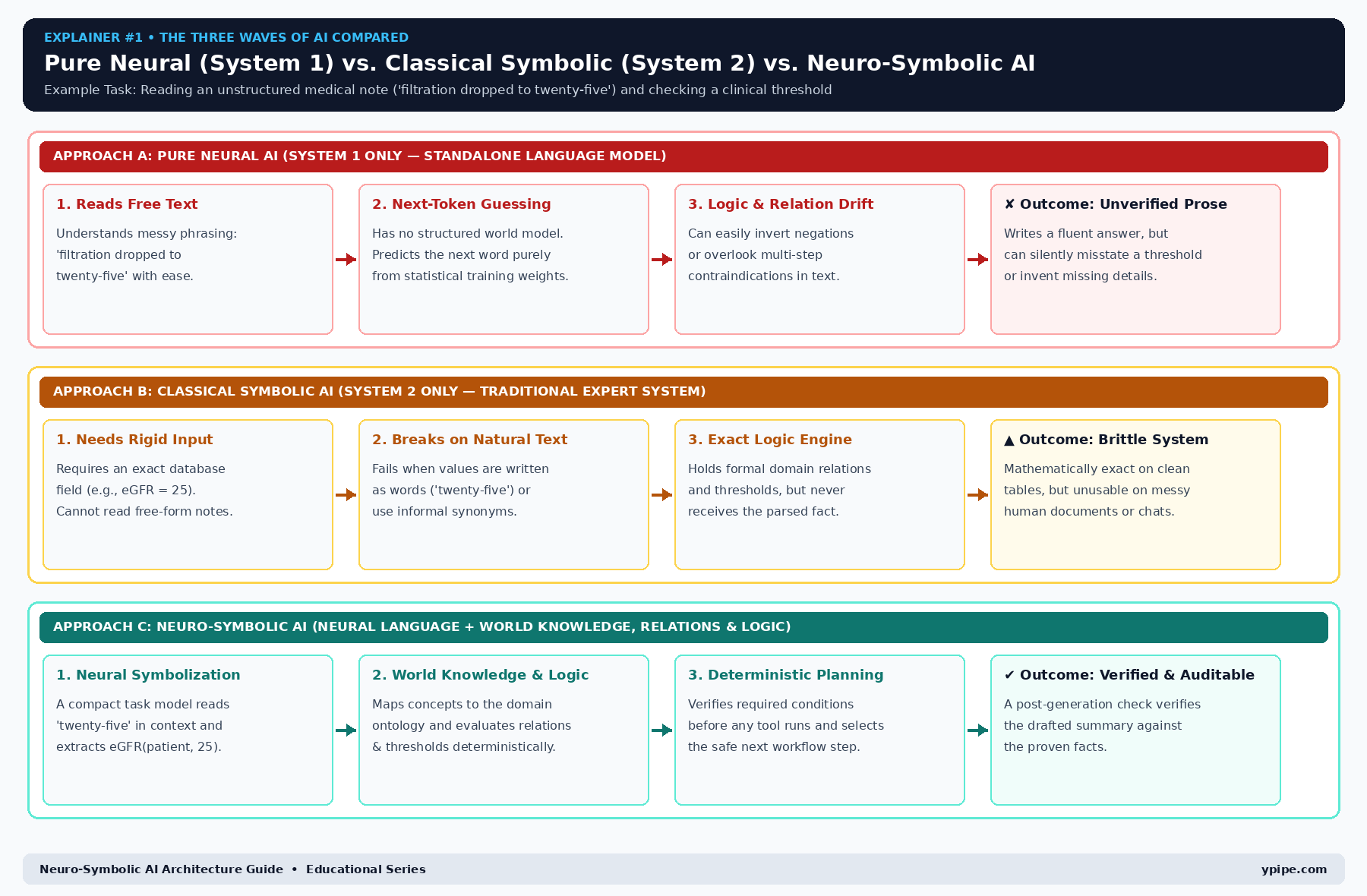
- Approach A — Pure Neural AI (A Normal LLM Alone): The LLM easily understands that “renal filtration rate dropped to twenty-five” means kidney function is 25. However, when asked to evaluate a complex 40-page clinical protocol with multiple inclusion/exclusion clauses and draft a recommendation, the LLM relies on next-token prediction. As Stanford HAI’s empirical studies demonstrate, standalone LLMs regularly invert negations (“contraindicated unless…”) or write summaries where the prose contradicts the numeric threshold.
- Approach B — Classical Symbolic AI Alone: The symbolic engine holds the exact medical ontology (
eGFR < 30 -> contraindicated(Metformin)). However, because the physician wrote “renal filtration dropped to twenty-five” in free prose rather than enteringeGFR = 25into a structured database field, the classical system cannot parse the input and fails to run. - Approach C — Neuro-Symbolic AI: Neural Step (System 1): A compact language model reads the prose sentence and extracts the formal relation
eGFR(patient, 25). Symbolic Step (System 2): The symbolic engine maps the medication to the clinical ontology, evaluates25 < 30deterministically on the CPU, blocks the unsafe prescription, and triggers the safe alternative workflow. Verification Step: A post-generation check verifies that the final natural-language explanation accurately states the proven facts.
3. When to Use Each Approach in Practice
- When Pure Neural AI Is Enough: Creative writing, brainstorming marketing copy, casual translation, or summarizing low-risk general text where a factual or logical slip has no operational consequence.
- When Pure Symbolic AI Is Enough: Closed-world systems where 100% of inputs already arrive as clean database rows, XML/JSON schemas, or sensor telemetry (such as an accounting ledger or SQL query optimizer).
- When You Need Neuro-Symbolic AI: Any workflow that starts with unstructured human input (emails, chats, PDFs, clinical notes) OR orchestrates live software tools/APIs, and requires reliable, auditable decisions. You can build this for a single use case by pairing a small local model with deterministic validation code, or across many workflows using a unified neuro-symbolic platform like YPipe.
Architectural Dataflow: How It Works Step-by-Step
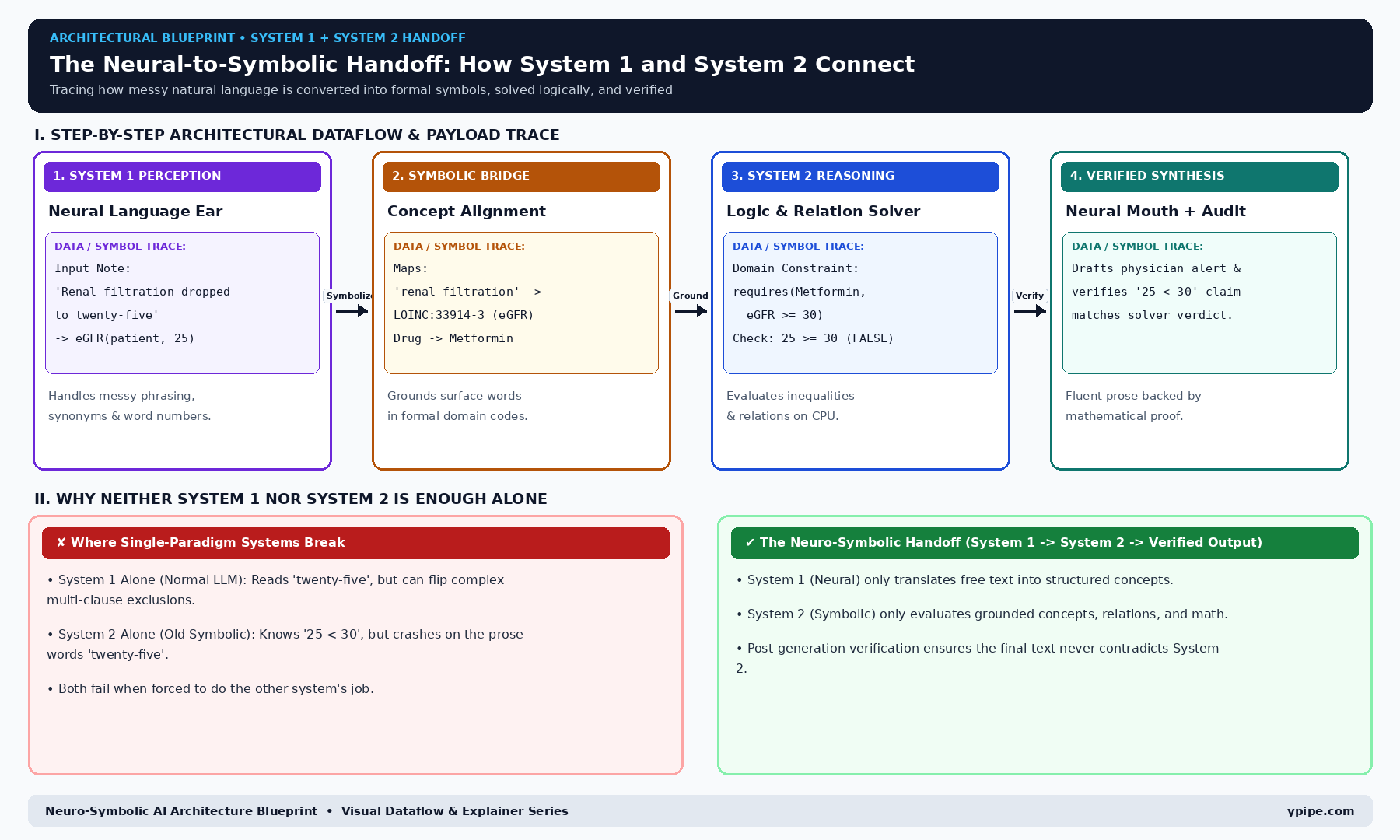
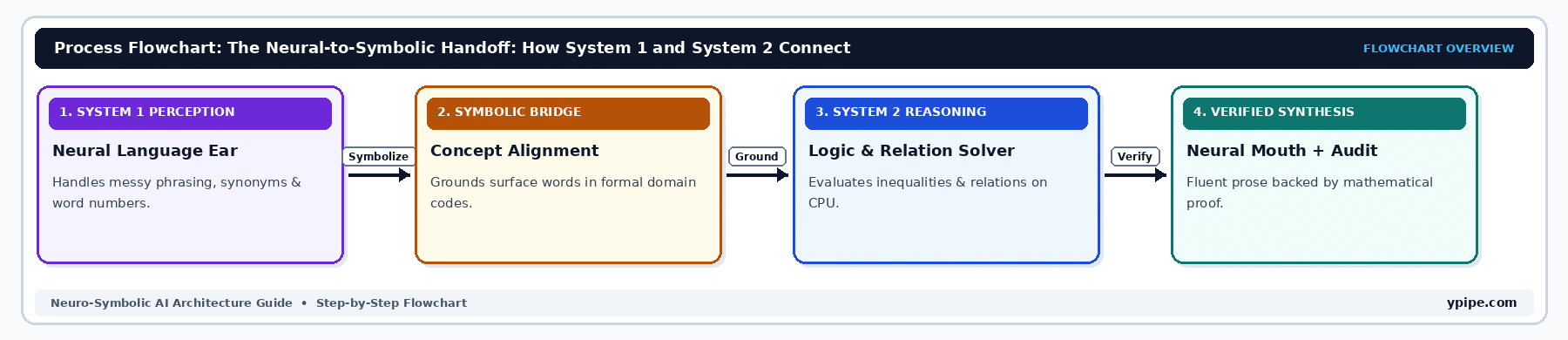
The architectural diagram below traces the exact moment control passes from System 1 (neural perception) to System 2 (symbolic verification):
Concrete Execution Trace (Step-by-Step)
- 1. SYSTEM 1 PERCEPTION (Neural Language Ear):
Input Note: 'Renal filtration dropped to twenty-five' -> eGFR(patient, 25)— Handles messy phrasing, synonyms & word numbers. - 2. SYMBOLIC BRIDGE (Concept Alignment):
Maps: 'renal filtration' -> LOINC:33914-3 (eGFR) Drug -> Metformin— Grounds surface words in formal domain codes. - 3. SYSTEM 2 REASONING (Logic & Relation Solver):
Domain Constraint: requires(Metformin, eGFR >= 30) Check: 25 >= 30 (FALSE)— Evaluates inequalities & relations on CPU. - 4. VERIFIED SYNTHESIS (Neural Mouth + Audit):
Drafts physician alert & verifies '25 < 30' claim matches solver verdict.— Fluent prose backed by mathematical proof.
Side-by-Side Comparison on This Example
- ✘ Where Single-Paradigm Systems Break:
- • System 1 Alone (Normal LLM): Reads ‘twenty-five’, but can flip complex multi-clause exclusions.
- • System 2 Alone (Old Symbolic): Knows
25 < 30, but crashes on the prose words ‘twenty-five’. - • Both fail when forced to do the other system’s job.
- ✔ The Neuro-Symbolic Handoff (System 1 -> System 2 -> Verified Output):
- • System 1 (Neural) only translates free text into structured concepts.
- • System 2 (Symbolic) only evaluates grounded concepts, relations, and math.
- • Post-generation verification ensures the final text never contradicts System 2.
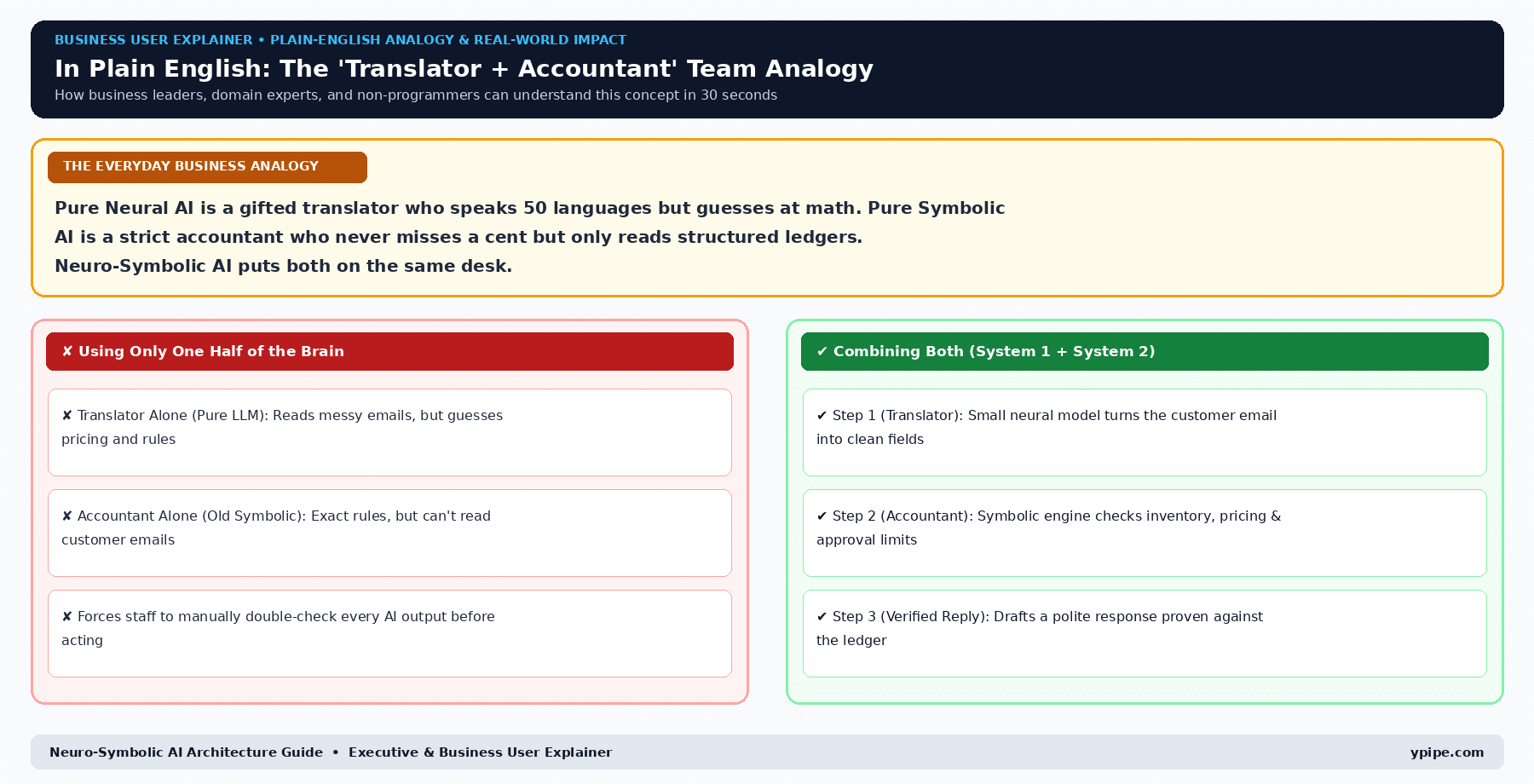
In Plain English for Business Leaders: The ‘Translator + Accountant’ Team Analogy
The 30-Second Analogy: Pure Neural AI is a gifted translator who speaks 50 languages but guesses at math. Pure Symbolic AI is a strict accountant who never misses a cent but only reads structured ledgers. Neuro-Symbolic AI puts both on the same desk.
For real-world benchmarks showing how this System 1 (Neural) + System 2 (Symbolic) partnership allows an 800M local model to execute 7-step chained SQL and clinical pharmacology checks on a standard laptop, read Re:Think Local AI: How an 800M Qwen 3.5 Model + The YPipe Manifold Engine Runs 7-Step Chained Tool Calls on a Laptop and Why Running a Local LLM Does Not Give You an AI System on the iunera Kraken Blog.
4. Key Takeaways
- Normal LLMs Are System 1 (Language & Intuition): Great at reading messy text, unreliable as standalone logic or math engines.
- Symbolic AI Is System 2 (World Knowledge & Logic): Mathematically exact on relations and constraints, but blind to unstructured prose.
- Neuro-Symbolic AI Is the Complete Brain: Neural models translate human language into symbols; symbolic engines prove what is true.
5. Frequently Asked Questions (FAQ)
Q1: If we make normal LLMs bigger (e.g., trillions of parameters), will they eventually stop needing Symbolic AI?
Empirical research shows the opposite. In GSM-Symbolic (2024), Apple Machine Learning Research showed that even frontier LLMs suffer sharp accuracy drops when variable names or numbers are changed or a single irrelevant clause is added—confirming that statistical token prediction does not turn into formal symbolic deduction simply by adding more weights.
Q2: Why do normal LLMs sometimes get basic inequalities or negations wrong?
Because an LLM predicts words based on how frequently phrases co-occur in its training data. If a training corpus frequently contains the reassuring phrase “is safely below the threshold,” the model may output “A score of 75 is safely below the threshold of 60” simply because the sentence structure is statistically probable.
Q3: Does Neuro-Symbolic AI replace the LLM, or work alongside it?
It works alongside it—and actually makes the language model’s job much easier. Instead of forcing the language model to act as a database, calculator, and logic solver, Neuro-Symbolic AI uses the language model strictly for language translation and summarization.
Q4: Can I use a Small Language Model (SLM) instead of a giant LLM in Neuro-Symbolic AI?
Yes! That is one of the biggest practical advantages of Neuro-Symbolic AI. Because the symbolic engine handles the complex domain relations and logic, you only need a small, fast local model to extract entities from text.
Q5: How does Neuro-Symbolic AI handle API and tool calling compared to a normal LLM?
A normal LLM chooses tools and fills in parameters purely from prompt probabilities—often guessing a default value (like quarter="Q1") when the user didn’t specify one. A Neuro-Symbolic system filters tools using a domain ontology and checks mandatory parameter preconditions deterministically before any API is called.
Q6: Which of the three approaches is required for regulatory compliance (like the EU AI Act)?
For high-risk applications in healthcare, finance, HR, and law, regulators require explainability and traceability. Pure LLMs cannot provide a deterministic proof of why a token was chosen, whereas Neuro-Symbolic AI provides an explicit symbolic proof trace for every decision.
Q7: Do I need specialized software to combine Neural and Symbolic AI?
Not for a single use case. You can combine a small local model (for extracting structured JSON/entities) with standard Python code or SQL constraints (for checking relations and logic). Unified platforms like YPipe are designed for teams that want visual neuro-symbolic workflows and ontologies ready to use out of the box.
Q8: When should a business use a normal LLM vs. Neuro-Symbolic AI?
Use a normal standalone LLM for creative brainstorming, drafting marketing copy, or casual summaries where a small factual slip doesn’t matter. Use Neuro-Symbolic AI whenever decisions involve money, health, legal compliance, databases, or live APIs.
Q9: Does Neuro-Symbolic AI cost more to run than a normal LLM?
No—it actually costs up to 90% less to run! Because the symbolic engine handles the heavy logic on a standard CPU, you can use a tiny local language model instead of renting expensive frontier cloud GPUs.
Q10: Why do people call Neuro-Symbolic AI ‘System 1 and System 2’?
Nobel laureate Daniel Kahneman defined System 1 as fast, intuitive association (how neural networks read text) and System 2 as slow, deliberate logical verification (how symbolic engines check relations and constraints).
Further Reading
- Daniel Kahneman (2011): Thinking, Fast and Slow
- Garcez & Lamb (2020): Neurosymbolic AI: The 3rd Wave (
arXiv:2012.05876) - Mirzadeh et al., Apple ML Research (2024): GSM-Symbolic: Understanding the Limitations of Mathematical Reasoning in Large Language Models (
arXiv:2410.05229) - Kambhampati et al. (2024): LLMs Can’t Plan, But Can Help Planning in LLM-Modulo Frameworks (
arXiv:2402.01817) - Stanford HAI (2024): Hallucinating Law: Legal Mistakes with Large Language Models Are Pervasive
- iunera Kraken Blog — Re:Think Local AI: How an 800M Qwen 3.5 Model + The YPipe Manifold Engine Runs 7-Step Chained Tool Calls on a Laptop
- iunera Kraken Blog — Why Running a Local LLM Does Not Give You an AI System
- iunera Kraken Blog — Agentic Loops Explained: Why Modern AI Is No Longer Just a Model