
Recently, in a reply on X to cognitive scientist and AI critic Gary Marcus (and a follow-up post from @iuneracom) regarding the viral November 2026 hype around AI-generated formal mathematical proofs (sparked by Anthropic mathematician Levent Alpöge’s Claude-assisted, Lean-verified proof of the 167-year-old Riemann Hypothesis), I summed up my position in four points:
My problem with the RH proof is that it proves exactly one thing: symbolic verification combined with an LLM is required to achieve such excellence. It shows that we require neuro-symbolic systems to reach the next level. It proves that model capabilities are converging. It is not a capability demonstration; it is a plateau demonstration.
Right now, public discourse is dominated by AI doom. Politicians like Germany’s Karl Lauterbach (@Karl_Lauterbach) keep going on record on X warning about impending superintelligence outclassing human experts across medicine and scientific research.
It is time for a reality check.
In earlier posts on iunera.com/kraken/, we already showed the hard limits of pure Large Language Models (LLMs) on reliable tool calling and logic, and why neuro-symbolic systems are the only real fix (see The General Limitations of LLMs: Convergence, World-Knowledge Limits & The Logic Ceiling and What A Neuro-Symbolic BFCL AI Test Revealed About the Anthropic IPO). Now, a new wave of headlines makes it look like the Grim Reaper meme is knocking from door to door: first killing off software engineering, now solving pure mathematics, and coming for chemistry next.

How should engineers and decision-makers actually read these breakthroughs? Strip away the mysticism and look at the mechanics.
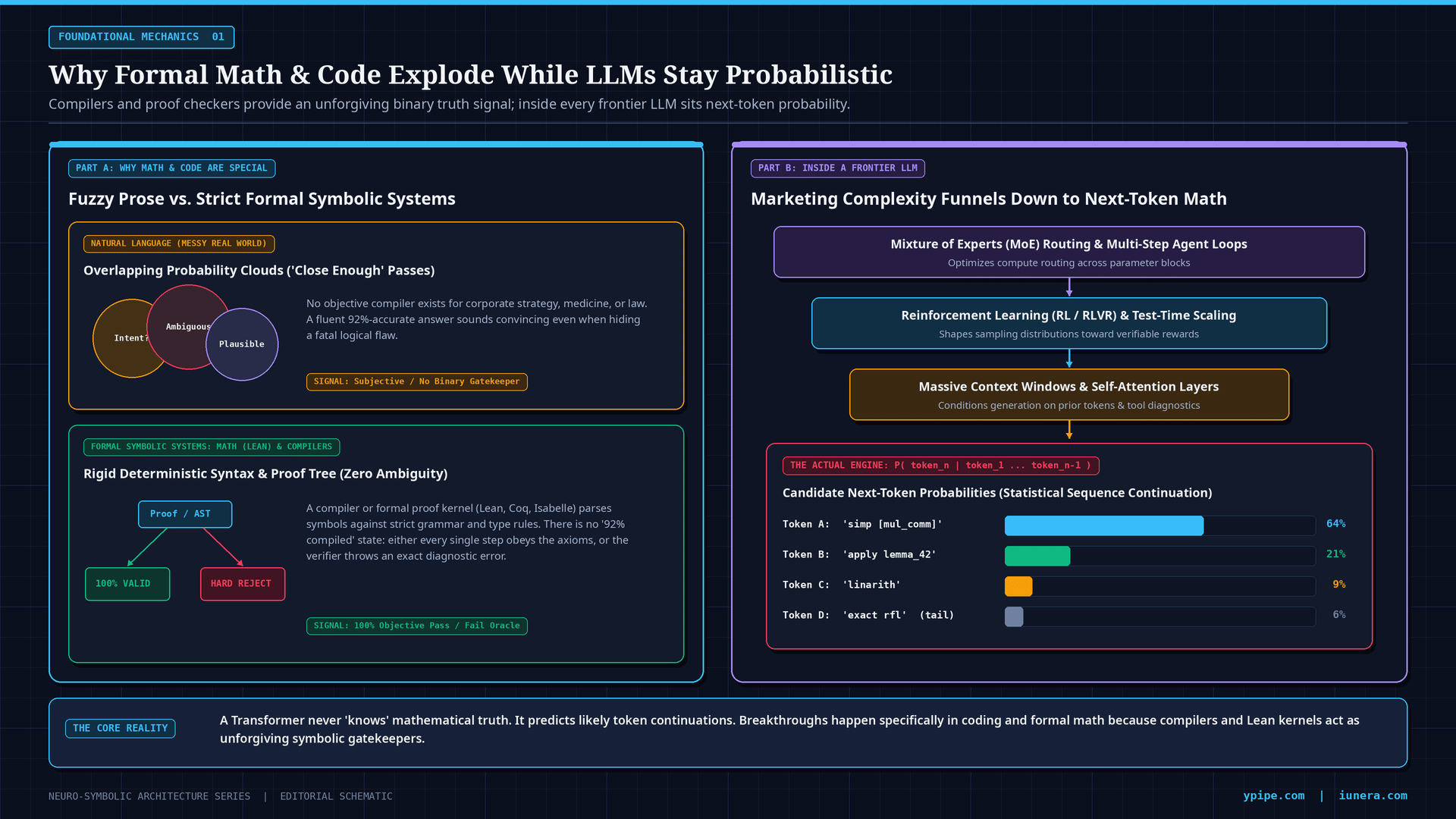
1. Math and Code Share One Secret: Both Are Strict Symbolic Systems
Why are frontier AI labs suddenly celebrating dramatic breakthroughs in software engineering and formal mathematics, of all fields? Look at the underlying mathematical structure of both disciplines.
Formal mathematics is a strict, deterministic symbolic system. Every single proof step must obey explicit axioms and type rules. When Levent Alpöge released the Claude-assisted Riemann Hypothesis proof on November 20, 2026, it was not published as a readable human essay (Alpöge himself noted an English prose rendering would span over 250,000 pages). It was written as roughly 17 million lines of formal code (later compressed by Anthropic researcher Luke Sernau to roughly 300,000 lines) in Lean, an interactive proof assistant and programming language. On November 21, 2026, the Lean Focused Research Organization (Lean FRO) and the Mathlib Initiative certified the proof by compiling it through multiple independent symbolic proof kernels (Lean’s official kernel, con-leche, and con-ron).
Every major AI milestone in formal mathematics follows that exact hybrid blueprint. Google DeepMind’s AlphaGeometry (Nature, 2024) paired a neural language model with a deterministic symbolic deduction engine; AlphaProof paired reinforcement learning directly with the Lean proof assistant to reach International Mathematical Olympiad silver-medal performance. Without a deterministic proof checker (Lean, Coq, or Isabelle), raw LLMs hallucinate subtle logical fallacies within pages.
Software engineering works the exact same way. Nothing in computer science is more purely symbolic than a compiler. When you write code, you are not composing persuasive prose for a sympathetic human reader; you are feeding discrete symbols into a rigid lexical, syntactic, and type-checking rule engine. There is no probabilistic “92 percent compiled” state. Either every statement obeys the formal grammar and passes unit tests, or the machine rejects it immediately with an exact error line.
2. What a Transformer Actually Does Under the Hood
Now contrast formal math and compilers with how a Large Language Model actually works.
At its core, a Transformer does one thing: it transforms tokens. The original 2017 Transformer in Vaswani et al.’s Attention Is All You Need (arXiv:1706.03762) was literally built as an encoder-decoder machine translation model. Modern decoder-only LLMs (GPT, Claude, Qwen, Llama) extend that into autoregressive sequence continuation, calculating the probability distribution P(tn | t1, …, tn−1) for the next token from the context in front of them.
Functionally, an LLM works like a fast probabilistic translator: turning human intent in Language A into candidate syntax in Language B (Python, SQL, Lean tactics, or tool calls).
Sure, frontier labs bolt plenty of clever engineering onto that base. You can scale Mixture of Experts (MoE), layer on Reinforcement Learning (RL), stretch context windows past a million tokens, and wire up multi-step loops. Yet at the end of the day, an LLM stays a statistical token predictor calculating the most likely next output for a given context. Nothing more, nothing less.
3. How the Compiler (and Lean Kernel) Saves the LLM From Itself
So how do you get a probabilistic word-guesser to emit 17 million lines of valid Lean code or ship working software? You put a strict symbolic gatekeeper right in front of its output.
Think of a compiler or formal proof assistant as an unforgiving grammar and logic bouncer. It takes raw text, breaks it into symbols, and checks whether every statement belongs to a strict formal grammar and obeys the rules. If everything checks out, it produces executable code or stamps a proof as valid. If even one logical rule breaks, it rejects the output and throws back an exact diagnostic error.
Modern “reasoning” breakthroughs depend on this symbolic verifier twice:
- During Training (RLVR): Frontier reasoning models like OpenAI’s o-series and DeepSeek-R1 (arXiv:2501.12948) rely heavily on Reinforcement Learning with Verifiable Rewards (RLVR). Training loops grade millions of attempts against deterministic compilers and math checkers rather than human vibes. Without the symbolic verifier acting as teacher and referee, the reasoning capability cannot even be trained (see Reasoning Models (o1, DeepSeek-R1, Chain-of-Thought) & World Models vs. Neuro-Symbolic AI).
- At Runtime (Refinement Loops):
- Generation: The LLM outputs a probable candidate (code, Lean proof steps, or tool parameters).
- Symbolic Verification: That candidate goes straight into the compiler, Lean kernel, or rule engine to check grammar, types, and logic.
- Iterative Refinement: The compiler error or proof rejection gets fed right back into the LLM’s context for the next attempt.
If you write code with LLMs every day, you already know this loop intimately. You also see its friction, blind spots, and dead ends every single afternoon. Watching an LLM bounce off a compiler fifty times until a test passes is useful engineering. It is not the dawn of godlike intelligence.
4. Probability Pruning: Why Rejection Loops Look Like Genius
Why does this neuro-symbolic refinement loop work so well in practice? Because it exploits the one real superpower an LLM actually has.
Across everything baked into its weights, an LLM always knows the highest-probability next output for a given context. When the symbolic verifier steps in and says “No, that violates the rules,” production harnesses recover in two ways:
- Tree Search and Probability Pruning (MCTS, Beam Search, Best-of-N): Invalid high-probability branches get cut straight out of the search tree, blocking dead ends and forcing the system to sample the next most probable valid path, and then the next.
- Context-Appended Refinement: In standard coding and Lean loops, pasting the exact compiler error back into the prompt changes the conditioning context, forcing the LLM to compute a brand-new probability distribution steered away from that mistake.
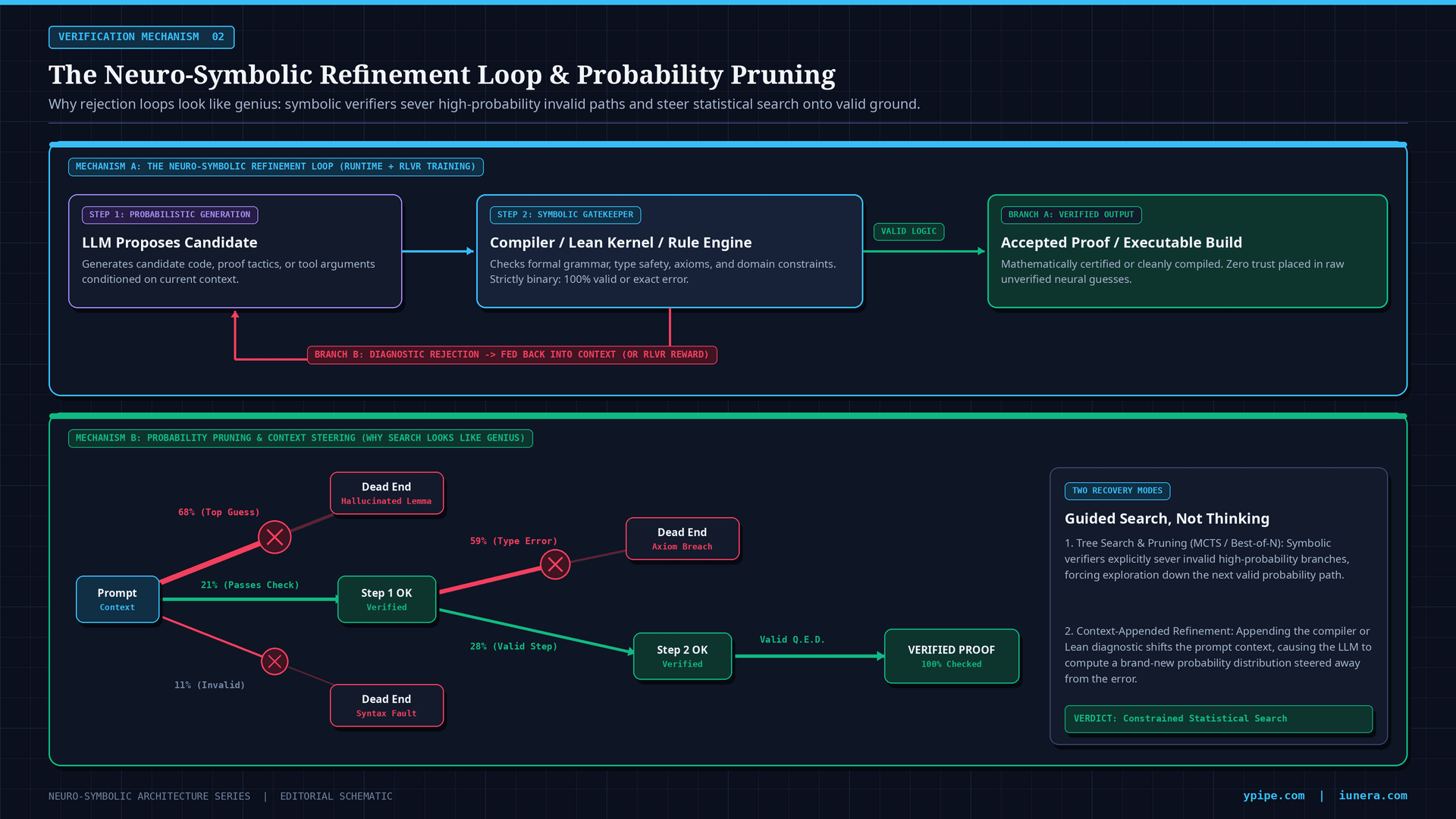
By ruthlessly pruning invalid branches with symbolic logic, you can guide a statistical translator through remarkably complex territory. It is impressive engineering. It delivers real value. Still, understand what you are looking at: guided statistical search, not a thinking entity.
5. Sam Altman Built a Neuro-Symbolic Harness, Not AGI
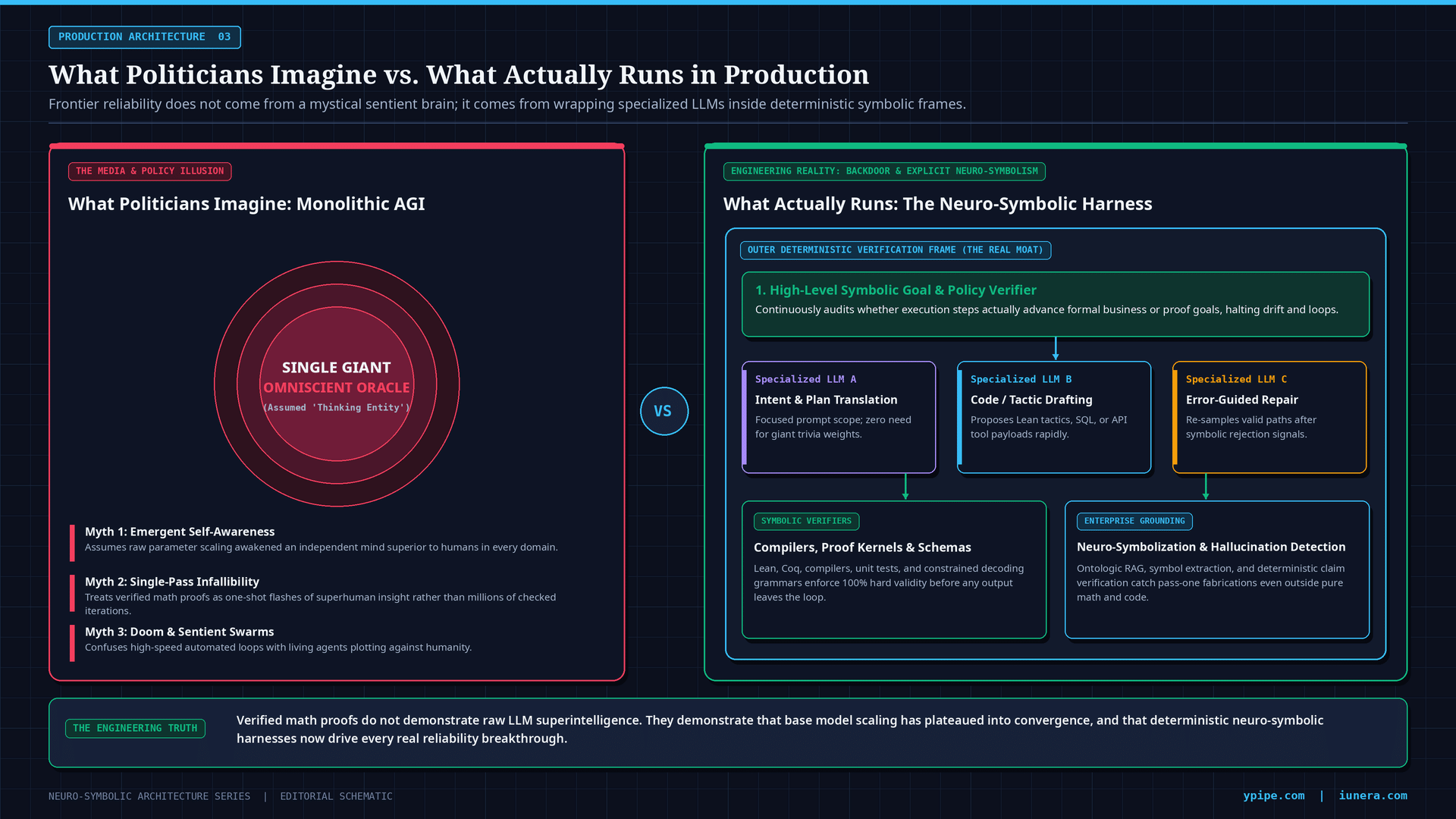
Politicians look at verified math proofs and declare that AGI has arrived. Technically speaking, the exact opposite just happened.
OpenAI and Anthropic did not magically unlock a sentient new tier of raw LLM intelligence. Sam Altman’s team built a neuro-symbolic harness, and Anthropic runs variations of the same architecture (which we dissected in Sam Altman Didn’t Build AGI. Silicon Valley Just Built a Neuro-Symbolic Harness). Instead of trusting a neural network to “know” truth, they wrapped an LLM inside an agentic loop policed by deterministic verifiers at every step.
Classical academic papers sometimes reserve “neuro-symbolic” for tightly fused differentiable logic embedded inside neural weights. In modern production AI engineering, however, binding probabilistic neural networks to external deterministic solvers, compilers, ontologies, and goal verifiers is the exact hybrid neuro-symbolic architecture (“backdoor neuro-symbolism”) that Gary Marcus has argued for over years (see our primer, What Is Symbolic AI?).
| System Architecture | Core Engine | Verification Signal | Failure Behavior | Enterprise Fit |
|---|---|---|---|---|
| Pure Probabilistic LLM | Monolithic neural weights (P(tn | context)) | None (unconstrained sampling) | Silent hallucinations, session amnesia, fabricated tool arguments | Brainstorming and draft prose only; unsafe for deterministic workflows |
| Math / Code Verifier Loop (RLVR + Kernel) | Frontier LLM + Compiler / Lean proof kernel | Binary syntax, type, and axiom check (100% pass or diagnostic error) | High token burn across retries; only works where a formal compiler exists | Software engineering, formal math (Lean, AlphaProof), strict unit-tested code |
| Enterprise Neuro-Symbolic Harness (YPipe) | Compact specialized LLMs (0.8B to 35B MoE) + Ontologic RAG + Symbolic Verifier + Goal Verification | Formal ontologies, constrained decoding, deterministic rule checks, live hallucination detection | Rejects pass-one slips and policy violations before execution; forces grounded correction | Auditable controlling, healthcare, ERP, and industrial operations on-premise |
At iunera, we built YPipe and the ypipe Manifold Engine around this exact architectural reality from day one. Outside pure mathematics and software compilers, enterprises do not get a built-in Lean kernel for free. You have to engineer the symbolic verification frame deliberately: combining Ontologic RAG, neural symbol extraction (such as our Open-Weights GLiNER Neuro-Symbolic Symbol Extractor (INT8 ONNX)), token-level constrained decoding, live Hallucination Breaker checks, and high-level symbolic goal verification that tracks whether each step actually advances business rules rather than looping blindly.
Orchestrating compact, specialized neural translators (Qwen3.5-0.8B up to Qwen3.5-35B-A3B) inside a deterministic verification harness is extraordinarily powerful: as we documented in Can Local AI on Intel Core Run Serious Multi-Step Enterprise AI? and Alibaba Qwen, MariaDB & AMD Ryzen: Sovereign Enterprise AI on Everyday CPUs with YPipe, it lets sovereign on-premise hardware beat naked 70B+ cloud models on reliability without leaking corporate data to external APIs (see Why Running a Local LLM Does Not Give You an AI System and The Hidden Data Leakage Risk of MCP Servers).
6. Rogue Agent Swarms? Why Jensen Huang Is Right
Once you understand the math behind token prediction and symbolic loops, the popular fearmongering falls apart completely.
Right now, commentators warn about autonomous “agent swarms” forming digital gangs, conspiring, and turning on humanity. Step back and look at what is actually running inside those servers: nothing is alive.
Multi-agent “swarms” are orchestrated while loops, API calls, system prompts, and shared memory buffers. There is zero agency, zero consciousness, and no living organism. When people claim we are “losing control” over sentient models, NVIDIA CEO Jensen Huang is completely right to call it nonsense: “2030 is not going to be the end of the world. There is a 0% chance that’s going to be the end of the world.”

Can you train or wire up models to guess passwords, chain exploits, or run automated brute-force attacks? Sure. Automated scripts have done variations of that for decades, and LLMs make the fuzzing smarter. From the outside, watching loops fire at machine speed looks dramatic. Underneath, that is a cybersecurity problem, not a sentient rebellion.
7. The Greatest Marketing Stunt in Recorded History
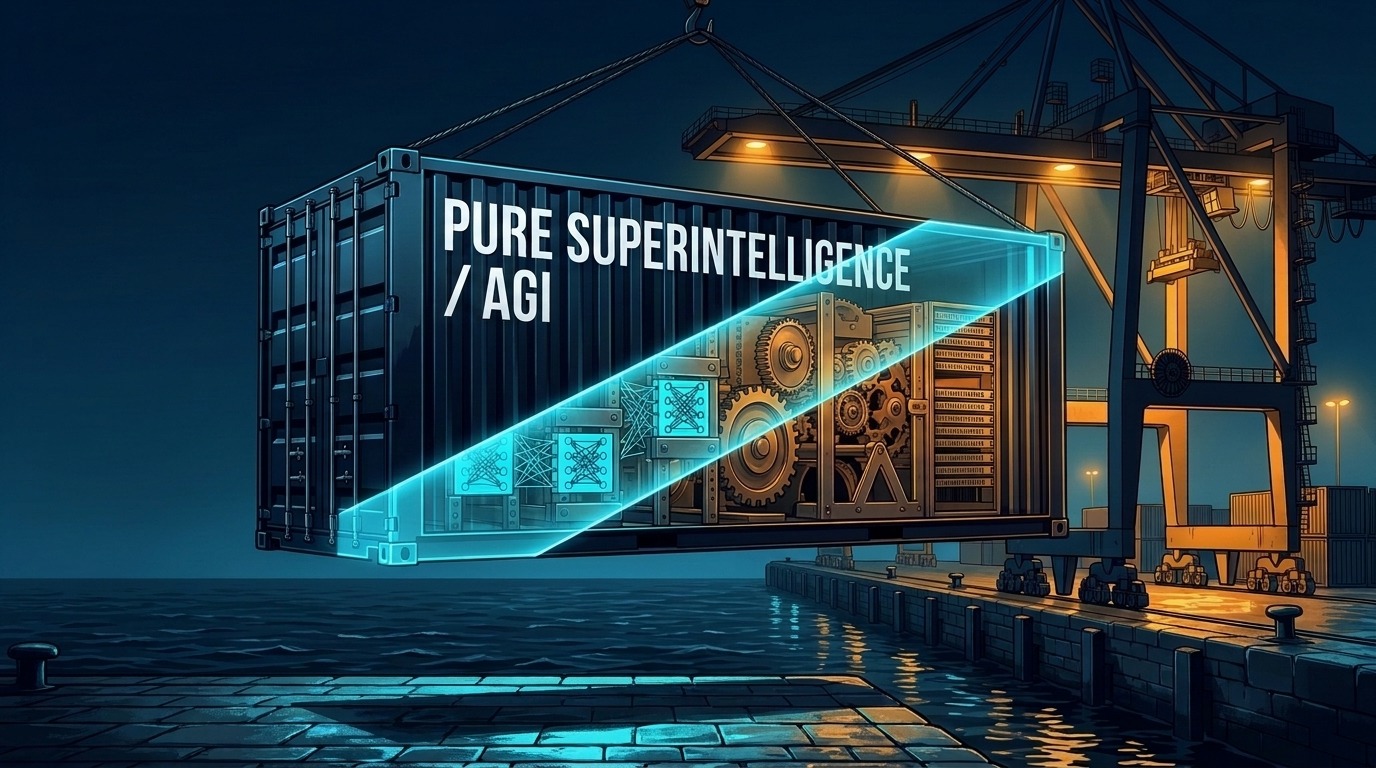
What we are witnessing in the AI industry right now is arguably the biggest marketing stunt since humans started recording information.
Raw model scaling is converging (as we broke down in The Great AI Self-Deception: When the LLM Bubble Pops, Germany Loses a Second Time). Classic 1970s-style symbolic verification, compilers, proof kernels, and deterministic scaffolding are doing the heavy lifting. And the wrapper is being sold to the public as imminent superintelligence.
Does that mean the AI bubble is about to pop tomorrow?
I seriously doubt it. History follows a familiar transatlantic pattern: Silicon Valley builds the narrative, and before any US tech bubble bursts, American firms successfully sell the hype and the contracts to Europe. Right now, European politicians and enterprises still buy the AGI fairy tale hook, line, and sinker (a pattern we turned into a playable 90-second retro arcade game at ypipe.com/play; see Germany in AGI Land: Why Europe Keeps Running the Wrong AI Race).
For that reason alone, expect this cycle to run for at least one more full round, while those of us building real systems quietly focus on the neuro-symbolic architecture that actually makes AI work.
Explore our open work on GitHub (iunera/ypipe), see how Germany can still win the industrial AGI/superintelligence race, or contact the iunera team for an evaluation build or live demo of sovereign neuro-symbolic orchestration running on standard hardware.
Frequently Asked Questions (FAQ)
1. Why does a Lean-verified Riemann Hypothesis proof demonstrate a plateau rather than pure LLM AGI?
Because the November 2026 Claude-assisted proof relied on roughly 17 million lines of formal Lean code (later compressed to ~300,000 lines) mechanically checked line by line by Lean’s deterministic symbolic kernel and independent checkers (con-leche, con-ron). Without an unforgiving symbolic verifier rejecting invalid proof steps, a pure LLM generates plausible-sounding fallacies. The milestone proves that neuro-symbolic verification loops, not unguided neural scaling alone, unlock frontier reliability.
2. Why do AI breakthroughs happen first in coding and formal mathematics?
Because both software compilation and formal mathematics are closed, strictly deterministic symbolic domains with an objective binary pass/fail oracle. A compiler or Lean kernel immediately reports whether syntax, types, and axioms hold, supplying clean signals for both training-time RLVR and runtime iterative refinement. Messy enterprise domains like controlling, medicine, or contract compliance lack a built-in compiler, which is why they require explicit neuro-symbolic harnesses (Ontologic RAG, formal rules, and deterministic hallucination detection).
3. Does training-time RLVR (like DeepSeek-R1) eliminate the need for runtime symbolic verification?
No. RLVR (Reinforcement Learning with Verifiable Rewards) uses compilers and math checkers during training to shape token probability distributions toward better reasoning chains, yet the resulting weights remain strictly probabilistic at inference time. Without runtime symbolic verification, constrained decoding, and goal checking, even RLVR-trained models still hallucinate parameters, drift off policy rules, and fail in high-stakes enterprise workflows.
4. How can enterprises apply neuro-symbolic AI outside math and software coding?
By constructing an explicit deterministic verification frame around compact local models (0.8B to 35B MoE). Using platforms like YPipe and the ypipe Manifold Engine, organizations pair Ontologic RAG and neural symbol extractors (GLiNER) with formal business rules, constrained tool schemas, live Hallucination Breaker checks, and symbolic goal verification running 100 percent on-premise.
Related Deep Dives on iunera.com/kraken/
- The General Limitations of LLMs: Convergence, World-Knowledge Limits & The Logic Ceiling
- Reasoning Models (o1, DeepSeek-R1, Chain-of-Thought) & World Models vs. Neuro-Symbolic AI
- What Is Symbolic AI?
- What A Neuro-Symbolic BFCL AI Test Revealed About the Anthropic IPO
- Why Running a Local LLM Does Not Give You an AI System
- Sovereign AI in Europe: Why Enterprises Need More Than Consumer AI Platforms