
By Dr. Tim Frey, Founder of iunera & Creator of YPipe
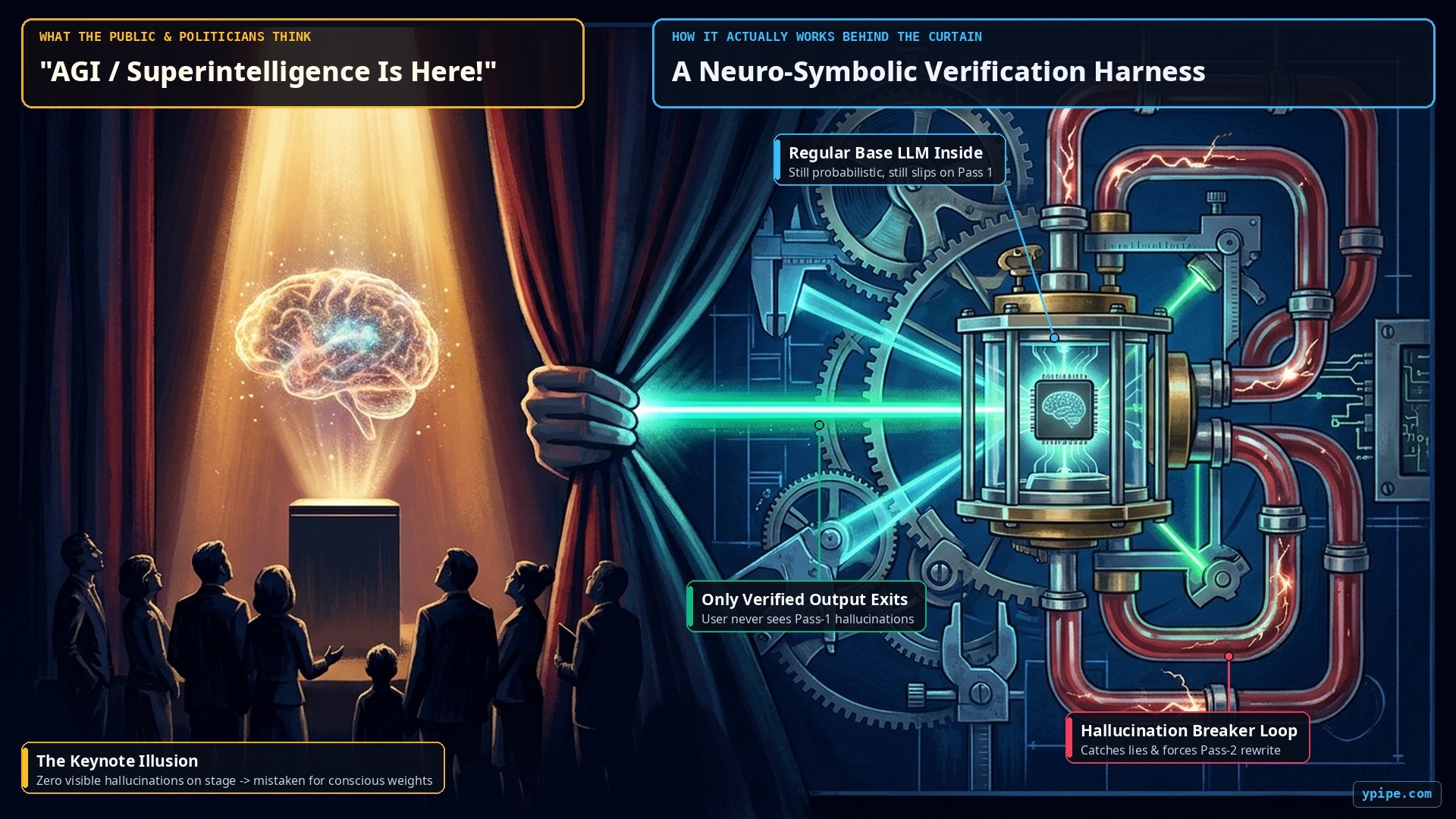
Every few months, someone in Silicon Valley steps up to a microphone and announces that AGI is basically here, or that hallucinations are finally solved. When Sam Altman writes on his blog that OpenAI is confident they know how to build AGI and already aiming at superintelligence, tech media and half of Europe’s parliaments assume the big labs must have discovered some secret breakthrough inside the neural network weights.
If you actually build AI systems every day instead of reading press releases, you hear something very different.
When Sam Altman says “AGI,” he could just as easily have said: “We finished our neuro-symbolic harness.”
That sentence sounds far less dramatic than a sci-fi breakthrough, which is why nobody in Silicon Valley puts it on a keynote slide. You don’t justify a half-trillion-dollar valuation or IPO story by telling investors that your core language model hit diminishing returns and you had to wrap it in deterministic software to keep it from lying. Yet that is what actually happened.
The Quiet Secret Behind Base Model Stagnation
Look closely at what frontier labs are really worried about right now, especially companies like Anthropic facing intense scrutiny over what comes next. Their biggest fear isn’t that a chatbot will suddenly wake up and take over the world. The much more uncomfortable problem is the market realizing that raw base models are only making incremental improvements, hitting the exact mathematical convergence and logic limits we broke down in The General Limitations of LLMs: Convergence, World-Knowledge Limits & The Logic Ceiling. In fact, Anthropic’s own engineering team openly documented why autonomous models lose track across sessions without externalized state files, structured JSON feature trackers, and independent verification loops in Effective Harnesses for Long-Running Agents.
This isn’t a fringe complaint from one local-AI vendor either. Across the research community, some of the sharpest minds in AI have been pointing straight at this exact scaling ceiling for years. Subbarao Kambhampati demonstrated in his LLM-Modulo Frameworks (ICML 2024) work that autoregressive models cannot reliably plan or self-verify without external symbolic critics checking them in a loop. Gary Marcus has argued relentlessly on X that pure scaling hits fundamental reliability walls that only neuro-symbolic architectures solve. François Chollet (creator of Keras and ARC Prize) keeps reminding everyone that scaling memorization is a dead end for AGI without test-time search and program synthesis, and Turing Award laureate Yann LeCun has repeatedly called pure next-token prediction a dead end because text probabilities lack grounded world models. Meanwhile, Kalai and Vempala (ACM STOC 2024) proved mathematically that calibrated pure language models must hallucinate on facts they cannot verify.
We saw this directly in our own benchmarks (What A Neuro-Symbolic BFCL AI Test Revealed About the Anthropic IPO). When we ran 3,829 official tool-calling tests from the UC Berkeley Function Calling Leaderboard (BFCL V4) across 109 models, the ceiling showed up immediately. Scaling a raw transformer from 1 billion to 70 billion parameters cleans up surface syntax. It writes cleaner JSON. Yet on the failure modes that actually break real software, like ignoring irrelevant distractor tools or refusing to guess when a required parameter is missing, huge unharnessed models still fall apart.
On the official BFCL V4 Enterprise Irrelevance suite (875 cases), Llama-3.3-70B failed 59.6% of the time. When a required parameter was missing, it guessed blindly 85.5% of the time. Even frontier cloud giants (Claude Opus 4.5, Claude Sonnet 4.5, GPT-5.2, OpenAI o3) scored lower on open-ended Live Relevance than a tiny 800-million-parameter local model running on a laptop CPU once we wrapped that 800M model in a neuro-symbolic harness.
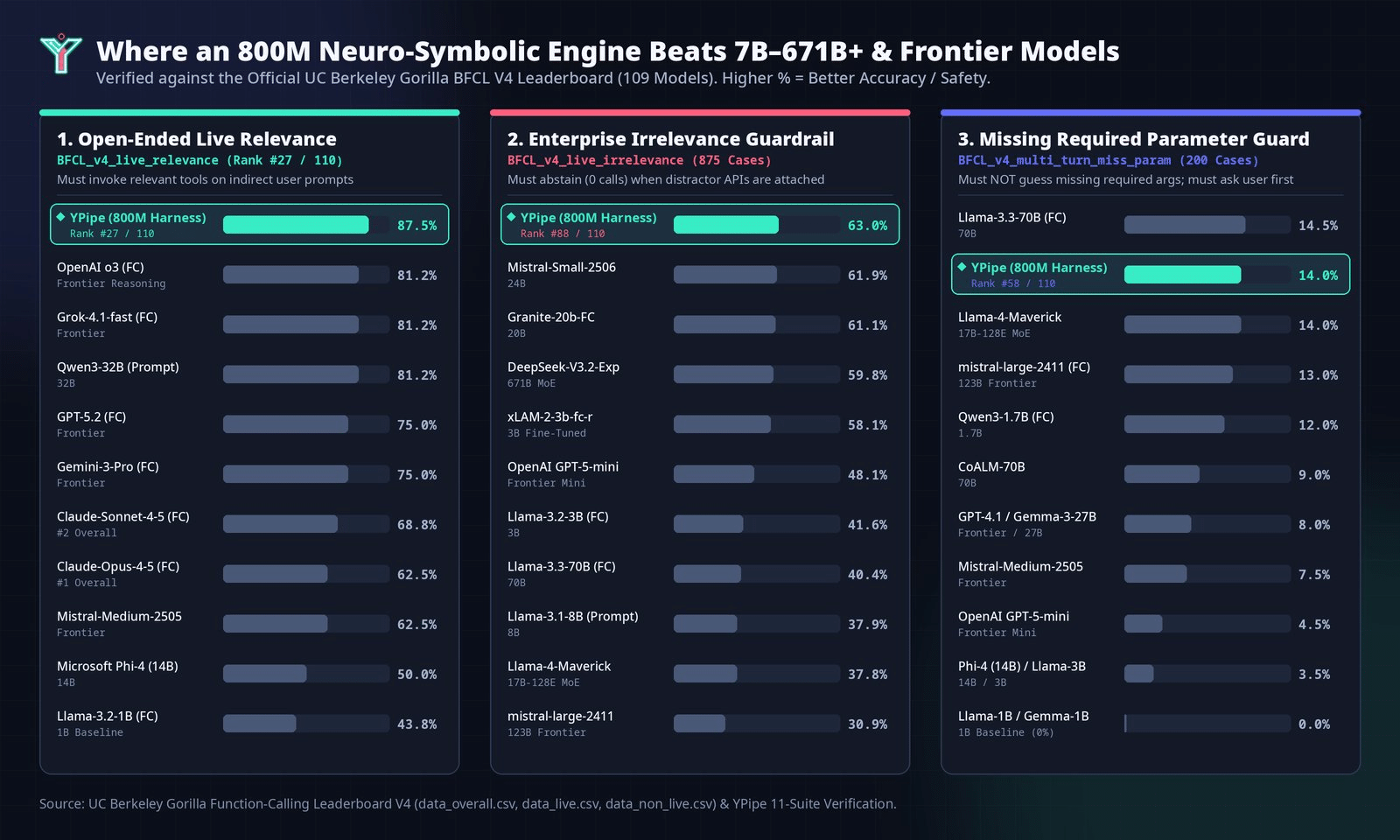
If a tiny 800M CPU model inside a deterministic harness can outperform unharnessed frontier models on core relevance and safety guardrails, then raw parameter scaling is not the untouchable moat Silicon Valley claims it is.
Why Alibaba’s Qwen Models Suddenly Looked “Worse”
This also explains something that caught a lot of developers off guard recently: why Alibaba’s Qwen models, which are genuinely strong open-weight models, suddenly started feeling “worse” in side-by-side comparisons against the big closed US APIs.
Did Alibaba suddenly forget how to train transformers? Of course not.
What people are actually comparing isn’t model versus model. When you download an open-weight Qwen checkpoint and run it raw on your machine, you are talking to a naked probabilistic neural network (as we explained in Why Running a Local LLM Does Not Give You an AI System). When you send a prompt to a closed US frontier API today, you are no longer talking to a naked model. You are talking to a full production pipeline: routers, tool filters, state trackers, verification layers, and data-harvesting loops wrapped tightly around the weights.

Strip the neuro-symbolic harness off the US frontier models and test them head-to-head against raw Qwen weights, and the gap shrinks fast. Put a proper neuro-symbolic harness around a local Qwen model (like we demonstrated in Alibaba Qwen, MariaDB & AMD Ryzen: Sovereign Enterprise AI on Everyday CPUs with YPipe), and it suddenly behaves like a completely different class of machine.
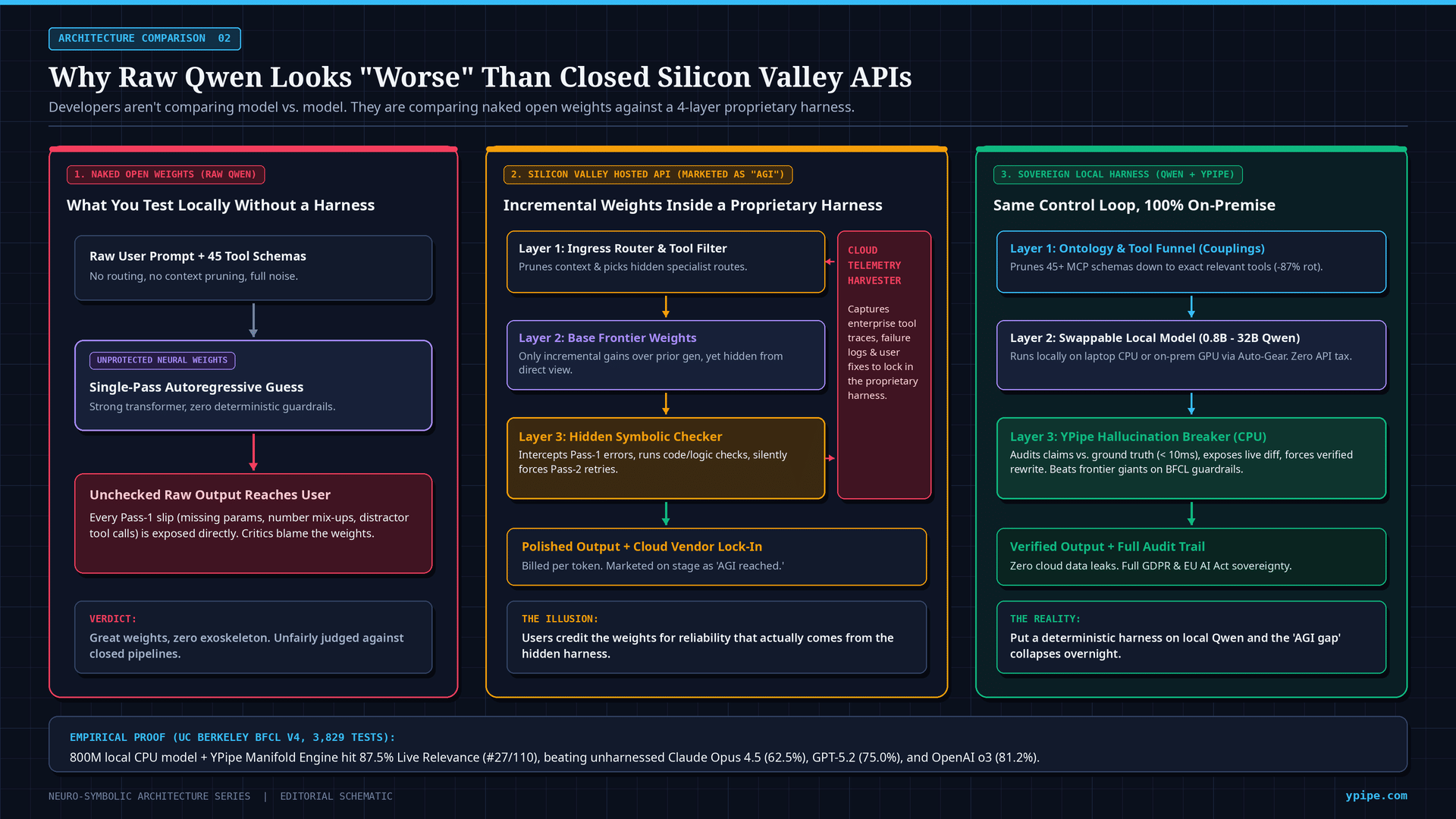
Alibaba didn’t lose some mysterious “neural intelligence” race. People were simply testing naked weights against heavily harnessed pipelines and blaming the weights.
Why Hallucinations Dropped: Speculative Decoding on the Symbolic Level
So how did hallucinations suddenly drop in the big closed products if the underlying transformers still fundamentally predict the next likely token?
The clearest way to understand what Silicon Valley built is speculative decoding, except moved up from the token level to the symbolic level.
In classic speculative decoding (Leviathan, Kalman, & Matias, ICML 2023), a small, fast draft model guesses the next few tokens, and a verifier checks them in parallel, accepting the valid tokens and rejecting the bad ones before the user ever sees them.
Now move that exact same pattern one layer higher, to the level of facts and logic:
- The LLM generates a candidate answer (essentially a fast, fluent guess).
- Before that draft reaches the user, a neuro-symbolic checker intercepts it, breaks the prose back down into concrete claims (numbers, entities, statuses, constraints, using fast extractive perception like our open-weights GLiNER INT8 ONNX symbol extractor), and checks every single one against ground-truth data, tool outputs, and formal rules.
- Whenever a claim contradicts reality or lacks grounding, the checker isolates the exact error and forces the LLM to regenerate with that hard constraint attached.
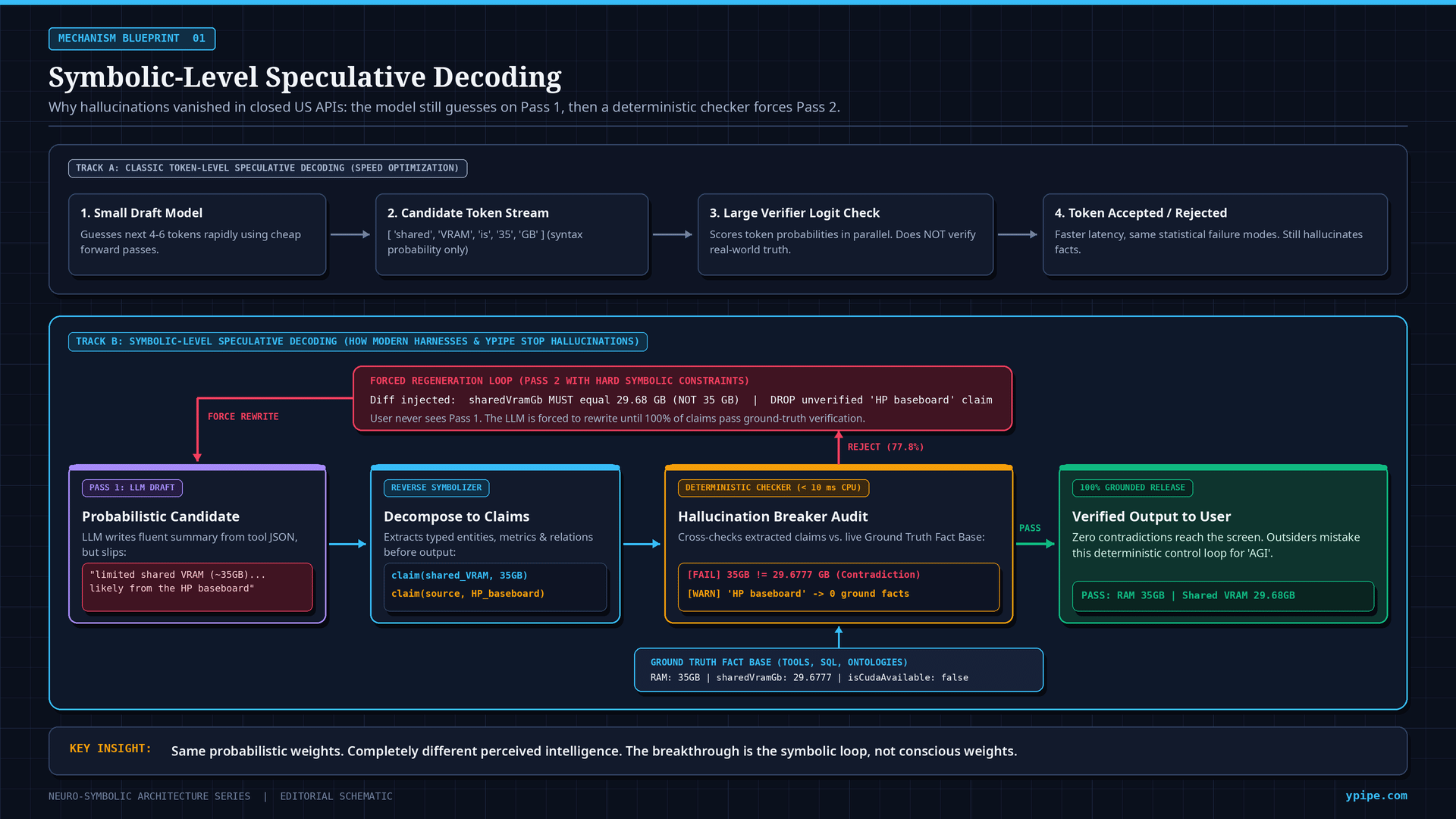
From the outside, the user sees a clean answer with almost no hallucinations and thinks, “Wow, the model got so smart, this must be AGI.”
From the inside, the model never stopped hallucinating. It hallucinated on pass one, got caught by a deterministic symbolic verifier, and rewrote its answer on pass two.
Seeing It Live: Our Own Hallucination Breaker Catching an LLM Red-Handed
This isn’t armchair theory. We built this exact mechanism into the ypipe Manifold Engine (we call it the Hallucination Breaker), and we watch it catch language models red-handed every single day.
Here is a real, unedited output from YPipe running locally on a standard Linux laptop (AMD Ryzen 5 PRO 7540U):
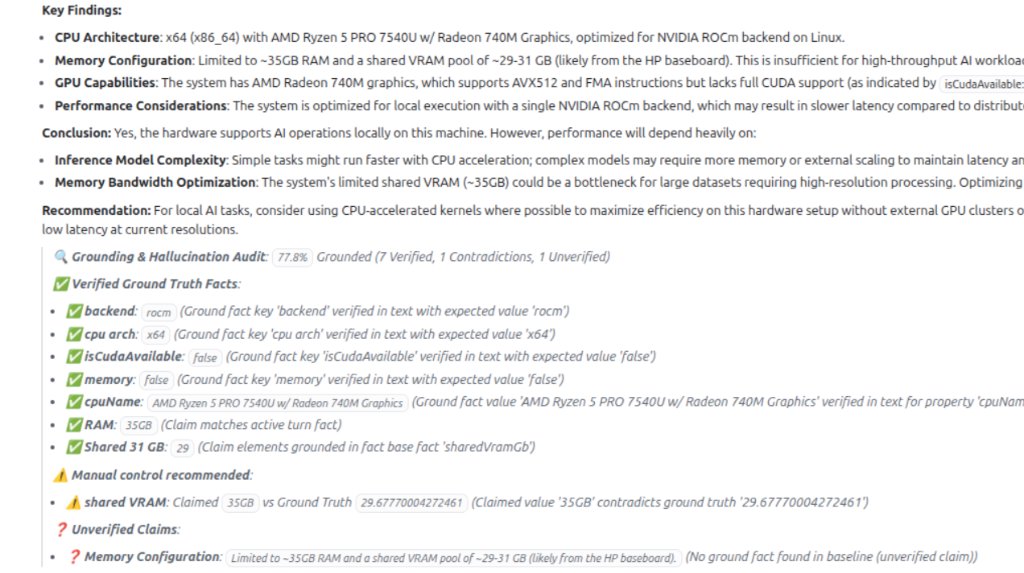
Look closely at what happened in that screenshot, because it is the exact kind of subtle mistake that slips past human readers all the time:
The local hardware tool returned exact ground truth: backend: rocm, cpuName: AMD Ryzen 5 PRO 7540U w/ Radeon 740M Graphics, isCudaAvailable: false, RAM: 35GB, and sharedVramGb: 29.6777….
The LLM read those exact numbers and wrote a confident, well-formatted hardware summary (it even wrote “optimized for NVIDIA ROCm” on an AMD Radeon chip in the very first bullet, which tells you everything you need to know about raw LLM confidence). Halfway down, under Memory Bandwidth Optimization, it quietly blurred two numbers together and wrote “The system’s limited shared VRAM (~35GB)…”, confusing total RAM (35GB) with shared VRAM (29.68GB). On top of that, it casually invented “(likely from the HP baseboard)”, a claim that existed nowhere in the baseline facts.
Right underneath, YPipe’s Grounding & Hallucination Audit checked every extracted claim against the ground-truth fact base and immediately surfaced the exact errors:
- Overall audit: 77.8% Grounded (7 Verified, 1 Contradictions, 1 Unverified)
- Contradiction caught: shared VRAM: Claimed 35GB vs Ground Truth 29.67770004272461
- Unverified claim caught: likely from the HP baseboard (No ground fact found in baseline)
When the harness feeds that exact diff back into the loop, it forces the LLM to drop the invented baseboard guess and correct 35GB to 29.68GB before anyone acts on it.
Notice what we did not need to catch that error. We didn’t need a 2-trillion-parameter cloud datacenter. We didn’t wait for “AGI.” A deterministic neuro-symbolic checker caught a probabilistic slip in milliseconds on a regular laptop CPU and forced the model back onto the rails. That is literally the entire trick. It is pure neuro-symbolic AI.
Pipelines, Data Harvesting, and Why They Call It “AGI”
There is a second reason Silicon Valley rushed to wrap every model in hosted harnesses and pipelines.
A hosted neuro-symbolic harness doesn’t just mask base-model stagnation. It operates as a massive data-harvesting loop. Whenever companies wire their internal databases, codebases, and operational workflows into cloud agents (a sovereignty trap we broke down in The Hidden Data Leakage Risk of MCP Servers), the harness records every failure mode, every broken tool call, every retry, and every human correction. That operational telemetry feeds straight back into hardening their proprietary pipelines and deepening customer lock-in.
Put yourself in the shoes of a lab CEO raising tens of billions or preparing for an IPO. Which headline gets you the valuation multiple?
“Our base transformers plateaued, so we built deterministic verification harnesses and data pipelines around them, which is classic neuro-symbolic software engineering.”
Or:
“We have reached AGI.”
The second line moves markets, dominates news cycles, and convinces competitors and governments that the game is already over.
A Direct Takeaway for Politicians and Policymakers
This is the part that genuinely worries me, because it stopped being harmless Silicon Valley marketing a long time ago. It is now actively steering research and industrial policy in Germany and Europe in the wrong direction.
Look at what happened when prominent policymakers like Karl Lauterbach (Chair of the Bundestag Research Committee, @Karl_Lauterbach on X) flew to the United States and China, sat down with engineers at labs like OpenAI and Anthropic, and came back sounding the alarm in a widely discussed November 2026 Der Spiegel interview:
“In den beiden führenden KI-Nationen sieht man uns als Zaungast und Kunden. Bestenfalls sind wir noch als Ingenieursnation interessant, wegen unserer Industriedaten und derer des Mittelstands. Da würden alle gern herankommen.”
(Translation: “In the two leading AI nations, we are seen as onlookers and customers. At best, we are still interesting as an engineering nation because of our industrial data and that of the Mittelstand. Everyone would love to get their hands on that.”)
Read that second sentence twice. The labs themselves are telling German politicians out loud what they actually want: Europe’s industrial and Mittelstand data. Why? Because scraping the public web already hit diminishing returns, and feeding real operational enterprise data into their proprietary harnesses is the real business model. Yet when policymakers walk out of a demo room in San Francisco after watching a heavily harnessed pipeline produce clean, hallucination-free answers on cue, it feels like mythical superintelligence and convinces them the race is already over. Nobody in that room is going to pull back the curtain and show you the symbolic checker catching pass-one errors and forcing silent retries behind the scenes.
So here is the plain-English reality every policymaker in Berlin and Brussels should keep on their desk before signing the next AI strategy or funding bill:
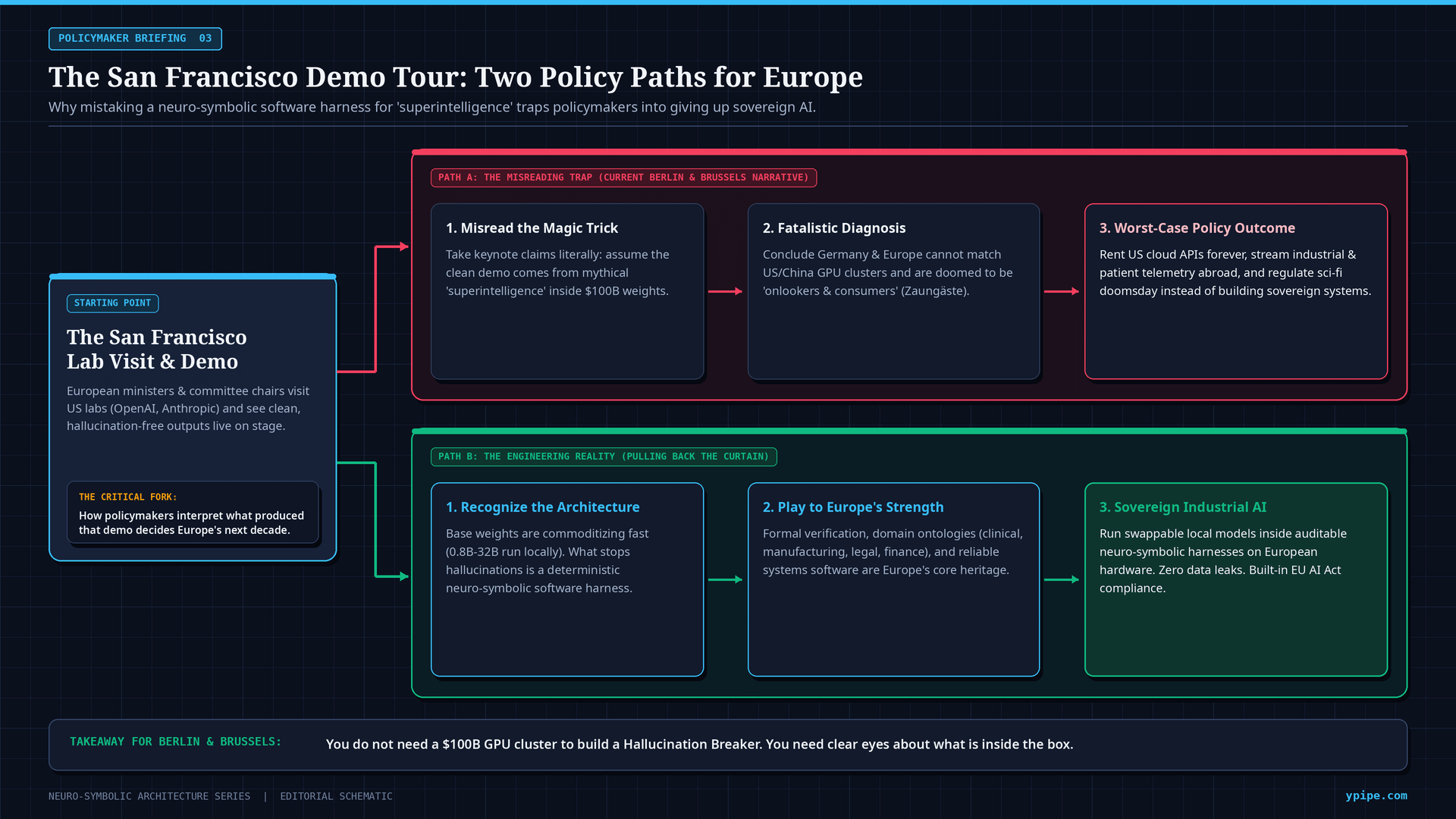
First, you are not looking at mythical superintelligence. What looks like “AGI” in those executive demos is a commoditizing statistical language model wrapped inside a neuro-symbolic software harness (verification loops, domain rules, ontologies, and deterministic guardrails).
Second, Europe has not lost the layer that actually decides industrial value. The US and China poured tens of billions into pre-training giant base models, and that layer is already commoditizing rapidly. Open-weight 0.8B to 32B models already handle language parsing locally on standard hardware. What turns a commodity model into reliable, hallucination-free enterprise AI is the neuro-symbolic harness and the formal domain knowledge around it: clinical guidelines, manufacturing tolerances, legal rules, and financial compliance.
Third, mistaking harness engineering for sci-fi superintelligence leads to the worst possible policy choices. It pushes European decision-makers either to resign themselves to renting US cloud APIs forever (streaming European industrial and patient data abroad in the process) or to spend years debating hypothetical sci-fi doomsday scenarios while neglecting sovereign local neuro-symbolic infrastructure (as we also argued in Sovereign AI in Europe: Why Enterprises Need More Than Consumer AI Platforms).
Systems engineering, formal verification, domain ontologies, and industrial reliability are not weaknesses in Europe. They are the exact strengths Europe’s engineering economy has been built on for decades. You do not need a $100 billion GPU cluster to build a Hallucination Breaker or a sovereign neuro-symbolic harness. You just need to see clearly what is actually inside the box.
Where This Leaves Us
Hallucinations didn’t disappear because neural networks suddenly learned what truth is. They are being suppressed because the industry finally rediscovered what computer science has known for a long time: statistical intuition needs a deterministic logic layer keeping it honest.
Call it “AGI” on stage if it helps close a funding round. Under the hood, it is neuro-symbolic AI, with a language model proposing candidates and a symbolic verifier checking and correcting them in a loop.
And you do not have to rent that architecture from a cloud monopoly or send private company data overseas to use it. You can hack together a brittle 50-line regex script for one toy case and watch it break on the second real-world edge case. Turning that pattern into a generalized, domain-agnostic verification engine across messy enterprise prose, numeric units, ontologies, and live tool outputs is where the real engineering lives. That is exactly why we built YPipe (by iunera), bringing visual SmartPipes, declarative KnowledgePipes, and the ypipe Manifold Engine directly onto your own hardware.
If you are an engineer, journalist, or policymaker who wants to see the Hallucination Breaker catch and correct a local model live, without smoke, mirrors, or a cloud API, reach out via ypipe.com or iunera.com/contact and I will walk you through it on a regular laptop.
Quick Answers (FAQ)
Did large language models actually stop hallucinating?
No. Autoregressive base models still predict probable next tokens and still slip on numbers, missing parameters, and unverified details. What changed in closed frontier products is that a neuro-symbolic harness intercepts pass-one drafts, verifies claims against ground-truth tools and rules, and forces a silent rewrite before the user sees the mistake.
What is symbolic-level speculative decoding?
Classic speculative decoding speeds up inference by having a draft model propose tokens and a verifier check token probabilities. Symbolic-level speculative decoding moves that check one layer higher: the LLM drafts an answer, a deterministic symbolic verifier audits the extracted facts and logic against ground truth (like YPipe’s Hallucination Breaker), and rejected claims force the model to regenerate under hard constraints.
Why do Alibaba’s Qwen models feel worse than US cloud APIs in casual tests?
Because most people compare raw, unharnessed open-weight Qwen checkpoints running locally against heavily harnessed US cloud pipelines wrapped in tool routers, state trackers, and retry verifiers. Once you wrap a local Qwen model inside a neuro-symbolic harness, that perceived gap collapses.
What does Silicon Valley actually mean when it announces “AGI” today?
In practical engineering terms, it mostly means the lab finished wrapping incrementally improving base weights inside reliable neuro-symbolic harnesses, tool pipelines, and telemetry-driven verification loops. Calling it AGI raises valuations and intimidates competitors, but underneath it is deterministic systems engineering that enterprises and European builders can run sovereignly on their own hardware.
Latest Related Engineering Deep Dives on iunera.com/kraken/
- Open-Weights GLiNER Neuro-Symbolic Symbol Extractor (INT8 ONNX): 22 ms CPU/NPU Schema.org & Clinical Extraction
- The General Limitations of LLMs: Convergence, World-Knowledge Limits & The Logic Ceiling
- Reasoning Models (o1, DeepSeek-R1, Chain-of-Thought) & World Models vs. Neuro-Symbolic AI
- What A Neuro-Symbolic BFCL AI Test Revealed About the Anthropic IPO
- Alibaba Qwen, MariaDB & AMD Ryzen: Sovereign Enterprise AI on Everyday CPUs with YPipe
- Re:Think Local AI: 800M Qwen 3.5 & YPipe Manifold Engine on a Business Laptop
- Why Running a Local LLM Does Not Give You an AI System
- The Hidden Data Leakage Risk of MCP Servers
- Sovereign AI in Europe: Why Enterprises Need More Than Consumer AI Platforms
- Agentic Loops Explained: Why Modern AI Is No Longer Just a Model