
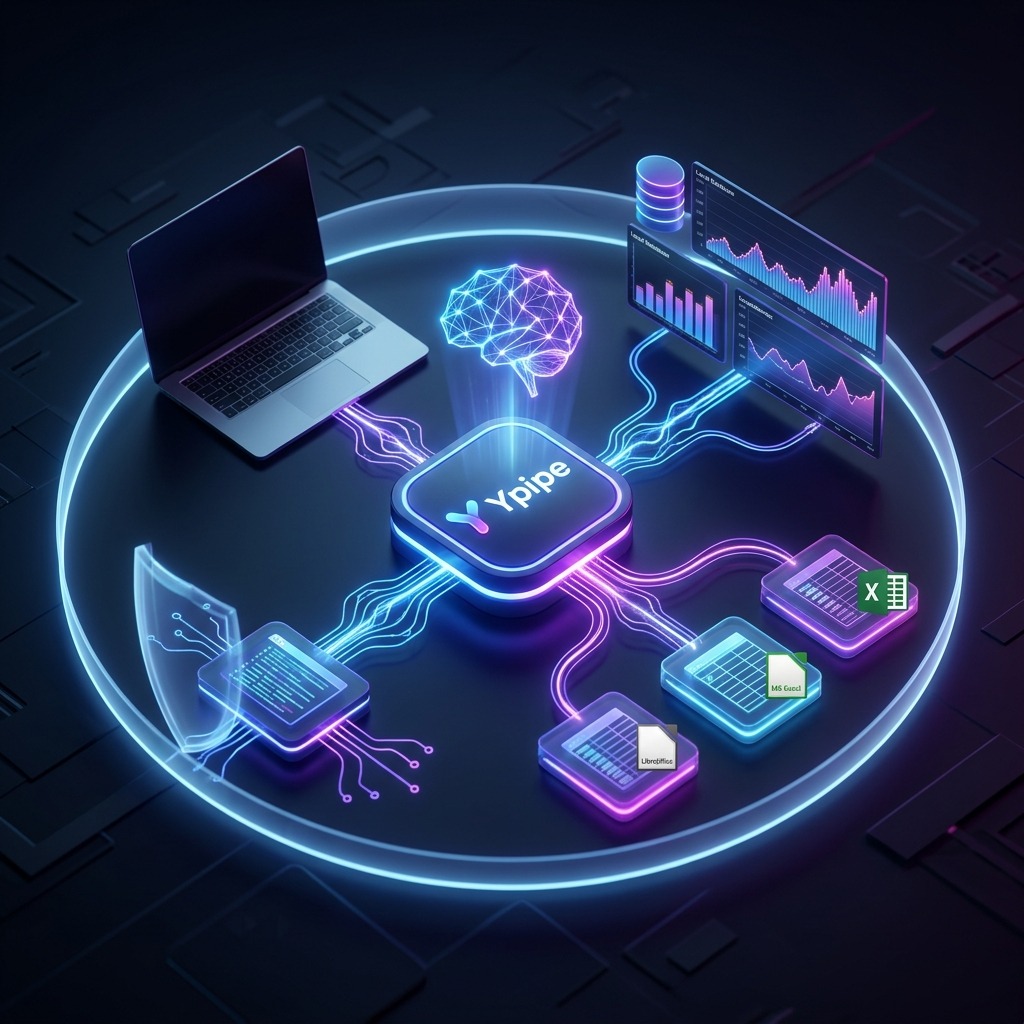
What Happens When Your Database Talks to a Cloud LLM?
Most conversations about the Model Context Protocol (MCP) focus on what it lets AI assistants do. Very few ask a more important question: what actually happens to your data once an MCP server returns a tool result to a cloud AI model?
During testing of an Apache Druid MCP server, we saw firsthand something every enterprise architect should understand before rolling out MCP powered AI workflows in production.
Table of Contents
- How MCP Actually Works
- A Real Example: Querying Apache Druid
- Why This Matters for Enterprise Data
- The Tool Description Problem
- Context Pollution: When More Tools Means Worse Answers
- The Enterprise Privacy Challenge
- How Ypipe Addresses the Problem
- Data Sovereignty Is Becoming a Competitive Advantage
- Conclusion
- Frequently Asked Questions
- Related Articles
How MCP Actually Works
Most people picture MCP working like this:
User
  ↓
AI Assistant
  ↓
Database
  ↓
Answer
The reality looks quite different:
User
  ↓
LLM
  ↓
MCP Client
  ↓
MCP Server
  ↓
Database
  ↓
MCP Server
  ↓
LLM
  ↓
Final Response
The critical detail hiding in that second diagram: the database result is never returned directly to the user. It goes back to the language model first. The model has to see the raw result before it can turn it into a natural language answer, which means every query result becomes part of the conversation the model is having.
A Real Example: Querying Apache Druid
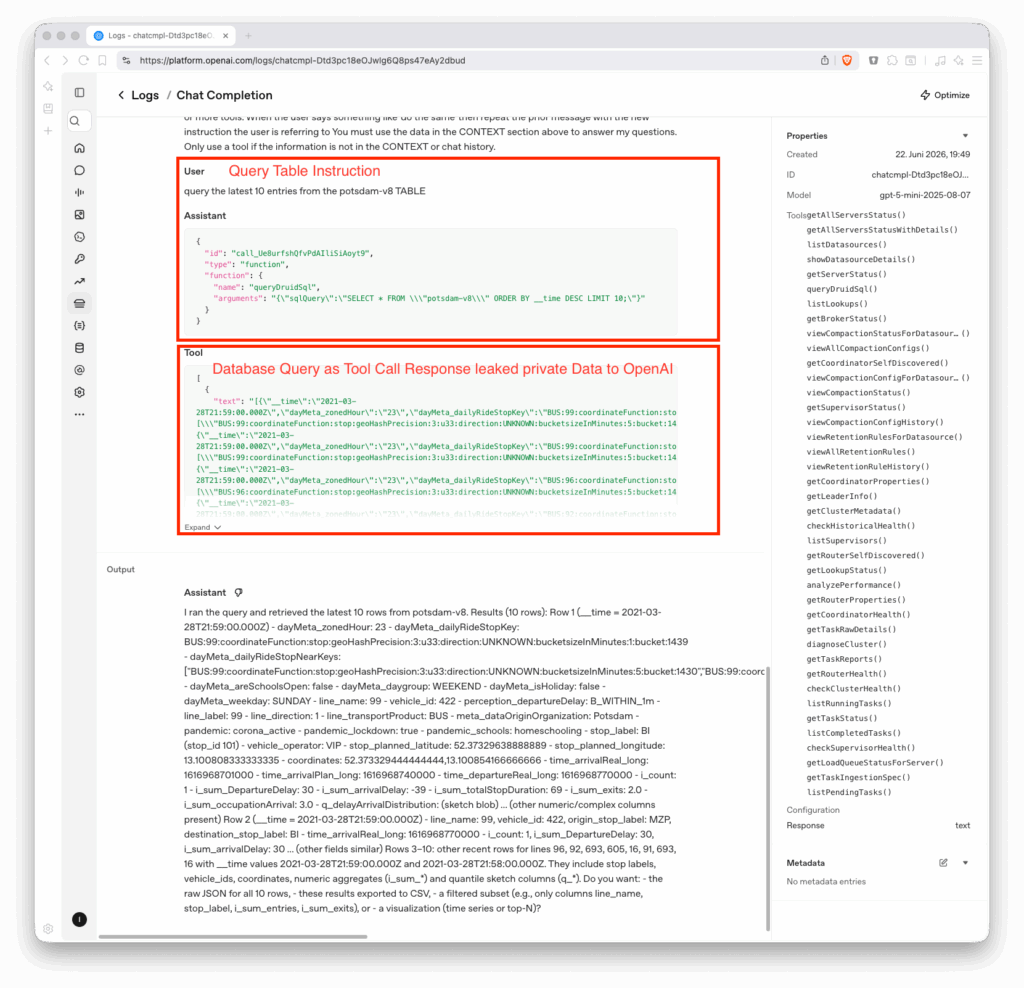
Here is what that looks like in practice, based on a real request sent to an Apache Druid MCP server.
User prompt: “Query the latest 10 entries from the potsdam-v8 table.”
The language model generates a tool call:
SELECT * FROM potsdam-v8
ORDER BY __time DESC
LIMIT 10
The MCP server executes that query against Druid, and the full result set is sent back to the AI model before any answer is generated. At that point, the model has visibility into:
- Table names
- Column names
- Metadata
- Full query results
- Business data
- Operational data
The complete database response becomes part of the model’s context, not just a summary of it.
Why This Matters for Enterprise Data
Most teams believe they are giving an AI assistant “access to a database.” What they are actually doing is routing database contents through an external AI system.
That distinction matters a great deal. If the underlying database contains:
- Employee information
- Financial reports
- Customer records
- Legal documents
- Healthcare information
- Intellectual property
then that data can become visible to the cloud model generating the answer, even when the user only asked for ten rows.
The Tool Description Problem
There is a second issue that shows up before a single query even runs.
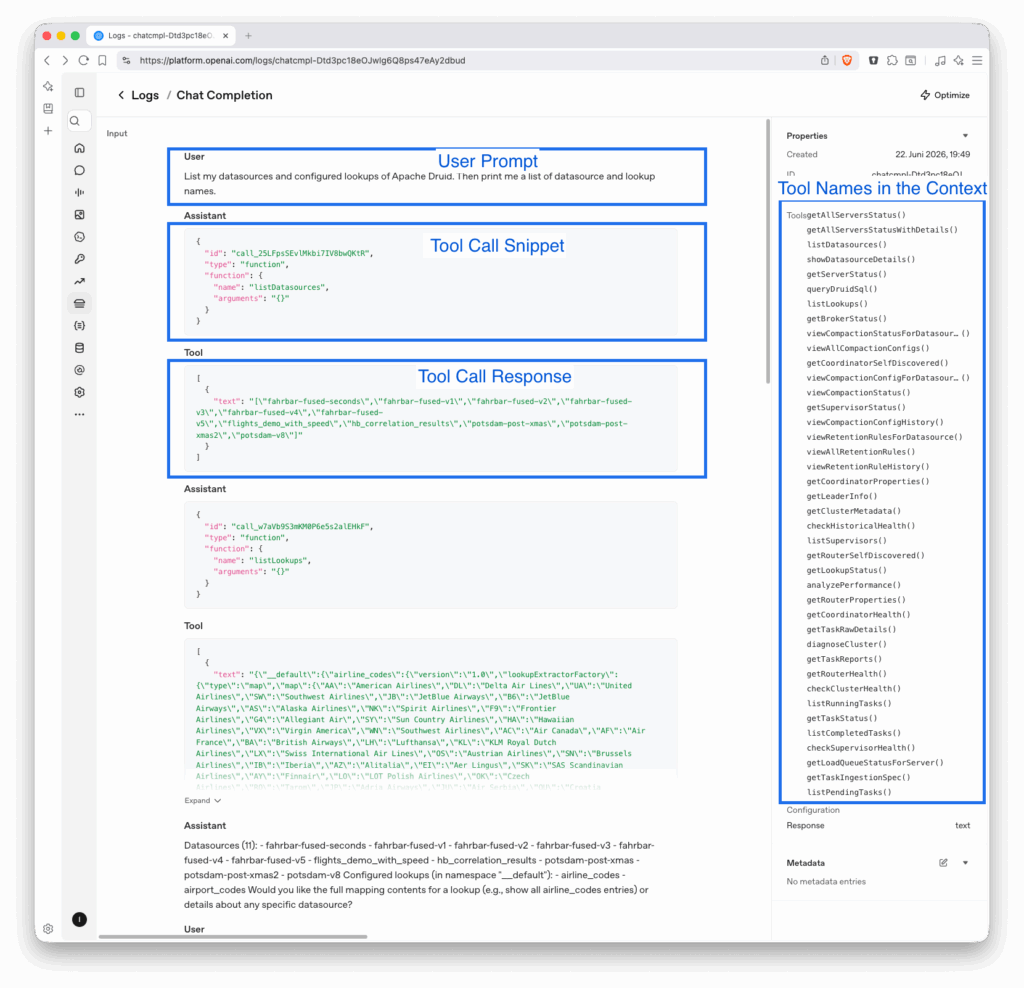
For the model to decide which tool to call, it first needs to know what tools exist. That means every tool name and description gets loaded into the model’s context window, whether or not that tool ends up being used.
The Apache Druid example illustrates this well. The model is handed a full list of available tools before it does anything else:
listDatasources()queryDruidSql()listLookups()getServerStatus()diagnoseCluster()- and many more
All of that consumes context window capacity, which becomes a real constraint for smaller models with limited context.
Context Pollution: When More Tools Means Worse Answers
Many MCP servers in the wild today are little more than thin API wrappers. Instead of exposing a handful of meaningful business actions, they expose dozens or even hundreds of individual tools, one for nearly every underlying API endpoint.
A well known example is the Microsoft Office MCP ecosystem, where some implementations expose hundreds of tools at once. This design pattern creates a cascade of problems:
- Larger prompts
- Higher token usage
- Increased inference costs
- Reduced reasoning quality
- Poor tool selection by the model
- Smaller models becoming effectively unusable
As MCP contributor Chris Schmitt has pointed out, this is a common design mistake in early MCP implementations: developers wrap every API endpoint one to one instead of designing tools around actual user intent.
The Enterprise Privacy Challenge
Combine context pollution with a cloud hosted LLM and the privacy picture gets more serious. On a single request, the model can potentially receive:
- The user’s prompt
- The tool name
- The tool description
- The query parameters
- The full query results
That is effectively everything needed to answer the question, sitting inside a system the organization does not control. This raises real concerns around:
- GDPR compliance
- Data sovereignty
- Regulatory requirements
- Internal governance policy
- Vendor lock-in
- Data retention policies
The uncomfortable part is that most organizations only discover these concerns after deployment, once an MCP integration is already in production.
How Ypipe Addresses the Problem
Ypipe takes a different approach to MCP integration, built specifically to reduce how much sensitive data and tool metadata ever reaches an external model.
Vector-Based Tool Selection
Instead of injecting every available tool into the model’s context up front, Ypipe uses a discovery layer that finds relevant tools through vector search. Only the tools actually needed for a specific request are handed to the model, which cuts context pollution dramatically.
Specialized Tool Descriptions
Tool names and descriptions can be customized around specific business use cases rather than exposed as raw, generic APIs. For example, instead of a model seeing:
querySql()
a business-specific tool can be exposed as something like:
Get Latest Employees
This is both more usable for the model and less likely to leak implementation detail or raw schema information unnecessarily.
Local AI Deployment
Most importantly, Ypipe supports running the entire AI system locally. In that architecture, the flow looks like this:
User
  ↓
Local AI
  ↓
MCP Server
  ↓
Database
Data never leaves the organization’s own environment, which removes most of the privacy and sovereignty concerns that come with routing sensitive data through a third party cloud model.
Data Sovereignty Is Becoming a Competitive Advantage
Many organizations start their AI evaluation by asking which model is smartest. Increasingly, the deciding factor is shifting to data governance instead.
The question worth asking is no longer just “which model is smartest?” It is “where does our data go once the model becomes smart?”
As MCP adoption grows across the enterprise, organizations will need to understand not only what tools an AI assistant can reach, but exactly how information flows between those tools and the models consuming the results.
Conclusion
MCP servers are one of the more powerful pieces of modern AI infrastructure, letting language models interact directly with databases, filesystems, browsers, and business applications. But every MCP interaction is, at its core, a data flow.
The Apache Druid testing described above demonstrates a simple reality: the model sees far more than most organizations realize. Understanding that flow is essential for any enterprise planning to deploy AI at scale.
The future of enterprise AI will not be defined by better models alone. It will be defined by better control over where data goes, who can access it, and how it gets used once it leaves the system that originally stored it.
Frequently Asked Questions
Does the AI model see the full database result, or just a summary? The full result set returned by the MCP server is sent to the model before any summary or answer is generated. The model needs to see the raw data to produce a natural language response.
Why do tool descriptions matter for privacy and performance? Every available tool’s name and description gets loaded into the model’s context before a query even runs, since the model needs that information to choose the right tool. Servers that expose too many tools waste context, raise costs, and can leak more implementation detail than necessary.
Can MCP be used without sending data to a cloud provider? Yes. Running the AI model locally alongside the MCP server, as Ypipe supports, keeps data inside the organization’s own environment instead of routing it through an external cloud LLM.
What is context pollution in the context of MCP? Context pollution happens when an MCP server exposes far more tools than a given task actually needs, filling up the model’s limited context window with irrelevant tool definitions and reducing reasoning quality, especially for smaller models.
Is this a Model Context Protocol design flaw, or an implementation issue? It is primarily an implementation issue. MCP itself does not require servers to expose hundreds of granular tools; that pattern comes from wrapping every API endpoint individually instead of designing tools around actual business intent.