
Meta Description: Local AI deployment is not the same as EU AI Act compliance. Discover the governance gap most enterprises miss and how Ypipe bridges it with audit logging, MCP orchestration, and workflow control.
Target Keywords: EU AI Act compliance, local AI compliance, enterprise AI governance, local LLM audit logging, Ollama compliance, vLLM governance, data sovereignty AI, MCP orchestration enterprise, AI workflow traceability, llama.cpp enterprise
Introduction: Local AI Is Not the Same as Compliant AI
For many organizations, the rise of local AI deployment feels like the perfect answer to growing concerns around privacy, data sovereignty, and regulation.
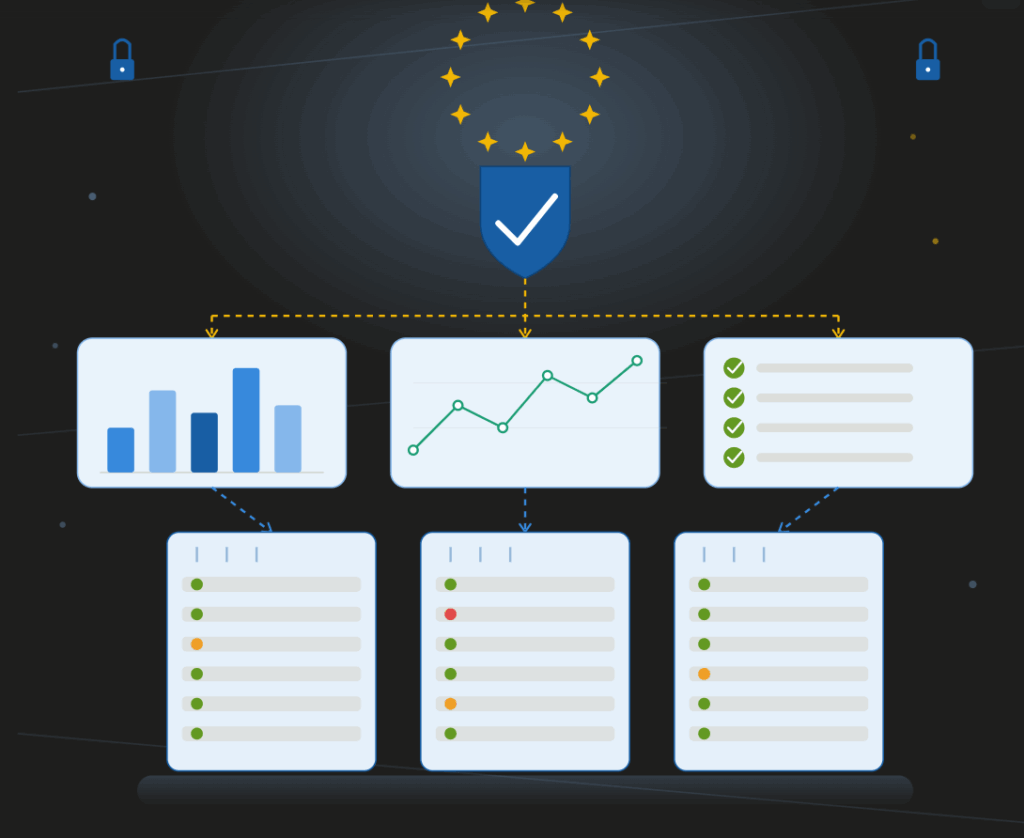
Instead of sending sensitive information to external AI providers, companies can now deploy large language models on their own infrastructure using tools such as Ollama, vLLM, or llama.cpp. Data stays inside the organization, infrastructure costs become predictable, and dependency on external cloud vendors is eliminated.
As a result, many decision-makers have reached a comfortable but incorrect conclusion: running AI locally automatically solves compliance challenges associated with the EU AI Act.
That assumption is wrong, and acting on it carries real regulatory risk.
Local AI is an important component of a compliance strategy. But compliance requires far more than deciding where a model runs.
Why Local AI Adoption Is Accelerating Across Regulated Industries
Organizations across Europe are increasingly deploying local AI for three converging reasons.
Data sovereignty is the first. Sensitive information never leaves organizational infrastructure, reducing exposure to data transfer regulations and third-party access risks.
Privacy is the second. Internal documents, customer records, contracts, and intellectual property can be processed without routing them through external AI services.
Operational control is the third. Enterprises gain the ability to select models, customize deployments, and govern infrastructure according to their own policies rather than a vendor’s terms of service.
These advantages are real and significant. They explain why local AI adoption is accelerating across healthcare, financial services, manufacturing, defense, and public administration.
However, privacy and data residency are only part of the compliance picture under the EU AI Act.
The Compliance Misconception Putting Enterprises at Risk
A growing narrative in enterprise AI circles suggests that if a model runs locally, most compliance concerns disappear. The logic appears internally consistent:
- No external APIs
- No data leaving the organization
- Full infrastructure control
Therefore: compliance achieved.
But the EU AI Act does not primarily regulate where data travels. It regulates how AI systems are built, operated, governed, and held accountable.
The question regulators ask is not simply where AI runs. It is whether organizations can demonstrate responsible, transparent, and auditable operation of AI systems.
What the EU AI Act Actually Requires
The EU AI Act introduces a governance framework that extends far beyond data residency requirements.
Depending on risk classification, organizations deploying AI systems may need to demonstrate:
- How AI systems are being used within the organization
- Which models are deployed and under what version
- How risks are assessed, documented, and actively managed
- Whether meaningful human oversight mechanisms exist
- How AI-influenced decisions can be explained and traced
- How incidents are recorded and reported
- How systems are monitored continuously over time
None of these requirements disappear because a model runs on local hardware. A private deployment may improve privacy compliance, but privacy alone does not satisfy governance obligations.
Compliance Requires Traceability: A Practical Example
Consider a common enterprise scenario. An employee uses an internal AI assistant to generate a recommendation. That recommendation influences a significant business decision. Several weeks later, a compliance review raises questions.
The organization must answer:
- Which model generated the output?
- Which exact version of the model was active?
- What prompt was submitted and under what conditions?
- Which external tools or MCP integrations were involved?
- Which data sources influenced the result?
- Who had access to the system at that time?
Without structured audit trails and traceability infrastructure built into the AI system, these questions may be impossible to answer accurately.
Local deployment does not automatically create audit logs. Those capabilities must be deliberately designed into the platform.
Human Oversight Does Not Configure Itself
One of the foundational principles of the EU AI Act is meaningful human oversight. AI systems must not operate entirely without accountability structures.
This requires organizations to define and enforce:
- Who is responsible for reviewing AI outputs before action is taken
- What processes exist for humans to intervene or override AI decisions
- When escalation to human judgment is mandatory
- What documentation exists to prove oversight occurred
Running a model on local hardware addresses none of this. Governance processes, access controls, and oversight mechanisms are separate requirements that must be built into the operational layer of an AI deployment.
Risk Management Shifts to the Organization
Every AI deployment introduces operational and regulatory risk. These risks include inaccurate recommendations, biased outputs, hallucinations, security vulnerabilities, and regulatory exposure from uncontrolled AI use.
Cloud AI providers typically bear some of this responsibility through their own compliance certifications and contractual obligations. When an organization moves to local AI, that responsibility transfers entirely to the deploying organization.
Local AI does not eliminate risk. In many cases, it concentrates risk within the organization and increases the governance burden accordingly.
The Missing Layer in Most Local AI Deployments
This is where enterprise AI projects most commonly encounter friction.
Inference runtimes like Ollama and vLLM are genuinely excellent at what they do. They make local model serving accessible, fast, and practical. However, they are not governance platforms, and they were not designed to be.
What enterprises operating under the EU AI Act typically require goes well beyond inference:
- Audit logging: Structured, queryable records of all AI interactions
- Workflow management: Definition and execution of repeatable, observable agentic processes
- Deployment versioning: Configuration management that allows reproduction of any past deployment state
- Access management: Controls over who can interact with which models and tools
- Integration governance: Managed connections between AI agents and enterprise systems
- Lifecycle management: Processes for approving, monitoring, updating, and retiring AI deployments
Without these capabilities, scaling AI adoption responsibly across an enterprise becomes extremely difficult.
Ypipe: Governance-Ready Local AI Orchestration

Ypipe, developed by iunera, is a Java-native local AI client and MCP orchestration engine built specifically for the operational and governance requirements that regulated enterprises face.
Where standard inference runtimes stop at model serving, Ypipe provides the orchestration and governance layer that bridges local AI capability with enterprise accountability requirements.
Private Agentic Chat With Full Local Execution
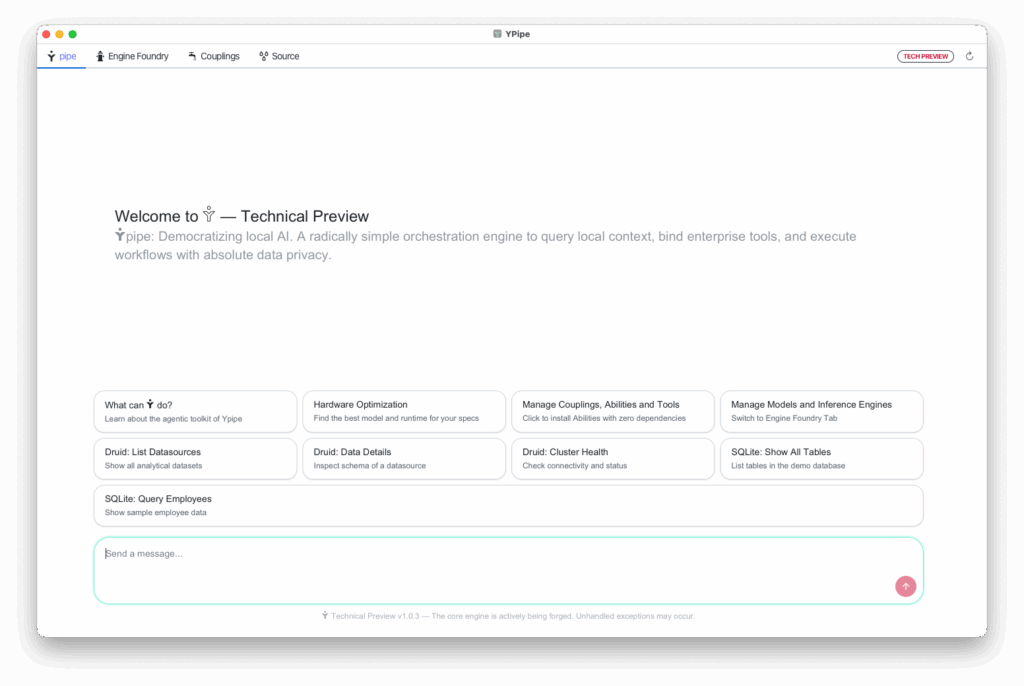
Ypipe’s main interface provides a private agentic chat environment that runs entirely on local infrastructure. Sensitive prompts, context, and responses never leave the machine. Built-in shortcuts surface common enterprise queries across connected data sources, and the system actively routes tasks to appropriately sized models based on detected hardware.
The chat interface connects directly to local databases, file systems, and enterprise APIs through MCP integrations, enabling complex agentic workflows that execute with zero external network dependency.
Engine Foundry: Hardware-Optimized Model Management
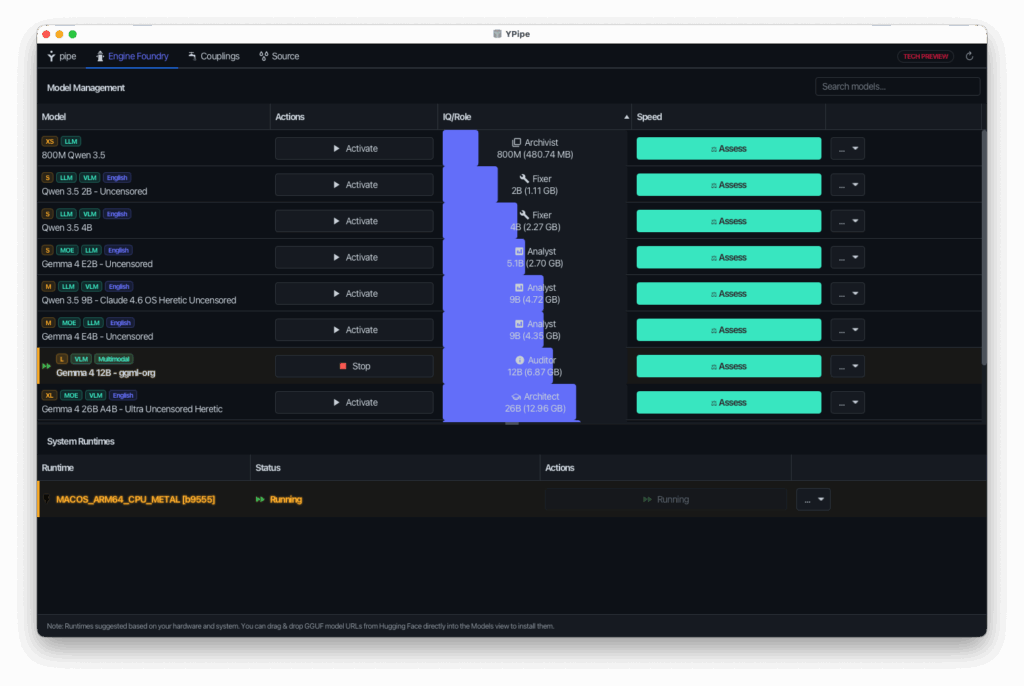
The Engine Foundry provides structured model management with automatic hardware assessment and role-based model assignment. Models ranging from 800M parameter lightweight classifiers to 26B parameter reasoning architectures are organized by IQ/Role (Archivist, Fixer, Analyst, Auditor, Architect), enabling intelligent task routing without manual configuration.
This role-based model assignment is directly relevant to governance: every task executed through Ypipe is routed through a defined model with a documented role, creating a traceable record of which intelligence tier was responsible for which output. The active runtime (shown here as MACOS_ARM64_CPU_METAL) is logged and versioned, providing the deployment reproducibility that audit requirements demand.
MCP Couplings: Governed Enterprise Integrations
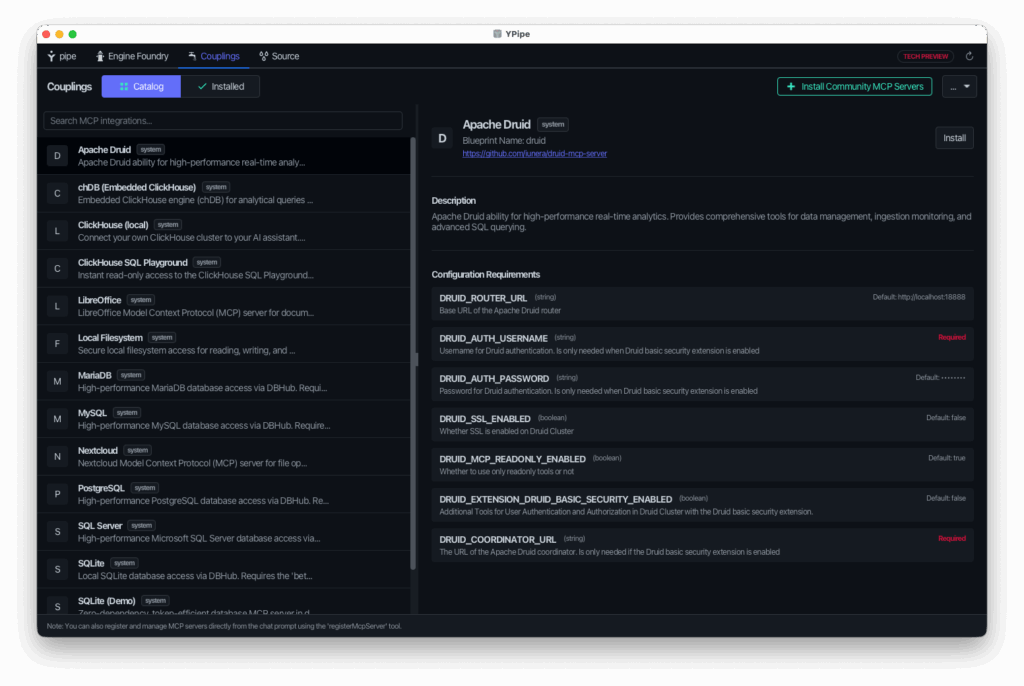
The Couplings dashboard provides a structured catalog of enterprise MCP integrations covering Apache Druid, ClickHouse (embedded and local), PostgreSQL, MySQL, MariaDB, SQL Server, SQLite, Nextcloud, LibreOffice, and local filesystem access. Each integration exposes only explicitly configured tools, with fine-grained control over which capabilities are available to AI agents.
This is governance infrastructure. Rather than allowing AI agents unrestricted access to enterprise systems, Ypipe requires explicit configuration of every integration, every exposed tool, and every connection parameter. The catalog model means integrations are standardized, versioned, and auditable rather than ad hoc.
From Experimentation to Production: The Governance Gap
The operational difference between a single engineer running a local model on a workstation and hundreds of employees interacting with multiple AI systems across an enterprise is enormous, and it is almost entirely a governance problem rather than a technical one.
As AI adoption scales within organizations, teams must answer questions that inference runtimes simply cannot address:
- Which models are approved for production use and by whom?
- Who has access to which AI capabilities and under what conditions?
- How are model updates reviewed, tested, and deployed?
- How are multi-step agentic workflows defined, versioned, and monitored?
- How are integrations with sensitive enterprise systems authorized and governed?
These are operational and governance challenges. Organizations that address them early build a foundation for scaling AI confidently. Those that defer them will find compliance remediation far more costly later.
Why Governance Will Become a Competitive Differentiator
As EU AI Act enforcement matures and extends to a broader range of AI applications, the organizations that invested in governance infrastructure early will hold meaningful advantages.
They will be able to demonstrate compliance during audits rather than scrambling to reconstruct records after the fact. They will accelerate internal AI adoption because employees and leadership trust the governance framework. They will reduce regulatory and reputational exposure from uncontrolled AI use. They will build credibility with customers and partners who increasingly ask suppliers about AI governance practices.
Organizations that focus exclusively on model capability and deployment speed, while deferring governance, face a compounding disadvantage as regulatory expectations continue to tighten.
Getting Started With Ypipe
Ypipe is available as a Technical Preview at no cost for evaluation and production use during the preview period.
Instant start via JBang (no installation required):
jbang ypipe@iunera/ypipe
Platform installers available at ypipe.com:
- Windows: MSI installer or AppImage
- macOS: Apple Silicon DMG
- Linux: DEB (Ubuntu), RPM (RedHat), or Tarball
- Universal: Executable JAR for any Java-enabled environment
For enterprise deployments, Kubernetes support is available. Contact the iunera architectural team for managed deployment, legacy system integration, or sovereign governance consulting.
Conclusion: The Future of Enterprise AI Is Governed AI
Running AI locally is an important and often necessary step toward privacy, data control, and infrastructure sovereignty.
But local deployment alone does not make an organization compliant with the EU AI Act.
Compliance requires governance, accountability, meaningful human oversight, traceability, and active risk management. These requirements apply equally to cloud deployments and local ones.
The organizations that will define the next era of enterprise AI are not necessarily those with the most powerful models. They will be those that can demonstrate they operate AI responsibly, with documented processes, auditable records, and genuine control over the systems they deploy.
The conversation must move beyond infrastructure and toward the broader, harder, more important challenge of operating AI with integrity.
Frequently Asked Questions
Does the EU AI Act apply to locally deployed AI systems?
Yes. The EU AI Act regulates AI systems based on their risk classification and use case, not on where the model runs. Local deployment addresses data residency concerns but does not exempt organizations from governance, oversight, traceability, and risk management obligations.
What is the difference between data sovereignty and AI compliance?
Data sovereignty means sensitive data stays within organizational or national boundaries. AI compliance under the EU AI Act encompasses data sovereignty plus governance, human oversight, audit logging, traceability, risk documentation, and lifecycle management. Sovereignty is necessary but not sufficient for compliance.
What is MCP and why does it matter for AI governance?
The Model Context Protocol (MCP) is an open standard that allows AI models to connect to external tools and systems in a standardized, auditable way. Using MCP rather than custom integrations means enterprise connections are documented, versioned, and controllable, which directly supports governance requirements.
How does Ypipe differ from running Ollama with custom scripts?
Ollama handles model inference. Ypipe handles model inference plus workflow orchestration, MCP integration management, role-based model routing, governed enterprise connections, and the operational infrastructure needed for production AI deployments. Custom scripts can partially replicate some of this but lack the standardization, versioning, and governance structure that compliance frameworks require.
Is Ypipe suitable for highly regulated industries like healthcare or finance?
Yes. Ypipe’s Java-native architecture, zero external dependency model, headless deployment capability, and absolute data sovereignty design make it well suited for high-compliance environments. The iunera team provides enterprise consulting specifically for regulated industry deployments.
Ypipe is developed and maintained by iunera. For enterprise consulting, Kubernetes deployment, or custom integration, contact the iunera architectural team directly.
Related resources: Ypipe | iunera Enterprise AI Consulting | Apache Druid MCP Server