
Meta Description: Local AI deployment is exploding, but most enterprises are missing the governance layer that makes it production-ready. Discover the hidden gap and how Ypipe solves it.
Target Keywords: local AI governance, enterprise AI management, AI sprawl, agentic AI governance, local LLM orchestration, MCP enterprise integration, AI workflow management, Ollama enterprise governance, local AI compliance, AI operational maturity
Local AI Is Having a Moment, But Governance Is Getting Left Behind
Local AI is having a moment.
Organizations across Europe and beyond are rapidly deploying large language models on their own infrastructure. Privacy concerns, data sovereignty requirements, EU AI Act obligations, and rising API costs have made local AI a genuinely compelling alternative to cloud-based services.
Tools like Ollama, vLLM, llama.cpp, and Open WebUI have become remarkably popular as a result.
Yet despite this momentum, a growing number of enterprises are hitting a wall they never anticipated.
The challenge is no longer running AI.
The challenge is governing AI.
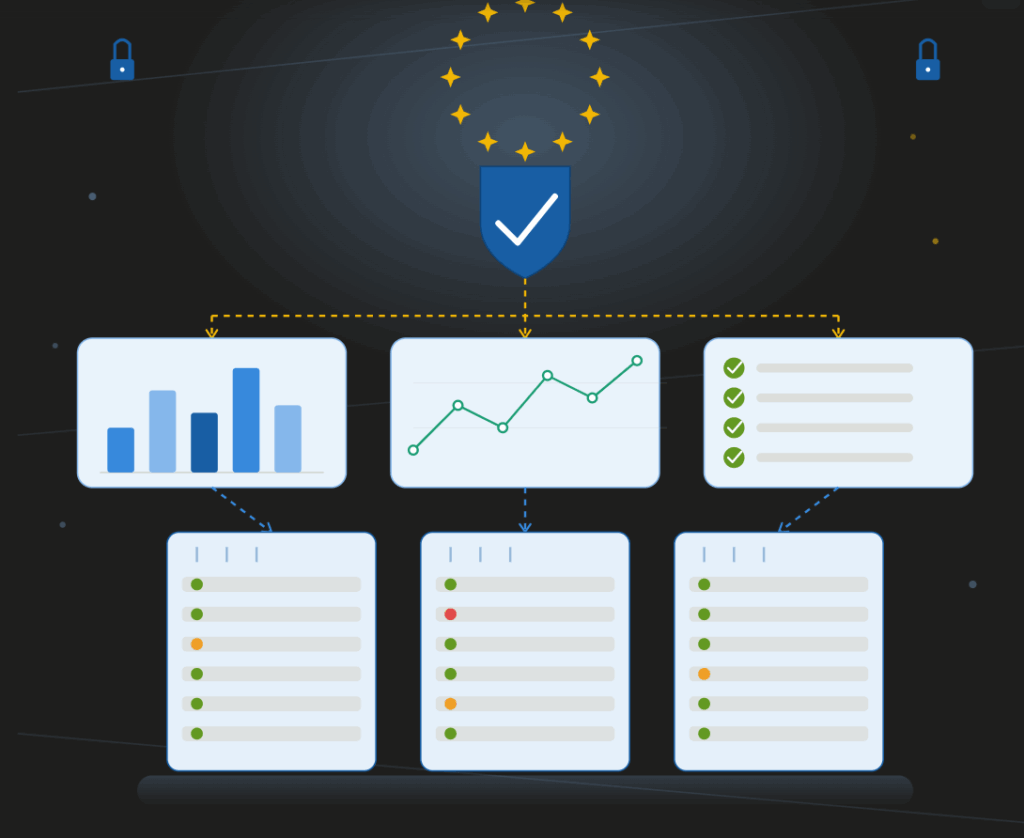
Everyone Talks About Models. Almost Nobody Talks About Management.
Scroll through any enterprise AI discussion and the topics are predictable:
- Model benchmarks and leaderboard rankings
- Inference speed and throughput
- GPU requirements and cost optimization
- Context window sizes
- Quantization techniques and GGUF formats
These topics matter. They are the right questions to ask when selecting and deploying a model.
But they only address a fraction of what actually happens when organizations move AI into production environments at scale.
Running a model successfully is often the easiest part of the journey. Managing that model over time, across teams, connected to enterprise systems, under evolving regulatory requirements, is where real complexity begins.
The Journey From One Model to Many
A developer experimenting with a local model on a laptop occupies a completely different operational reality from an enterprise deploying AI across business units.
What begins as a clean, manageable setup:
One model > One user > One use case
Quickly evolves into something far more complex:
- Multiple models serving different departments and roles
- Multiple teams with different prompting practices and expectations
- Multiple agentic workflows executing autonomously
- Multiple MCP integrations connecting AI to enterprise systems
- Multiple environments (development, staging, production)
Once this complexity emerges, benchmark scores stop answering the questions that matter:
- Which model is approved for production use in this department?
- Who reviewed and authorized this deployment?
- How are model updates tested and rolled out without breaking workflows?
- What happens when an agentic workflow fails midway through execution?
- How are integrations with sensitive systems monitored and audited?
These are governance questions. And most local AI tooling offers no answers to them.
AI Sprawl Is Already Happening
Many organizations are already experiencing what can fairly be described as AI sprawl, even if they have not named it yet.
Individual teams deploy models independently. Different departments develop their own prompting strategies with no shared standards. Workflows connect to enterprise systems through ad hoc integrations built without security review. No central visibility exists over what AI is doing, what data it is touching, or what outputs it is generating.
The consequences compound over time:
- Inconsistent and unpredictable outputs across teams
- Duplicated infrastructure and wasted compute
- Security exposure from ungoverned integrations with internal systems
- Operational inefficiencies from unmaintained workflows
- Compliance exposure that only becomes visible during audits
This challenge intensifies as organizations move from passive chat-based AI toward active agentic systems that take real actions in enterprise environments.
Why Agentic AI Makes Governance Urgent
Modern enterprise AI has moved well beyond question-and-answer interfaces. The real productivity gains come from agentic systems that can act, not just respond.
Organizations are increasingly deploying AI that:
- Calls external and internal tools autonomously
- Connects to enterprise databases and queries live data
- Integrates with legacy systems via Model Context Protocol (MCP)
- Executes multi-step workflows without human intervention at every stage
- Generates reports, drafts documents, and surfaces insights from internal data
These capabilities represent a fundamental shift in how AI interacts with enterprise infrastructure. An agent with access to internal systems, databases, and file structures can have an outsized impact on operations, for better or worse.
The more capable the AI system becomes, the more consequential the absence of governance becomes.
The Missing Layer Most Local AI Tools Do Not Provide
Standard local AI inference tools are designed to answer operational questions about model execution:
- How do we run the model efficiently on available hardware?
- How do we reduce latency and optimize throughput?
- How do we minimize memory footprint for constrained environments?
These are genuinely valuable capabilities. But enterprises operating AI at scale need answers to a fundamentally different set of questions:
- How do we manage which models are active and approved across the organization?
- How do we control which teams and users can access which AI capabilities?
- How do we monitor agentic workflows and detect failures or unexpected behavior?
- How do we maintain visibility across all AI system interactions for compliance purposes?
- How do we ensure consistency in deployments that can be reproduced and audited?
This is the governance layer. And it is the layer that most local AI deployments are missing entirely.
Ypipe: Built for the Governance Layer
Ypipe, developed by iunera, was architected precisely around this gap. It is a Java-native local AI client and MCP orchestration engine that treats governance not as an add-on feature but as a foundational design principle.
Where standard inference runtimes stop at model serving, Ypipe provides the operational and governance infrastructure that makes local AI production-ready for regulated enterprises.
Structured Model Management With Role-Based Routing
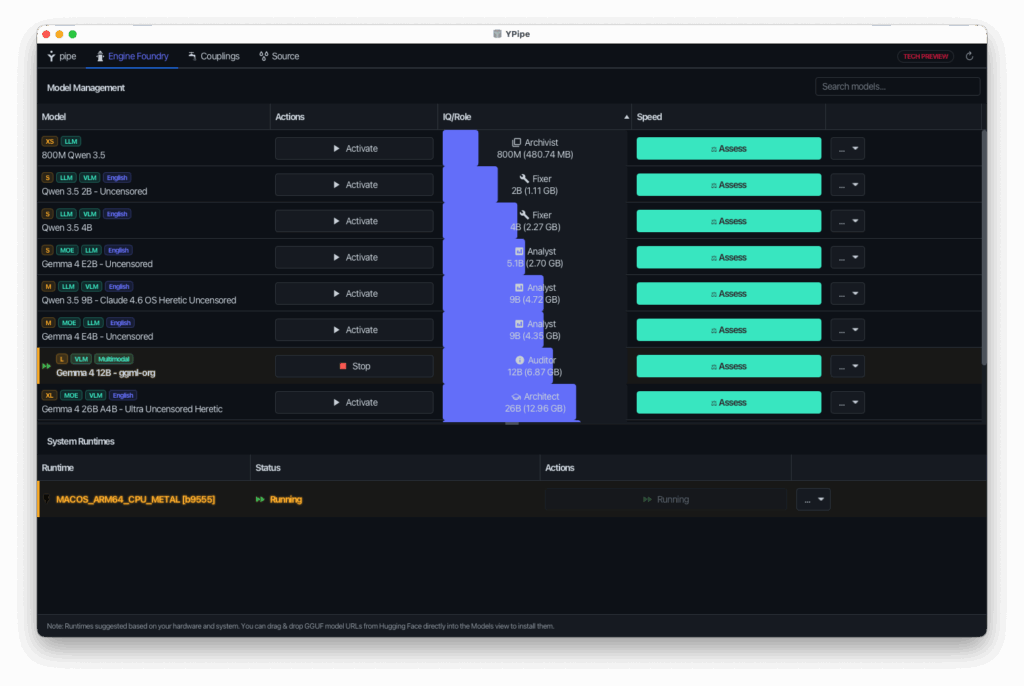
Rather than leaving model selection to individual users or ad hoc decisions, Ypipe’s Engine Foundry organizes models by role: Archivist, Fixer, Analyst, Auditor, and Architect. Each role corresponds to an appropriate model size and capability tier, from lightweight 800M parameter classifiers to 26B parameter reasoning architectures.
This role-based approach means every task executed through Ypipe is routed to a defined, documented model tier. The result is consistent, reproducible behavior across teams and deployments, and a traceable record of which model handled which task.
The Agentic Gearbox automatically assesses available hardware (CPU, GPU, and RAM) and recommends models matched to the system’s actual capabilities, removing the guesswork from local AI configuration without requiring ML engineering expertise.
Governed MCP Integrations, Not Ad Hoc Connections
One of the most significant governance risks in enterprise AI is ungoverned integration with internal systems. When AI agents connect to databases, file systems, and APIs through custom scripts and undocumented connections, visibility and control disappear.
Ypipe’s Couplings dashboard provides a structured catalog of enterprise MCP integrations covering Apache Druid, PostgreSQL, MySQL, MariaDB, SQL Server, ClickHouse, SQLite, Nextcloud, LibreOffice, and local filesystem access. Each integration exposes only explicitly configured tools, with fine-grained control over which capabilities are available to AI agents at any given time.
This is the difference between AI that can access anything it can reach and AI that can only access what has been explicitly authorized. For governance, that distinction is critical.
Headless Deployment for Audit Infrastructure
Ypipe supports headless operation as a background service, enabling it to function as an automated orchestration and audit logging layer within existing enterprise architectures. This is directly relevant to EU AI Act requirements for documentation, oversight, and the ability to demonstrate compliance during formal reviews.
Java-Native Stability for Enterprise Environments
Ypipe runs on Java, eliminating the Python environment fragility that undermines many AI deployments in professional settings. No conflicting package versions, no virtual environment management, no runtime compatibility surprises across operating system updates.
For enterprises operating in high-security environments, regulated industries, and professional DevOps pipelines, the stability and auditability of the infrastructure layer itself is a governance requirement, not just a convenience.
Zero Dependency, Fully Self-Contained
Unlike architectures that require separately installing and maintaining Ollama or other inference engines, Ypipe ships with fully built-in inference. Hardware-optimized execution for Apple Silicon (Metal), CPU, and Vulkan is configured automatically. No external inference engines need to be installed or maintained.
Governance as a Competitive Advantage
As AI becomes embedded in core business processes, operational maturity will increasingly separate enterprises that scale AI responsibly from those that struggle with the consequences of ungoverned deployments.
The organizations that will define the next era of enterprise AI are not necessarily those running the largest models or achieving the fastest inference speeds. They will be the organizations that can:
- Deploy AI with documented, auditable processes
- Govern integrations with enterprise systems through structured controls
- Scale workflows consistently across departments without quality degradation
- Maintain full visibility over AI system behavior in production
- Adapt to evolving regulatory requirements without rebuilding from scratch
Governance is no longer a compliance checkbox. It is a business capability that directly determines whether AI delivers durable value or accumulates operational and regulatory debt.
Getting Started With Ypipe
Ypipe is available as a Technical Preview at no cost during the preview period.
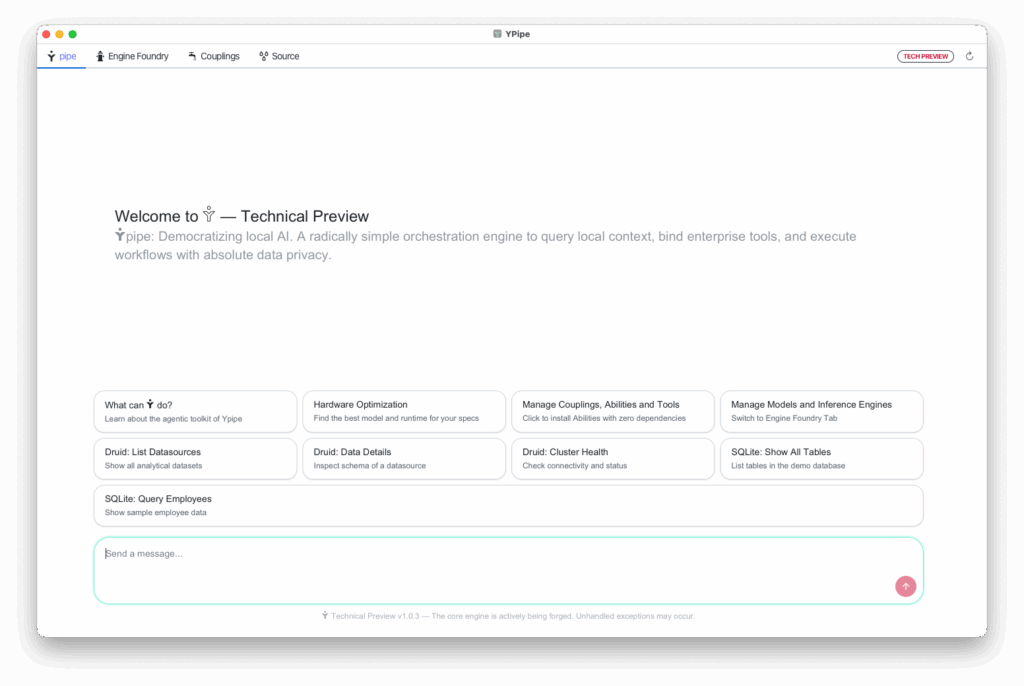
Instant start via JBang:
jbang ypipe@iunera/ypipe
Platform installers at ypipe.com:
- Windows: MSI installer or AppImage
- macOS: Apple Silicon DMG
- Linux: DEB (Ubuntu), RPM (RedHat), or Tarball
- Universal: Executable JAR for any Java-enabled environment
For Kubernetes deployments, legacy system integration, or regulated industry consulting, contact the iunera architectural team.
Conclusion: The Real Challenge Is Management, Not Models
The next phase of enterprise AI adoption will not be defined by who downloads the most powerful model first.
It will be defined by who can operate AI effectively, reliably, and responsibly across an entire organization.
That requires more than hardware. It requires more than benchmarks. It requires more than inference speed.
It requires governance.
As local AI adoption accelerates, enterprises that look beyond model performance and invest in the operational layer will build sustainable AI capabilities. Those that defer governance will face compounding costs when compliance requirements, security incidents, or operational failures demand remediation at scale.
The real challenge is no longer model performance.
The real challenge is managing AI once it becomes part of the business.
Frequently Asked Questions
What is AI sprawl and why does it matter for enterprises?
AI sprawl refers to the fragmented proliferation of AI deployments across an organization without central governance, standardization, or visibility. It leads to inconsistent outputs, security exposure, duplicated infrastructure, and compliance risk. It typically emerges when individual teams deploy AI independently without coordination.
Why is agentic AI harder to govern than standard chat AI?
Agentic AI takes autonomous actions against real enterprise systems, not just generating text responses. When an AI agent reads documents, queries databases, triggers workflows, or writes to file systems, the consequences of ungoverned behavior are significantly higher. Every action needs to be authorized, logged, and auditable.
What is the Model Context Protocol and why is it relevant to governance?
MCP is an open standard for connecting AI models to external tools and systems in a structured, documented way. Using MCP rather than custom integrations means every enterprise connection is explicitly defined, versioned, and controllable, which directly supports governance and audit requirements.
Can Ypipe replace Ollama or vLLM entirely?
Ypipe includes self-contained inference, so it does not require a separate inference runtime. For organizations already running Ollama or vLLM, Ypipe operates as the orchestration and governance layer above inference. OpenAI API compatibility also allows Ypipe to serve as a drop-in replacement for tools currently pointing at external AI providers.
What industries is Ypipe best suited for?
Ypipe is particularly well suited for regulated industries including healthcare, financial services, manufacturing, public administration, and defense, where data sovereignty, audit requirements, and governance obligations are most demanding. Its Java-native architecture fits naturally into existing enterprise infrastructure in these sectors.
Ypipe is developed and maintained by iunera. For enterprise consulting, custom deployments, or Kubernetes integration, contact the iunera team directly.
Related resources: Ypipe | iunera Enterprise Services | Apache Druid MCP Server