
Meta Description: TII’s Falcon H1 90M is one of the smallest tool-calling models ever released. We break down what it can actually do, where it fails, and why tiny models might be the future of AI orchestration.
Target Keywords: Falcon H1 model, 90M parameter LLM, small language model tool calling, Falcon H1 tool calling, TII Falcon model, lightweight LLM 2026, edge AI model, small LLM agent, local AI orchestration, SLM vs LLM
Everybody Is Chasing Bigger. Falcon H1 Goes the Other Way.
The last two years of AI have been a size competition.
GPT-4o. Llama 3.3 70B. Qwen 3 32B. DeepSeek R1 671B. The narrative has been relentless: more parameters, more capability, more intelligence.
Then the Technology Innovation Institute (TII) in Abu Dhabi released Falcon H1, and one entry in the lineup stopped people mid-scroll.
A tool-calling model. With 90 million parameters.
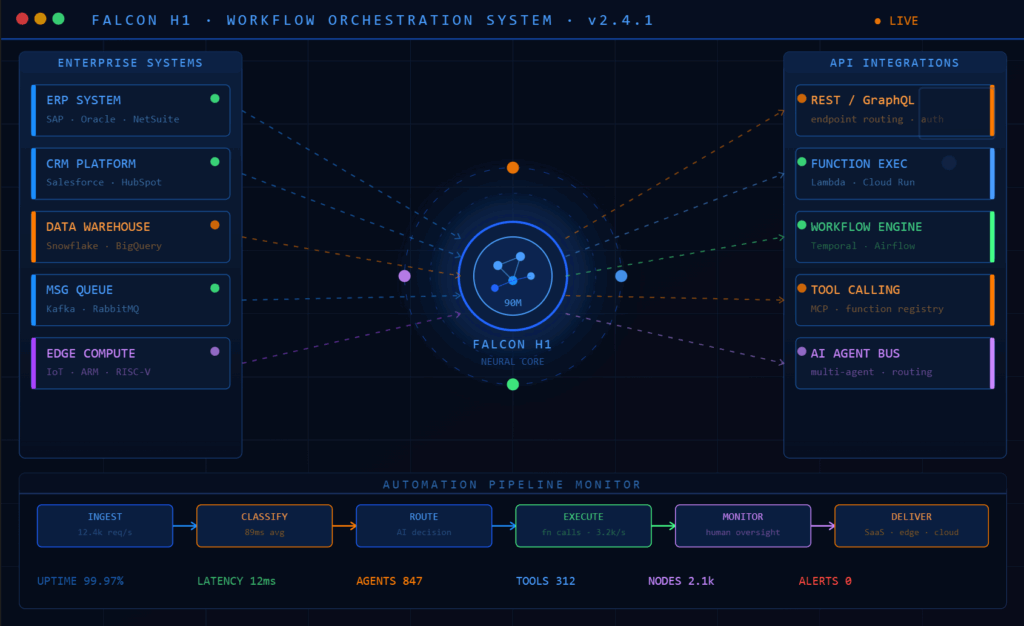
Not 90 billion. Not 9 billion. 90 million.
For context, that is roughly the size of a compressed JPEG collection. Your smartphone camera app probably uses more compute than this model needs.
So the obvious question: can a 90M model actually be useful in 2026?
The answer is yes. But the reasoning behind that answer is more interesting than the number itself.
What Is the Falcon H1 Family?
Falcon H1 is a family of lightweight language models developed by TII, the same institute behind the original Falcon models that briefly topped the Open LLM Leaderboard in 2023.
Where the original Falcon models competed on raw capability, the H1 family takes a different design philosophy: build models that are fast, small, and good at specific operational tasks rather than generalist reasoning.
The lineup spans from the 90M tool-calling specialist up through 0.5B, 1.5B, 3B, 7B, and larger variants, all available on Hugging Face. Each is designed with deployment flexibility in mind, targeting edge devices, resource-constrained environments, and agent pipelines where inference cost matters as much as output quality.
Think of the H1 family not as a single model but as a toolkit of specialized components. And the 90M tool-caller is the most interesting component in the box.
Why 90M for Tool Calling Specifically?
Here is the insight that makes Falcon H1 90M worth paying attention to.
Most conversations about AI focus on intelligence: how well can the model reason, write, explain, and generate? These are legitimate questions for models acting as the primary brain of an application.
But in a well-designed agentic workflow, the model is not always the brain. Sometimes it is just the traffic controller.
Consider what tool calling actually requires in many enterprise scenarios:
- Recognize that the user wants to look up an order status
- Trigger the correct database query tool with the right parameters
- Pass the result to the next step in the workflow
- Route to a different model or tool if needed
None of those steps require deep reasoning. They require reliable pattern recognition, structured output, and fast execution. A 90M model that does those things well and does them in milliseconds is genuinely valuable in a way that a 70B model being overkill for the same task is not.
This is the philosophy behind Small Language Models (SLMs) and specialized micro-models. It is also the same philosophy behind Microsoft’s Phi series, Google’s Gemma 2B, and Apple’s OpenELM. Tiny models doing narrow jobs extremely efficiently.
What Falcon H1 90M Can Actually Do
Let’s be specific, because vague praise for small models is unhelpful.
Tool Calling and Function Routing
This is where Falcon H1 90M earns its place. It is designed to reliably identify when to invoke a tool and format the call correctly. In MCP (Model Context Protocol) and function-calling pipelines, the model can act as a lightweight dispatcher:
- Trigger a receipt extraction tool when given an invoice
- Initiate a database lookup with structured parameters
- Invoke a validation step and pass results forward
- Route to a specialized downstream model
In these narrow, well-defined scenarios, the model punches far above its weight class.
Edge and Embedded Deployment
Running a 90M model requires almost no hardware. We are talking CPU inference on a Raspberry Pi, a Jetson Nano, an old laptop, or even a microcontroller with sufficient memory. This opens up genuine use cases in:
- IoT devices and smart sensors
- Industrial edge computing
- Air-gapped environments with no GPU infrastructure
- Embedded AI in consumer hardware
Speed
At 90M parameters, inference is fast. Not “pretty fast for its size” fast. Actually fast, measured in single-digit milliseconds on modern hardware. For real-time applications where latency matters more than reasoning depth, this is a genuine competitive advantage over any model measuring its size in billions.
Low Infrastructure Cost
No NVIDIA A100. No H100. No cloud GPU bill. A 90M model runs on the kind of hardware that already exists in most enterprise environments without any additional investment.
Where Falcon H1 90M Honestly Falls Short
There is no point sugarcoating the limitations, because using this model outside its intended role will disappoint you.
Do Not Ask It to Reason
Complex multi-step analysis, mathematical problem solving, nuanced writing, and abstract reasoning are not what this model is for. Compared to Qwen 3 8B or Gemma 3 12B, the reasoning gap is enormous and expected.
Do Not Use It as a Conversational Assistant
Users expecting ChatGPT-quality conversation will be confused and frustrated. This model is not a chat assistant. Deploying it as one is the wrong application.
Not a Replacement for Your Primary Model
Falcon H1 90M is a component. It belongs inside a workflow, not at the top of it. The moment it becomes responsible for the final answer to a complex question, it will fail.
Narrow Use Cases
Its strengths only become visible in structured, well-defined automation pipelines. In open-ended or unpredictable environments, larger general-purpose models like Qwen 3 14B or Llama 3.3 70B are the right choice.
Falcon H1 vs the Competition: Honest Numbers
| Feature | Falcon H1 90M | Qwen 3 8B | Gemma 3 12B | Phi-4 Mini |
|---|---|---|---|---|
| Parameters | 90M | 8B | 12B | 3.8B |
| Inference Speed | Excellent | Good | Good | Very Good |
| Tool Calling | Good | Excellent | Excellent | Very Good |
| Reasoning | Limited | Strong | Strong | Good |
| General Chat | Limited | Strong | Strong | Good |
| RAM Required | Under 1 GB | 10 to 16 GB | 16 to 20 GB | 4 to 8 GB |
| Edge Deployment | Yes | Difficult | No | Partial |
| Infrastructure Cost | Minimal | Moderate | Moderate | Low |
The table makes the tradeoff obvious. Falcon H1 90M wins on exactly two dimensions: size and speed. Everything else goes to the larger models. The question is whether size and speed matter enough for your specific use case to justify the capability tradeoff. For tool-calling dispatchers and edge deployments, the answer is often yes.
The Bigger Idea: Why Small Specialized Models Are Having a Moment
Falcon H1 is not an isolated experiment. It reflects a genuine shift in how serious AI practitioners are thinking about model architecture.
The mixture of experts approach used in models like DeepSeek V3 and Qwen 3 MoE already embeds this logic: not every token needs every parameter. Route different tasks to different specialists.
Microsoft’s Phi-4 Mini, Apple’s OpenELM, Google’s Gemma 2 2B, and SmolLM2 from Hugging Face are all betting on the same thesis: there is enormous value in models that do specific things extremely efficiently rather than everything adequately.
The SLM (Small Language Model) movement is real, and it is driven by practical economics. Cloud inference costs money. Edge deployment requires small models. Real-time applications need low latency. Regulatory environments increasingly require local processing. None of these requirements are satisfied by always reaching for the biggest available model.
Where Falcon H1 Fits in a Real Workflow
The most natural home for Falcon H1 90M is as a first-stage router inside a multi-model pipeline.
Here is a concrete example of how this works with an orchestration layer like Ypipe:
User Request
     |
     v
Falcon H1 90M (intent classification + tool routing)
     |
     |---> Simple database lookup? --> Execute via MCP tool directly
     |
     |---> Document analysis needed? --> Route to Qwen 3 14B
     |
     |---> Complex reasoning required? --> Route to Qwen 3 32B
     |
     v
Final Response
In this architecture, the 90M model handles the classification and routing step that would otherwise waste a 14B or 32B model on a trivial decision. The big models only activate when the task genuinely requires them.
This is the Intelligence Switchboard approach: match compute to complexity. Do not use a 70B model for a 90M job.
Ypipe supports exactly this kind of multi-model orchestration with its Agentic Gearbox, which routes tasks across models ranging from sub-1B specialists like Falcon H1 up through 31B reasoning architectures, with governed MCP integrations to enterprise databases and systems throughout.
For more on why enterprises need an orchestration layer to manage multi-model workflows, read our guide on the hidden governance gap in local AI.
How to Run Falcon H1 Locally
The Falcon H1 models are available on Hugging Face in standard Transformers format. For the 90M model:
Via Hugging Face Transformers:
from transformers import AutoTokenizer, AutoModelForCausalLM

model_id = "tiiuae/Falcon-H1-0.5B-Instruct"
tokenizer = AutoTokenizer.from_pretrained(model_id)
model = AutoModelForCausalLM.from_pretrained(model_id)
Via Ollama: Check the Ollama library for available Falcon H1 variants as community uploads appear.
Via llama.cpp: Look for GGUF quantized versions from trusted quantizers like bartowski on Hugging Face for the most efficient CPU inference.
Via Ypipe: Ypipe’s Engine Foundry supports direct GGUF import from Hugging Face and automatic hardware-matched configuration.
Getting Started With Local AI Orchestration
If the Falcon H1 90M has sparked interest in multi-model local AI pipelines, the next step is exploring orchestration tools that can manage these workflows properly.
Ypipe by iunera is purpose-built for exactly this: running specialized small models alongside larger reasoning models in governed, auditable local workflows. Start instantly with JBang:
jbang ypipe@iunera/ypipe
Or download platform installers at ypipe.com for Windows, macOS, and Linux.
Final Thoughts: Small Is Not Weak, It Is Specialized
Falcon H1 is a reminder that the most interesting AI development in 2026 is not always happening at the frontier of scale.
The Technology Innovation Institute has produced something genuinely thought-provoking: a model so small it barely registers on a spec sheet, yet capable enough in its narrow lane to be useful inside real production workflows.
The 90M tool-calling model is not trying to compete with Qwen 3 32B or Gemma 3 27B. That would be like entering a bicycle in a Formula 1 race. But the bicycle is still the right vehicle for plenty of journeys.
The future of local AI is not a single massive model doing everything. It is an intelligent system of specialized models, each doing one thing extremely well, coordinated by an orchestration layer that routes tasks to the right intelligence at the right time.
Falcon H1 90M is a small but concrete step toward that future.
And 90 million parameters turns out to be enough, when you ask the right questions of it.
Frequently Asked Questions
What is the Falcon H1 90M model?
Falcon H1 is a family of lightweight language models developed by the Technology Innovation Institute (TII) in Abu Dhabi. The 90M variant is a specialized tool-calling model designed for workflow routing and agent pipelines rather than general-purpose conversation or reasoning.
Can the Falcon H1 90M replace larger models like Qwen or Gemma?
No. Falcon H1 90M is a specialist component, not a general-purpose replacement. It works best as a lightweight dispatcher inside a multi-model pipeline, routing tasks to larger models like Qwen 3 8B or Gemma 3 12B when deeper reasoning is needed.
What hardware does Falcon H1 90M require?
Almost none by modern standards. The model runs on CPU-only hardware with under 1GB of RAM. It is deployable on Raspberry Pi, edge computing devices, and any machine where larger models are impractical.
What is tool calling in LLMs?
Tool calling (also called function calling) is the ability of a language model to identify when an external tool should be invoked and to format the call with correct parameters. It is the foundation of agentic AI workflows and MCP integrations.
Where can I download Falcon H1 models?
All Falcon H1 models are available on Hugging Face. Look for GGUF quantized versions for use with llama.cpp, Ollama, and LM Studio.
How does Falcon H1 fit into enterprise AI orchestration?
Small models like Falcon H1 work best as routing and classification layers inside larger multi-model workflows. Orchestration platforms like Ypipe can coordinate Falcon H1 with larger reasoning models, routing tasks to the most efficient model for each step.
Local AI orchestration for multi-model workflows: Ypipe | Developed by iunera