
Meta Description: Discover why open AI models are becoming critical for defensive cybersecurity, AI sovereignty, and national resilience. The balance between AI safety and defensive capability explained.
Target Keywords: defensive AI cybersecurity, open AI models security, AI sovereignty cybersecurity, open source LLM security, cybersecurity AI tools 2026, local AI security, AI for threat analysis, open models cybersecurity, AI defensive capability, sovereign AI national security
Two Teams. Same Attack. Very Different Outcomes.
Imagine two cybersecurity incident response teams.
Both receive the same alert at 2:47 AM:
A sophisticated cyberattack has begun targeting critical infrastructure.
Team A has access to every AI tool they need. They ask their local model to explain the attack vector, analyze the malware behavior, map the lateral movement pattern, and draft the incident report simultaneously. They have answers in minutes.
Team B has faster hardware and bigger budgets. But every time their AI assistant is asked how the attack works, it refuses. Not because the defenders are doing anything wrong. Simply because the model cannot distinguish between an attacker building malware and a defender trying to stop it.
Which team would you rather have protecting your country’s hospitals, power grid, financial systems, or defense infrastructure?
This is not a hypothetical scenario from a cyberpunk novel. It is one of the most consequential debates in artificial intelligence right now, and it is being had in boardrooms, government agencies, and security operations centers around the world.
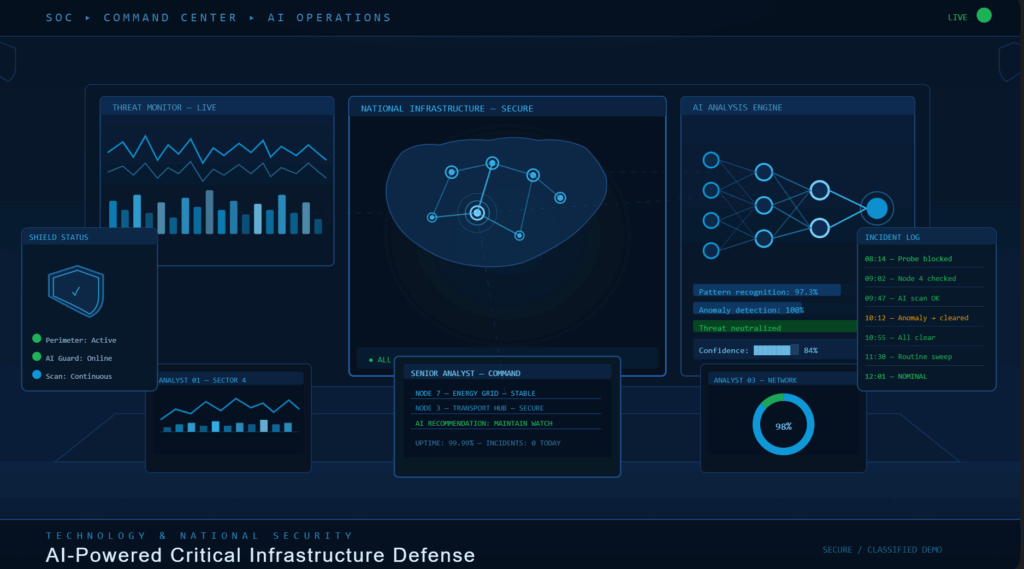
AI Has Permanently Changed the Cybersecurity Landscape
Cybersecurity has always been a race between attackers and defenders. Vulnerabilities are discovered, patches are deployed, new attack vectors emerge, and the cycle continues. MITRE ATT&CK currently catalogs over 600 techniques and sub-techniques used by real threat actors. No human team can stay current on all of them manually.
Artificial intelligence changes both sides of this race simultaneously.
For defenders, modern AI models can:
- Summarize thousands of pages of threat intelligence reports in minutes
- Explain CVE vulnerabilities in plain language for rapid triage
- Analyze malware behavior from samples or logs
- Review source code for OWASP Top 10 vulnerabilities
- Automate incident documentation and regulatory reporting
- Accelerate SIEM alert triage
- Generate detection rules for YARA, Sigma, and Snort
These capabilities make AI one of the most significant force multipliers ever introduced into a security operations center. The cybersecurity workforce gap currently stands at over 4 million unfilled positions globally. AI does not replace those missing professionals. It makes the ones who are there dramatically more effective.
But this power introduces a genuinely hard question.
What happens when the defenders cannot fully use their own tools?
The Hidden Challenge Nobody Wants to Talk About Publicly
Modern AI systems are trained to minimize harmful outputs. This is the right instinct. Nobody wants LLMs helping people build weapons or orchestrate attacks.
The problem is that cybersecurity occupies a deeply uncomfortable middle ground.
Security professionals legitimately need to understand:
- How ransomware encrypts files and evades detection
- How phishing campaigns bypass email filters and manipulate users
- How privilege escalation exploits work at a technical level
- Why specific exploit techniques succeed against certain configurations
- How advanced persistent threats (APTs) maintain persistence in networks
Understanding these topics is fundamentally different from performing an attack. The knowledge is the same. The intent and authorization are not.
Doctors study diseases in detail to treat them. Firefighters learn fire chemistry to fight fires. Penetration testers certified by OSCP, CEH, and GPEN must understand attack techniques to prove defenses work.
Without understanding the threat, effective defense becomes not harder, but sometimes impossible.
The Firefighter Problem: A Simple Story That Cuts Through the Noise
Here is a way to feel this tension concretely.
A firefighter prepares to enter a burning building. Before going in, they ask their AI assistant:
“Explain how this class of fire spreads through a structure with this floor plan.”
The assistant responds:
“I cannot discuss fire behavior because someone might misuse this information.”
That response is absurd. It would be dangerous. It would get people killed.
Yet security operations teams working on legitimate incident response sometimes encounter exactly this kind of friction when using heavily restricted commercial AI systems. The model that refuses to explain a SQL injection attack to a SOC analyst actively investigating a breach is not being safe. It is being counterproductive.
The challenge is not that safety measures exist. Safety measures absolutely should exist. The challenge is designing safety measures intelligent enough to distinguish between a defender doing their job and an attacker trying to do harm.
That is a genuinely hard alignment problem, and the AI research community, including researchers at Anthropic, DeepMind, and EleutherAI, is actively working on it.
Why This Is Becoming a National Security Issue
Artificial intelligence is no longer just enterprise software. It is becoming national infrastructure.
The US Cybersecurity and Infrastructure Security Agency (CISA) has explicitly identified AI as a critical component of national cyber defense strategy. The European Union Agency for Cybersecurity (ENISA) has published reports on AI in cybersecurity. NATO has adopted principles for responsible AI use in defense contexts.
Countries increasingly rely on AI-assisted capabilities for:
- Real-time threat detection and zero-day vulnerability identification
- Critical infrastructure protection for power grids and water systems
- Healthcare cybersecurity and medical device protection
- Financial system monitoring under PCI DSS and DORA
- Defense and intelligence network protection
When defensive AI capability is limited or entirely dependent on external providers, it creates a strategic vulnerability that goes beyond any individual organization. This is why the conversation around AI sovereignty is no longer confined to technology departments. It is in policy briefings, parliamentary discussions, and national security strategies.
AI Sovereignty: The Strategic Dimension
The concept of AI sovereignty has moved from academic discussion to active government policy across multiple continents.
The EU AI Act reflects in part a desire to ensure European organizations are not entirely dependent on non-European AI providers for critical capabilities. Germany’s national AI strategy explicitly addresses technological sovereignty. France’s AI policy invests in domestic capability. India’s AI Mission and Saudi Arabia’s SDAIA are building sovereign AI infrastructure.
The logic parallels established policy in other strategic domains:
- Countries invest in energy independence to avoid geopolitical vulnerability
- Countries maintain domestic semiconductor capacity as strategic infrastructure
- Countries build sovereign communication networks for critical government functions
AI is following the same trajectory. The question is no longer whether organizations should consider AI sovereignty. It is how to achieve it practically, and local AI platforms are a significant part of the answer.
For a deeper look at how European enterprises are approaching this challenge, read our guide on sovereign AI and why European organizations are moving away from cloud-only AI.
Why Open Models Are Becoming Essential for Defensive Security
Open AI models provide capabilities that closed, cloud-hosted models structurally cannot, regardless of how capable those cloud models become.
Full Inspectability
Security teams can examine model behavior, understand how outputs are generated, and audit responses against organizational policy. With closed models, this is impossible by definition. For teams operating under ISO 27001, SOC 2, or NIS2 requirements, inspectability is not optional.
Private Deployment for Sensitive Data
Incident response often involves processing actual malware samples, real attack logs, and sensitive network data. Sending that data to an external AI provider raises immediate data handling, chain of custody, and evidence integrity concerns. Local open models eliminate this problem entirely.
Customization for Specific Environments
Security teams can fine-tune open models on their own threat intelligence feeds, internal knowledge bases, and organization-specific detection patterns. LoRA fine-tuning on models like Qwen 3 8B or Llama 3.3 for cybersecurity-specific tasks is within reach of most organizations with modest GPU resources.
Governance and Audit Trails
Organizations using local AI for security workflows can maintain complete logs of every AI interaction for compliance purposes. Under EU AI Act and DORA requirements, this auditability is increasingly mandatory rather than optional.
No External Dependency During Incidents
A sophisticated cyberattack may deliberately target communication infrastructure. During an active incident, depending on cloud AI services that require internet connectivity creates a single point of failure. Local models remain operational regardless of external network status.
Popular open models actively used by security researchers include Llama 3.3 70B, Qwen 3 32B, Mixtral 8x7B, DeepSeek Coder V2, and security-specific fine-tunes available on Hugging Face.
Tools for Running Defensive AI Locally
The ecosystem for running open models in security environments has matured significantly. For a complete comparison, see our guide on top 20 tools to run LLMs locally in 2026.
Ollama: The fastest path to running open models locally. Supports Llama, Qwen, Mistral, and DeepSeek with a single command.
vLLM: Production-grade inference for security teams serving models to multiple analysts simultaneously.
llama.cpp: Maximum efficiency for air-gapped environments where GPU resources are limited.
Ypipe: For security teams that need more than inference, Ypipe by iunera provides a Java-native local AI orchestration engine with governed MCP integrations to enterprise security systems, audit logging for every AI interaction, and complete data sovereignty. Zero data leaves the machine. Every interaction is logged. The governance infrastructure that EU AI Act and NIS2 compliance requires is built in.
Read our guide on why local AI does not automatically make you EU AI Act compliant to understand what governance infrastructure your security AI deployment actually needs.
Responsible Use: The Non-Negotiable Foundation
None of this argues for removing safety from AI systems.
Responsible AI is not a constraint on defensive capability. It is part of what makes defensive AI trustworthy. Security research must always be conducted:
- Legally: Within applicable laws including CFAA, NIS2, and local jurisdiction requirements
- Ethically: Under recognized frameworks like the EC-Council Code of Ethics and CREST standards
- Under authorization: With documented scope and approval as required by penetration testing methodologies like PTES and OWASP Testing Guide
- Within organizational policy: Aligned with internal security governance and NIST frameworks
The goal is not unrestricted AI. The goal is AI that is smart enough to support legitimate defensive work without becoming a tool for harm. That requires both technical safety measures and organizational governance, not one or the other.
The Transparency Advantage: Why Open Ecosystems Win Long-Term
Cybersecurity has always benefited from openness. The strongest security tools in the world are open source:
- OpenSSL secures the majority of internet traffic
- Linux powers most of the world’s servers
- Wireshark is the universal network analysis tool
- Metasploit is the industry standard for penetration testing
- YARA, Sigma, and Suricata rules are shared openly across the community
The reason is simple: security through obscurity fails. Broad review finds weaknesses that closed development misses. The same logic applies to AI systems used in security contexts.
Open models allow the security research community to:
- Evaluate model behavior against real-world attack scenarios
- Identify alignment failures and jailbreak vulnerabilities before deployment
- Contribute improvements through fine-tuning and RLHF
- Publish findings through responsible disclosure processes
- Build shared detection capabilities like prompt injection defenses
OWASP’s LLM Top 10 and MITRE ATLAS (the adversarial ML threat matrix) are both products of this open collaborative approach to AI security research.
The Conversation That Needs to Happen at Scale
Artificial intelligence will define the future of cybersecurity. The important question is not whether AI should be safe. That conversation is over. It should.
The harder, more important question is:
How do we design AI safety in a way that actively supports legitimate defensive capability rather than accidentally undermining it?
That conversation needs to involve:
- Policymakers designing regulatory frameworks
- CISA, ENISA, and NCSC developing national AI security guidelines
- Security researchers and red teams providing practical feedback on model limitations
- Enterprise security teams deploying AI in real operational environments
- AI labs building alignment techniques sophisticated enough to distinguish intent
The organizations, governments, and research communities that engage with this balance earliest will build the most effective defensive AI capabilities. Those that defer the conversation will find themselves working around limitations instead of through them.
Conclusion: Defenders Need Tools That Actually Defend
Artificial intelligence is becoming foundational to cybersecurity in the same way that firewalls, SIEM platforms, and endpoint detection did before them. It is not optional infrastructure. It is the new baseline.
Open AI models, deployed locally with proper governance, give security teams the transparency, customization, and operational independence that closed cloud systems cannot provide. They are not a complete solution. Neither are any other tools in isolation.
The future of defensive cybersecurity will require thoughtful combinations of capable open models, responsible governance frameworks, local deployment infrastructure, and international collaboration on both attack and defense techniques.
The organizations and nations that understand this balance earliest will be better prepared for the attacks that are coming. And the attacks are coming.
Frequently Asked Questions
Are open AI models safe to use in cybersecurity environments?
Yes, when deployed responsibly with proper governance. Open models offer the additional advantage of full inspectability, which closed cloud models cannot provide. Organizations can audit exactly how models behave and what data they process, which is essential in security-sensitive environments. Tools like Ypipe provide the governance infrastructure needed for compliant local AI deployment.
Why do cybersecurity professionals need to understand attack techniques?
Understanding how attacks work is the foundation of effective defense. Penetration testers, threat hunters, malware analysts, and incident responders all require detailed knowledge of attacker techniques. Organizations like SANS, Offensive Security, and EC-Council have built entire certification frameworks around this necessity.
What is AI sovereignty and why does it matter for security?
AI sovereignty refers to an organization’s or nation’s ability to access, deploy, and govern AI capabilities independently of external providers. For security teams, this means maintaining AI-assisted defensive capability even when cloud services are unavailable, restricted, or potentially compromised. It is increasingly addressed in national strategies by CISA, ENISA, and NATO.
Which open models are best for cybersecurity tasks?
Llama 3.3 70B, Qwen 3 32B, DeepSeek Coder V2, and Mixtral 8x7B are commonly used for security research and analysis. Security-specific fine-tunes are also available on Hugging Face. For tool calling in automated security workflows, smaller specialized models like Falcon H1 can serve as lightweight dispatchers.
How does the EU AI Act affect cybersecurity AI deployments?
The EU AI Act imposes governance, audit, and transparency requirements on AI systems used in high-risk contexts including security applications. Local deployment with proper audit logging, access controls, and documented governance is becoming a compliance requirement rather than a best practice. Read our guide on EU AI Act compliance for local AI for a full breakdown.
What is the difference between using AI for offense versus defense in cybersecurity?
The technical knowledge is often identical. The difference is authorization, intent, and legal context. Authorized penetration testing using attack knowledge is legal and essential. Unauthorized attacks using the same knowledge are crimes. Responsible disclosure, bug bounty programs, and red team engagements all operate within defined legal and ethical frameworks that legitimize security research.