
Watch Germany’s AI debate for five minutes and it starts to look like a retro arcade game where the player keeps jumping headfirst into the exact same pitfalls while shouting that the game is rigged.
One week, Berlin celebrates a €1 billion GPU partnership as if buying 10,000 foreign chips will close a hundred-billion-dollar hyperscaler gap. The next week, a subsidized foundation model launches into “closed beta” while open weights from abroad already lap it. Then a delegation flies to San Francisco, sits through a slick executive demo, and flies home telling Der Spiegel that Germany is doomed to be an onlooker and customer (“Zaungast und Kunden”).
So instead of writing just another dry policy memo, we turned Germany’s entire AI catch-up race into a playable 90-second retro Jump & Run: Germany in AGI Land.
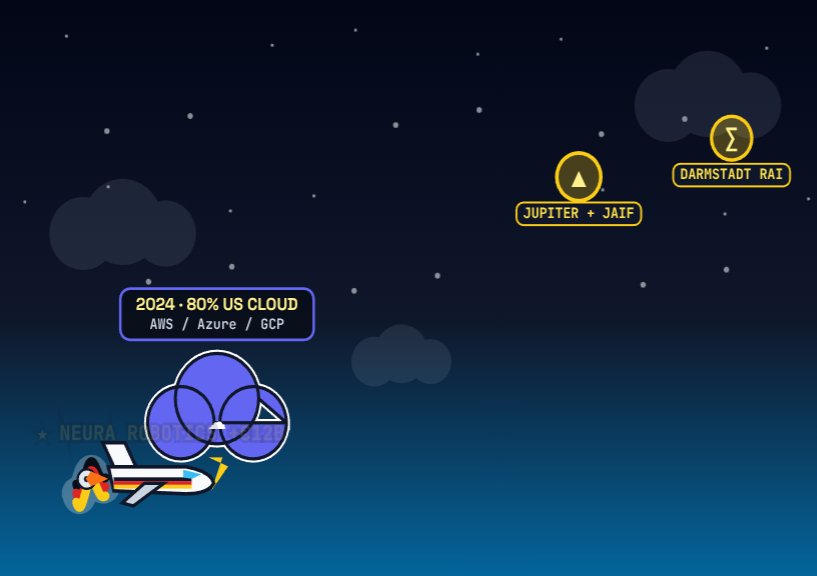
Live gameplay from Germany in AGI Land (ypipe.com/play): Level 2 Regierungsflieger banking past the 2024 80% US Cloud storm to grab JUPITER + JAIF and TU Darmstadt RAI German Win Coins.
You play as Z1 (named after Konrad Zuse’s pioneering 1938 Berlin computer), sprinting, double-jumping, and ducking through 27 real milestones from 1988 to 2026, sized proportionally to the real-world impact and prestige damage of each faulty decision and illustrated to look like the blunder itself, with a live right-side German AI Timeline Explainer that logs every mistake you dodge or hit and every German win you collect. Level 1 (1988–2024 Germany Ground Run) takes Z1 chronologically past DFKI’s consulting ivory tower, the giant 1982–90s copper-over-fiber cable drum, the lost 1997 LSTM neural breakthrough, ducking under the €50.8B UMTS auction & Neuer Markt crash beam, wet-ink Notar scrolls and dry-income ESOP taxes, 20-year ePA medical silos, 2010 pixelated Street View houses, 2013 “Neuland” fax machines, ducking under the sweeping orange 2016 KUKA robotics arm sold to China, 17+ peering GDPR watchdog eyes, the Gaia-X committee swamp, the shattered 2020 Wirecard & BaFin vault, oversized CARIAD sedans, the €30B VC cliff, LMU’s leaked Latent Diffusion canvas, ducking under the 2022 OZG & ICE Funkloch (“Kein Netz”) overhead wire, the colossal 2023 nuclear shutdown cooling tower, disconnected waste-heat pipes, and the towering 2024 EU AI Act law stack and Teuken-7B. Level 2 (2024–2026 Transatlantic Regierungsflieger Flight) climbs across the Atlantic past cracked Intel Magdeburg wafers, massive 80%+ US hyperscaler thunderclouds, Starlink satellites, SpaceX vs. Ariane-6 rockets, PhD brain drain and cloud API vortices, twin-fan €1B Blackwell GPUs, SOOFI’s closed-beta padlock fortress, and the San Francisco Zaungast demo tour.
And waiting in low-Earth orbit is the Final Boss: the Orbital Starlink Space-Datacenter Neuro-Symbolic AGI Monster. Z1’s Regierungsflieger transforms into a German Orbital Space Rocket against a deep-space datacenter ringed by Starlink solar arrays, blinking server racks, a spiked deterministic Outer Symbolic Shell, and a pulsing LLM Inside. Your naked-weight rocket shots bounce harmlessly off its outer symbolic armor (0 DMG, +120 Tokens), and every hit makes the Boss fire AGI Chip volleys faster and faster (at steady travel speed) until your endlessly growing Black-Red-Gold German Industry Moat (Flag) (starting at 1.0 and growing uncapped every time you catch one of 36 German Win Coins) finally runs down to 0. Points are tracked in Tokens, speed in Tokens/Heartbeat, and blunders rack up Token Burn. Only by pulling back the curtain and choosing Eat Your Own Dogfood (YPipe’s sovereign local Neuro-Symbolic Harness) can you win the race; hit 0 anywhere along the timeline and you face Unconditional Surrender with instant one-click sharing for X, Bluesky, and LinkedIn pointing back to ypipe.com/play.
Stage 1: Running an AI Race Without Cheap Energy, Fiber, or Speed
Every industrial technology race starts with physics, not press releases.
Before a single German foundation model even trained its first epoch, Germany stacked three structural hurdles right at the starting line:
- No Cheap Baseload Energy (€0.35/kWh vs. Hyperscaler Power): Training giant frontier models burns gigawatts of continuous, cheap baseload electricity. Shutting down reliable domestic capacity while industrial electricity prices sit multiples above the US and China made competing on brute-force pre-training mathematically absurd from day one.
- Digital Infrastructure Lag (Amt-Fax & Missing Fiber): Half of Germany’s public administration and Mittelstand still fights PDF forms, legacy ERP silos, and sluggish digital infrastructure while debating abstract “AI ecosystems.”
- Regulating Before Building (The Red-Tape Swamp): Europe sprinted to become the world champion of AI compliance checklists before shipping a single sovereign industrial AI runtime that small and mid-sized companies could actually run on-premise without a law firm on retainer.
Stage 2: Jensen’s Leather Jacket and the €1 Billion “Catch-Up” Illusion
When policymakers realized raw compute was missing, the reflex was predictable: write a giant check to buy foreign shovels.
In late 2025 and 2026, NVIDIA CEO Jensen Huang and Deutsche Telekom unveiled a €1 billion “Industrial AI Cloud” in Munich built on up to 10,000 NVIDIA Blackwell GPUs, alongside talk of a “Deutschland-Stack.” Having domestic compute is nice. Pretending that 10,000 rented GPUs closes a hyperscaler pre-training race against US and Chinese clusters running hundreds of thousands of chips is slideware.
Worse, while Berlin celebrates hardware press releases, thousands of German enterprises quietly wire their internal databases, engineering specs, and customer records straight into hosted US cloud APIs. As we documented in The Hidden Data Leakage Risk of MCP Servers, every tool call routed through an external cloud agent streams raw operational rows straight onto foreign servers.
Stage 3: The Subsidized Base-Model Graveyard (Teuken-7B, SOOFI & The Pivot Trap)
Then came the public-money foundation model wave.
First came OpenGPT-X / Teuken-7B, a federally funded consortium model built across Fraunhofer, DFKI, and universities. As an academic artifact it was fine. As an industrial answer to Silicon Valley, a naked 7B base model released into a world where global open weights (Qwen, Llama, Mistral, Gemma) commoditize every 90 days could never carry a sovereign strategy by itself.
Then came SOOFI (Sovereign Open Source Foundation Models), initiated in September 2025 with federal backing and releasing Soofi S (30B-A3B) in mid-2026 into an initial gated beta phase as an unaligned base model. Meanwhile, Germany’s highest-profile private frontier-model hope, Aleph Alpha, learned the hard way that trying to out-spend San Francisco on raw pre-training forces a pivot toward enterprise integration software (PhariaAI), culminating in its transatlantic merger agreement with Canada’s Cohere in September 2026.
Here is the uncomfortable lesson buried inside all three stories: raw model weights are a depreciating commodity. Even if Germany spent €20 million or €2 billion training a brand-new sovereign transformer tomorrow, a naked neural network still hallucinates on pass one, still invents missing API parameters, and still fails basic enterprise logic without a deterministic verification layer around it (as we proved across 3,829 official UC Berkeley BFCL V4 tests in What A Neuro-Symbolic BFCL AI Test Revealed About the Anthropic IPO).
Stage 4: The San Francisco Demo Tour and the AGI Curtain
The final stage of the game is what happens right after those domestic disappointments.
German politicians like Bundestag Research Committee chair Karl Lauterbach (@Karl_Lauterbach) fly to Silicon Valley, sit inside demo rooms at OpenAI and Anthropic, see clean outputs with almost zero visible hallucinations, and fly home telling Der Spiegel in November 2026:
“In den beiden führenden KI-Nationen sieht man uns als Zaungast und Kunden. Bestenfalls sind wir noch als Ingenieursnation interessant, wegen unserer Industriedaten und derer des Mittelstands. Da würden alle gern herankommen.”
Notice the irony. In our companion technical deep dive, Sam Altman Didn’t Build AGI. Silicon Valley Just Built a Neuro-Symbolic Harness, we pulled back the curtain on why those demos look so convincing. Base transformers did not suddenly wake up. Silicon Valley wrapped incrementally improving weights inside neuro-symbolic verification harnesses (symbolic-level speculative decoding) that catch pass-one hallucinations and force silent pass-two rewrites before the user ever sees the mistake.
When German policymakers mistake that hidden software harness for mystical superintelligence, they walk straight into the exact trap Silicon Valley wants: believing Germany can never build sovereign AI and handing over Mittelstand industrial data to foreign cloud APIs.
What Germany Actually Got Right (The 36 Collectible Win Coins)
Criticism is only useful if it stays honest about your real strategic assets. That is why you play as Z1 (honoring Konrad Zuse’s pioneering 1938 Berlin computer) and why every collectible coin in Germany in AGI Land represents a real breakthrough, supply-chain chokepoint, breakout champion, or course correction Germany got right, growing your German Industry Moat (Flag) across six concrete pillars:
- Foundational Science & Algorithmic Breakthroughs: German researchers invented core deep-learning building blocks (LSTM by Sepp Hochreiter and Jürgen Schmidhuber at TU Munich in 1997, Latent Diffusion at LMU Munich’s CompVis lab in 2022), founded DFKI back in 1988 decades ahead of the hype, launched Cyber Valley in 2016 (Max Planck Institute for Intelligent Systems, University of Tübingen, and later ELLIS) into Europe’s top ML research hub, protected tuition-free TU9 STEM universities (TUM, RWTH Aachen, KIT), and selected next-generation efficiency alliances like TU Darmstadt’s Reasonable Artificial Intelligence (RAI) Excellence Cluster in May 2025 to tackle reasoning, continuous learning, and energy consumption.
- Irreplaceable Chokepoints in the AI Hardware Supply Chain: Not a single advanced Nvidia, Apple, or AMD AI GPU on Earth can be printed without Carl Zeiss SMT in Oberkochen (whose ASML EUV and High-NA EUV multilayer mirrors are polished so flat that if scaled to the size of Germany, the highest bump would be under a millimeter) and TRUMPF’s pulsed CO2 laser amplifiers in Ditzingen vaporizing tin droplets 50,000 times per second. Add Infineon (spun out of Siemens in 1999 and now a global leader in silicon, SiC, and GaN AI server-rack power delivery), Siltronic / Wacker Chemie hyperpure silicon wafers, and Merck KGaA specialty electronic gases and chemicals, and Germany sits directly on the physical bottleneck of global AI hardware.
- Compute & Sovereign Infrastructure Pivots: Forschungszentrum Jülich inaugurated Europe’s first exascale supercomputer in 2025 (JUPITER, ranked #1 most energy-efficient exascale system in the world) paired with the JUPITER AI Factory (JAIF) opening GPU access to startups and SMEs. Frankfurt’s DE-CIX (founded 1995) has scaled past 21 Tbps across 1,100+ networks. In the private sector, Schwarz Group (Lidl/Kaufland) bypassed committees to build STACKIT (a commercially viable, DORA- and GDPR-compliant European cloud under Schwarz Digits) alongside the IPAI campus in Heilbronn, while Deutsche Telekom, Nvidia, and SAP stood up the Munich Industrial AI Cloud in six months by early 2026.
- Breakout AI Champions & Global Category Leaders: Black Forest Labs in Freiburg (founded August 2024 by original Latent Diffusion creators) launched Apache-licensed FLUX.1 and later FLUX.2 visual frontier models. DeepL (launched in Cologne in 2017) scaled to 200,000+ business teams, adding real-time Voice-to-Voice AI in 2024 with strict C5 security. Helsing in Munich (founded 2021) raised a $1.8B Series E in July 2026 at an $18B valuation. Celonis (founded at TU Munich in 2011) dominates global process mining while SAP (whose 1992 R/3 became the ERP backbone of global commerce) rolled out its Joule AI copilot starting in September 2023. In the agentic middleware layer, n8n (2019), Parloa (2018), and Langdock (2023) broke out globally, while BioNTech followed its 2020 mRNA breakthrough by acquiring AI pioneer InstaDeep (~€630M) in 2023 for AI-guided cancer immunotherapies in Mainz.
- Physical AI, Robotics & Industrial Edge Dominance: Germany coined the global Industrie 4.0 paradigm at Hannover Messe 2011, and Siemens teamed with Nvidia Omniverse and Industrial Edge starting in 2022 to combine #1 factory automation with physics-grounded digital twins. Deep mechatronics heritage across DLR, TUM, and KIT spawned a Physical AI robotics wave (NEURA Robotics unveiling its 4NE-1 cognitive humanoid in 2024, alongside Agile Robots, Franka Robotics, RobCo, Sereact, and Wandelbots) plus KUKA, Festo, Schunk, Duale Ausbildung, and over 1,300 Mittelstand Hidden Champions. Germany’s 2021 autonomous driving law let Mercedes-Benz (Drive Pilot) beat Tesla to internationally certified hands-off/eyes-off SAE Level 3 autonomous driving in December 2021, while 52% of German adopters systematically embed AI into shop-floor defect detection and Bosch/Siemens predictive maintenance rather than superficial hype.
- Institutional Course Corrections That Actually Worked: Germany proved public IT can work when SAP and Deutsche Telekom shipped the open-source, privacy-first Corona-Warn-App in 2020, passed the SPRIND Freedom Act (SPRIND-Freiheitsgesetz) in December 2023 to unshackle fast milestone-based Next Frontier AI challenges and direct equity, consolidated fragmented digital powers in May 2025 under a dedicated Federal Digital Ministry (BMDS) led by former private-sector tech executive Karsten Wildberger, saw Isar Aerospace conduct Europe’s first private orbital test launch in March 2025, and turned rigorous ISO/C5 Trusted AI safety engineering into a real enterprise moat for regulated pharma, finance, defense, and manufacturing.
Germany does not lack engineering brilliance, physical leverage, or industrial substance. It simply kept judging itself by a raw hyperscaler pre-training race instead of playing to its deterministic systems-engineering strengths.
The End of the Game: Eat Your Own Dogfood, or Unconditional Surrender
That brings you to the final screen of Germany in AGI Land.
Once Z1 clears all 27 historical hurdles across 1988 to 2026 and fights the Orbital Starlink Space-Datacenter AGI Monster until your German Industry Moat hits 0, the game stops and forces one honest choice:
- Option B (Unconditional Surrender): Keep believing AGI is “just a model,” keep renting foreign cloud APIs, and accept unconditional surrender as a permanent Zaungast und Kunde while streaming Europe’s industrial know-how abroad.
- Option A (Win: Eat Your Own Dogfood): Stop trying to out-burn San Francisco on $100B pre-training clusters. Take fast, commoditizing local models (0.8B to 32B parameters) and lock them inside a sovereign neuro-symbolic harness with formal ontologies, deterministic tool control, and a live Hallucination Breaker running on your own hardware.
Neuro-symbolic AI is Germany’s last best chance for leadership.
Base weights are turning into a global utility. What actually separates toy demos from reliable industrial AI is deterministic verification, formal rules, process discipline, and precision systems engineering. That is the exact discipline German engineers already dominate, and it is literally the philosophy behind YPipe (built by iunera). Instead of writing grant PDFs about sovereignty, we eat our own dogfood every day: running compact local models inside the ypipe Manifold Engine on standard CPUs and on-premise servers, auditing every claim deterministically, and keeping every byte of industrial and clinical data inside the building.
Play Germany in AGI Land right now at ypipe.com/play and share your Token Burn and milestone on X (@iuneracom), Bluesky, or LinkedIn. If the game is shared enough, we will unlock a bonus playable level showing how Germany can still win the industrial AGI/superintelligence race. And if you want to see the real local Hallucination Breaker catch and correct a model live on a regular laptop, reach out via ypipe.com or iunera.com/contact.
Related Deep Dives on iunera.com/kraken/
- Why Running a Local LLM Does Not Give You an AI System
- What A Neuro-Symbolic BFCL AI Test Revealed About the Anthropic IPO
- Alibaba Qwen, MariaDB & AMD Ryzen: Sovereign Enterprise AI on Everyday CPUs with YPipe
- Open-Weights GLiNER Neuro-Symbolic Symbol Extractor (INT8 ONNX)
- The Hidden Data Leakage Risk of MCP Servers
- Sovereign AI in Europe: Why Enterprises Need More Than Consumer AI Platforms