
Receipt processing is one of those problems that looks simple on the surface but becomes increasingly complex at scale. While OCR and LLM-based pipelines like ReceiptFlow solve the technical challenge of extracting structured data, their real value lies in how they transform operational workflows. This article explores the business impact of such systems, focusing on efficiency, cost reduction, and reliability. It highlights why combining automation with validation is not just a technical improvement, but a necessary step toward building systems that can be trusted in real-world financial environments.
Introduction
Up to this point, the discussion has been focused on technical improvements,+model selection, input formatting, debugging, and validation. But beyond the engineering effort, there is a much more important question: what problem does this actually solve in the real world? ReceiptFlow exists because receipt processing is still largely inefficient. In many organizations, this process is either manual or only partially automated. Employees upload receipts, someone verifies them, and data is manually entered or corrected before it becomes usable. This not only slows things down but also introduces errors that can affect financial reporting. What makes this problem interesting is not just its complexity, but its scale. Every business deals with receipts, and even small inefficiencies multiply quickly when applied across hundreds or thousands of transactions. This is where systems like ReceiptFlow start to create meaningful impact.
What you’ll learn
- Why receipt processing is still inefficient in many systems
- Limitations of OCR-only and rule-based approaches
- How multi-stage pipelines improve reliability
- Business impact of automation (cost, speed, consistency)
External Reference
For a practical overview of OCR + AI automation pipelines:
https://www.youtube.com/watch?v=5vScHI8F_xo
(see explanation around 1:20 for pipeline structure)
For implementation details of local LLM inference:
https://github.com/ggerganov/llama.cpp
The Problem with Current Systems
1, Manual Processing
In many workflows, receipts are still handled manually. Someone reads the receipt, identifies key fields like total, date, and items, and enters them into a system. While this approach works for small volumes, it does not scale. As the number of receipts increases, so does the time required, along with the likelihood of human error. What makes manual processing particularly problematic is that it introduces inconsistency. Two people may interpret the same receipt differently, especially when formats are unclear or information is missing. Over time, this leads to unreliable data, which affects downstream systems.
2. Basic OCR Systems
Traditional OCR systems improve efficiency by extracting text automatically, but they stop at raw extraction. The output is usually unstructured, meaning it still requires interpretation before it becomes useful. In practice, this often shifts the workload rather than eliminating it. Instead of typing data from scratch, users now have to clean and organize OCR output. This reduces effort slightly but does not solve the core problem of structuring and validating information.

3. Rule-Based Automation
Some systems attempt to solve this using predefined rules. For example, they might look for patterns like “Total:” or “Tax:” and extract values accordingly. While this works in controlled environments, it breaks easily when formats change. Receipts are inherently inconsistent. Different vendors use different layouts, languages, and formats. A rule that works for one receipt may fail completely for another, making rule-based systems difficult to maintain and scale.
Where ReceiptFlow Fits
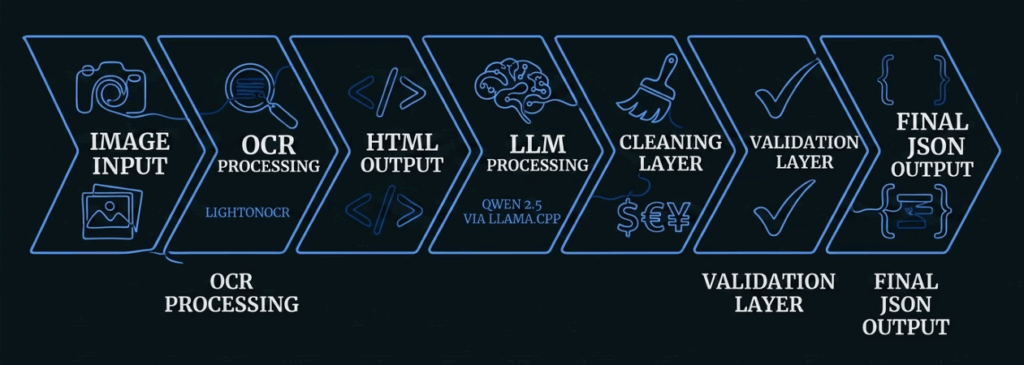
ReceiptFlow approaches the problem differently by combining multiple layers instead of relying on a single technique. OCR extracts the raw text, the LLM interprets and structures it, the cleaning layer fixes formatting issues, and the validation layer ensures correctness. What makes this approach effective is that it mirrors how a human would process a receipt,but in a structured and automated way. Instead of relying on rigid rules, the system adapts to different formats while still enforcing consistency through validation. This combination allows the pipeline to move beyond simple extraction and into something closer to reliable automation.
Operational Impact
One of the most immediate benefits of such a system is the reduction in manual effort. Tasks that previously required human intervention can now be handled automatically, allowing teams to focus on higher-value work. At the same time, processing speed improves significantly. Instead of waiting for manual verification, receipts can be processed almost instantly. This has a direct impact on workflows like reimbursements and accounting, where delays can affect both employees and business operations. Perhaps more importantly, consistency improves. When the same system processes all receipts, the output becomes standardized. This reduces discrepancies and makes downstream analysis more reliable.
Cost Implications
The cost savings from automation are not always obvious at first, but they become significant over time. Manual processing requires labor, and even semi-automated systems still depend on human oversight. By reducing the need for manual intervention, ReceiptFlow lowers operational costs. At scale, even small improvements in efficiency can translate into substantial savings. Additionally, reducing errors has its own financial impact. Incorrect data can lead to reporting issues, compliance risks, and additional work to fix mistakes. Preventing these errors upfront is often more valuable than correcting them later.
Why Validation Is Critical
One of the biggest gaps in most OCR or AI-based systems is trust. Extracting data is one thing, but ensuring that it is correct is another. In financial workflows, correctness is non-negotiable. A system that occasionally produces incorrect totals cannot be relied upon, regardless of how fast or advanced it is. This is where the validation layer becomes essential. By verifying numerical consistency, the system ensures that outputs are not just structured, but accurate. This transforms the pipeline from something experimental into something that can be used in real-world scenarios.
Scalability Perspective
As the system scales, its benefits become more pronounced. Handling a few receipts manually is manageable, but handling thousands is not. Automation allows the system to scale without a proportional increase in effort. At the same time, the adaptability of the pipeline makes it suitable for different environments. Whether it is a small startup looking to reduce costs or a large enterprise managing high volumes of transactions, the same system can be applied with minimal changes.
Key Insight
Automation only becomes valuable when it is both scalable and reliable It is not enough to automate extraction. The system must also ensure that the output can be trusted and used without constant human verification.
Conclusion
ReceiptFlow demonstrates how combining OCR, LLMs, and validation can solve a real-world problem that affects multiple industries. While the technical challenges are significant, the real impact lies in improving how businesses handle data. By reducing manual effort, improving accuracy, and enabling scalability, systems like this do more than just optimize workflows,they redefine them. The value is not just in automation, but in building systems that can operate reliably at scale.
Q&A Section
Q1. Why is this problem important?
Because receipt processing is common across industries and becomes inefficient at scale.
Q2. What makes ReceiptFlow different from OCR tools?
It structures and validates data, rather than just extracting text.
Q3. Where is this most useful?
In expense management, accounting, and financial workflows.
Q4. What is the biggest advantage?
Reduced manual effort combined with improved accuracy
Q5. Why is validation necessary
Because financial data must be correct, not just structured.
References
Brown, T. B., et al. Language Models are Few-Shot Learners, NeurIPS, 2020 Kiela, D., et al. Hallucinations in Neural Models, ACL, 2021 Smith, R. Tesseract OCR Engine, ICDAR, 2007 Industry Reports on Document Automation Financial Systems and Automation Research