
The real story isn’t about which AI model is smartest. It’s about which one your business can actually own and control.
TL;DR: As AI moves from chatbots into operational infrastructure, enterprises are discovering that controllability, deterministic behavior, and local deployment matter far more than raw model intelligence. Here’s why that shift is happening , and what it means for how businesses build AI systems going forward.
AI Stopped Being a Product. Most Businesses Haven’t Noticed Yet.
There’s a quiet but fundamental shift happening inside companies that are serious about AI.
It started the same way for most of them: a ChatGPT subscription here, an API integration there, a few experiments with automating repetitive tasks. The technology was impressive. The demos were great. And then the real questions started surfacing.
What happens when the API changes its pricing?
What happens when the model gets updated and our workflow breaks?
What happens when a compliance audit asks where our customer invoice data went?
What happens when the model randomly decides our perfectly reasonable automation prompt is “potentially harmful” and refuses to execute?
These aren’t hypothetical concerns. They’re the actual conversations happening in enterprise AI teams right now. And they’re driving a quiet but significant migration toward something that barely existed as a practical option two years ago: local, controllable AI infrastructure.
The Fundamental Problem with Consumer AI in Enterprise Contexts
To understand why this shift is happening, you have to appreciate how differently consumer AI and operational enterprise AI are designed , and for whom.
Public consumer AI systems are built to serve an enormous, unknown population of users safely. That means:
- Heavy moderation layers to prevent misuse at scale
- Conservative behavior when prompts are ambiguous
- Output modifications to reduce legal and reputational risk
- Behavioral guardrails tuned for the worst-case user, not the median one
- Dependency on the provider’s infrastructure, pricing, and policy decisions
For a chatbot serving millions of anonymous users, this approach is entirely reasonable. The risks of being too permissive far outweigh the friction of being too cautious.
But enterprise operational AI isn’t serving anonymous users. It’s:
- Processing your company’s invoices
- Extracting data from your internal documents
- Running inside your automation pipelines
- Executing structured workflows on your hardware
In that context, the same guardrails that protect consumers become operational liabilities. And the dependency on external infrastructure becomes a strategic vulnerability.
What “Operational AI” Actually Requires
Let me be concrete about what enterprise automation actually demands from an AI system , because it’s genuinely different from what most people associate with AI capabilities.
Deterministic output formatting. If your pipeline expects JSON with specific fields, the model needs to output exactly that, every time. Not “mostly that, with occasional helpful explanations added.” Every deviation is a parsing failure downstream.
Workflow continuity. An AI step in an automation pipeline that randomly refuses or hedges breaks the entire chain. In a workflow processing 500 documents overnight, you can’t afford a model that decides step 47 needs clarification.
Predictable behavior across runs. When you tune a prompt to work correctly, it needs to keep working correctly. Not drift. Not change. Work.
Private execution. Documents containing financial data, medical information, legal correspondence, or personnel records cannot be sent to external APIs in most regulated industries. Full stop.
Cost stability at scale. Per-token API pricing that looks reasonable at 1,000 documents becomes a significant budget line at 100,000. And that budget can change whenever the provider decides to reprice.
None of these requirements are about AI intelligence. They’re about AI reliability ,and that’s a completely different engineering problem.
Why Local Deployment Changes the Equation Entirely
The reason local AI is becoming strategically viable for enterprises right now is that the tooling finally caught up with the ambition.
Frameworks like llama.cpp have made it practical to run quantized language models on CPU hardware without dedicated GPUs. Model repositories like Hugging Face have created an ecosystem where high-quality models are readily available, well-documented, and continuously optimized by a global community. Tools like Ollama and LM Studio have compressed the setup process from weeks to hours.
The result is that the barriers which previously made local AI impractical for most businesses — cost, complexity, performance , have dropped dramatically. What’s left is a set of genuine advantages:
Data sovereignty. Your documents stay on your infrastructure. No third-party API ever sees your data. For industries operating under GDPR, HIPAA, SOC 2, or similar frameworks, this isn’t a nice-to-have — it’s a requirement.
Infrastructure ownership. The model doesn’t get deprecated without your input. The pricing doesn’t change overnight. The behavior doesn’t shift because the provider updated their alignment policy.
Workflow customization. You control the prompts, the parameters, the inference settings. You can fine-tune on your specific document types. You can optimize for your exact use case without fighting against someone else’s product decisions.
Cost structure. After hardware, local inference is effectively free. For document-heavy workflows at scale, this fundamentally changes the unit economics.
The OCR + Local AI Combination That’s Quietly Transforming Document Workflows
One of the clearest enterprise use cases where local controllable AI is already delivering real value is document processing , specifically the combination of OCR engines with local language models for semantic extraction.
Traditional enterprise OCR solves one problem well: extracting characters from images. But it leaves another problem entirely unsolved: understanding what those characters mean and organizing them into usable structure.
The hybrid pipeline that’s emerging looks like this:
Document scan / image
        ↓
OCR engine (Tesseract / EasyOCR / Azure Form Recognizer)
        ↓
Raw extracted text (often messy, inconsistently formatted)
        ↓
Local LLM: semantic grouping + structured reformatting
        ↓
Clean JSON / structured data
        ↓
Validation layer → downstream systems
The language model’s job in this pipeline isn’t to do OCR , it’s to do what OCR can’t: understand context, group related information, infer meaning from imperfect input, and produce consistently structured output.
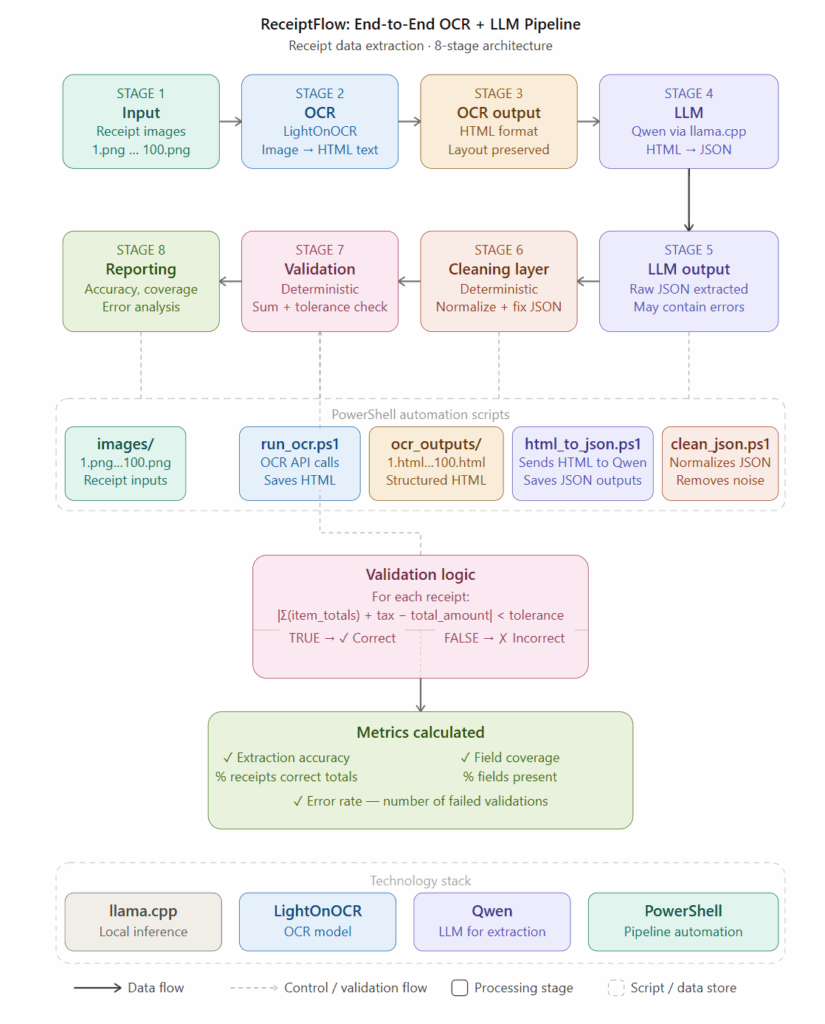
For invoice processing, expense management, contract analysis, or medical records handling, this combination is substantially more capable than either approach alone ,and when the language model runs locally, the entire pipeline can operate inside a private, controlled environment.
The Qwen model family, particularly the 1.5B and 3B variants running as GGUF quantizations via llama.cpp, has proven surprisingly capable for exactly these structured extraction tasks on consumer-grade hardware.
The Governance Question (And Why It’s More Nuanced Than People Think)
When enterprises start exploring local AI deployment, especially variants with reduced alignment constraints, a legitimate question comes up: doesn’t removing safety layers create risk?
It’s a fair question, and it deserves a direct answer.
The key insight is that model-level alignment is one component of a safety system , not the whole system. In a well-architected enterprise AI deployment, the safety architecture looks more like this:
Input validation — Inputs to the AI system are sanitized, scoped, and controlled. The model never receives arbitrary user input in automated workflows.
Output schema validation — Every model output is validated against a strict schema before entering downstream systems. Malformed or unexpected outputs are flagged and quarantined, not silently propagated.
Audit logging — Complete logs of model inputs, outputs, and decisions are retained for review. Anomalous outputs trigger human review processes.
Scope limitation — The model is tasked with specific, bounded operations. It doesn’t have open-ended agency or access to systems beyond its specific function.
Human oversight checkpoints — Decisions above defined confidence thresholds or involving specific document categories require human review before proceeding.
This is how serious operational AI is actually built. The model’s own alignment layer becomes less critical when the surrounding system is architected correctly , and enterprises increasingly prefer owning that surrounding system rather than outsourcing it to a third-party provider’s policy decisions.
The Small Model Surprise
Here’s something that consistently surprises people encountering local AI for the first time: you don’t need a massive model to do most enterprise workflow tasks.
The assumption that useful AI requires frontier-scale infrastructure made sense when the only reference point was GPT-4. But operational workflow tasks , structured extraction, semantic grouping, formatting normalization, document summarization , don’t require frontier-scale intelligence. They require frontier-scale reliability, which is a completely different thing.
In practical testing on consumer hardware:
| Model | RAM Required | Best Use Case |
|---|---|---|
| Qwen 1.5B (GGUF Q4) | ~3–4 GB | Structured extraction, formatting tasks |
| Qwen 3B (GGUF Q4) | ~6–8 GB | Complex grouping, multi-field extraction |
| Qwen 7B (GGUF Q4) | ~8–12 GB | Document analysis, nuanced summarization |
For most document processing workflows, Qwen 1.5B or 3B variants hit a practical sweet spot ,capable enough for reliable extraction, light enough to run alongside other business applications without dedicated hardware.
The implication is significant: a startup or small enterprise can build a production-grade document automation workflow on hardware they already own, with no ongoing API costs.
The Strategic Shift That’s Already Happening
The enterprises that are furthest along in AI adoption aren’t necessarily the ones with the biggest AI budgets or the most sophisticated models. They’re the ones that figured out earliest that AI is infrastructure ,and started building it accordingly.
Infrastructure thinking means:
- Reliability over novelty — a workflow that runs correctly 99.5% of the time is more valuable than one that’s impressive 70% of the time
- Ownership over convenience — controlling your stack beats being at the mercy of someone else’s product roadmap
- Integration over capability — an AI system that fits perfectly into your existing workflow beats a more capable one that requires constant babysitting
- Predictability over intelligence — knowing exactly how your system will behave matters more than being occasionally amazed by it
This framing shift is what’s driving the move toward local controllable AI, independent of any specific model or technology. The technology just finally caught up with the strategic need.
What This Means for Different Enterprise Contexts
Financial services and fintech — Invoice processing, expense reconciliation, document classification, regulatory document analysis. Local deployment satisfies data residency requirements that cloud APIs can’t meet. High-volume processing makes per-token costs prohibitive at scale.
Healthcare and life sciences — Medical records handling, clinical documentation support, insurance claim processing. HIPAA requirements make local deployment not just preferable but often mandatory.
Legal and professional services — Contract analysis, due diligence document review, correspondence classification. Client confidentiality obligations create strong incentives for local processing.
Manufacturing and logistics — Shipping document processing, supplier invoice handling, quality control documentation. High-volume, structured data extraction is exactly where small local models excel.
Enterprise IT and internal tooling — Knowledge base management, ticket classification, internal document search. Workflows that would be cost-prohibitive at API pricing become economical with local inference.
The Open-Source Advantage
One aspect of local AI that deserves explicit attention is the role of the open-source community in making this practical.
The Hugging Face ecosystem has created something remarkable: a global collaborative infrastructure for sharing, optimizing, and deploying AI models at zero marginal cost. A quantization optimization developed by one researcher is available to every enterprise experimenting with local AI within days.
Projects like llama.cpp are maintained by hundreds of contributors continuously improving inference efficiency, hardware compatibility, and deployment flexibility. EleutherAI and similar organizations are advancing the science of open, interpretable AI systems in ways that directly benefit enterprise deployability.
This collaborative ecosystem is compressing the timeline between “research breakthrough” and “production deployment” dramatically — and enterprises that engage with it actively, rather than waiting for commercial products to package it, are gaining meaningful competitive advantage.
Getting Started: A Practical Enterprise Path
For enterprise teams seriously evaluating local AI for operational workflows, here’s a grounded starting approach:
Phase 1 — Proof of concept (2–4 weeks) Pick one high-volume, structured document workflow. Set up llama.cpp with a Qwen 1.5B GGUF model. Build a basic extraction pipeline. Measure consistency against your current approach.
Phase 2 — Validation architecture (2–4 weeks) Build your output schema validation layer. Implement audit logging. Define your human review triggers. This is the governance infrastructure that makes production deployment responsible.
Phase 3 — Scale testing (2–4 weeks) Run batch processing at realistic volumes. Measure throughput, error rates, and consistency. Identify the model size and quantization level that optimizes for your specific workflow requirements.
Phase 4 — Production deployment Deploy with monitoring, alerting, and review workflows in place. Start with lower-stakes document types and expand based on demonstrated reliability.
The entire path from zero to production can realistically be completed in 3–4 months with a small team , significantly faster and cheaper than most enterprise software deployments.
The Bottom Line
Enterprise AI is in the middle of a quiet but significant transition , from something you consume as a product to something you operate as infrastructure.
That transition brings with it a different set of requirements: controllability, deterministic behavior, data sovereignty, workflow integration, and cost predictability at scale. And it’s driving serious enterprises toward local deployment in ways that would have seemed impractical just two years ago.
The technology is ready. The tooling is mature. The open-source ecosystem is thriving. The question for most enterprises isn’t whether local controllable AI makes sense for their operational workflows — it’s how quickly they want to start building.
Continue Reading
This article is part of an ongoing series on practical AI infrastructure for enterprise and operational workflows:
- Why Small Qwen Models Are Becoming the Most Interesting Local AI Systems
- OCR vs LLM Receipt Extraction: What Actually Works
- Testing OCR and AI Models for Structured Receipt Extraction
- Building Validation Layers for Reliable AI Receipt Extraction
- Processing 100 Receipts with OCR and LLMs on CPU
External Resources & Backlinks
- llama.cpp — GitHub — The standard open-source framework for local CPU inference with quantized models
- Qwen Models — Hugging Face — Official Qwen model repository with GGUF quantizations and community variants
- Ollama — Streamlined local model deployment for teams without deep ML infrastructure experience
- LM Studio — GUI-based local model runner with enterprise-friendly interface
- Hugging Face Open LLM Leaderboard — Community benchmarks for comparing open-source model performance
- EleutherAI — Research organization advancing open and interpretable AI systems
- GDPR Official Site — Data protection regulation framework relevant to enterprise AI deployment in Europe
- Tesseract OCR — GitHub — The gold standard open-source OCR engine for document processing pipelines
- EasyOCR — GitHub — Python-native OCR library with strong multilingual support