
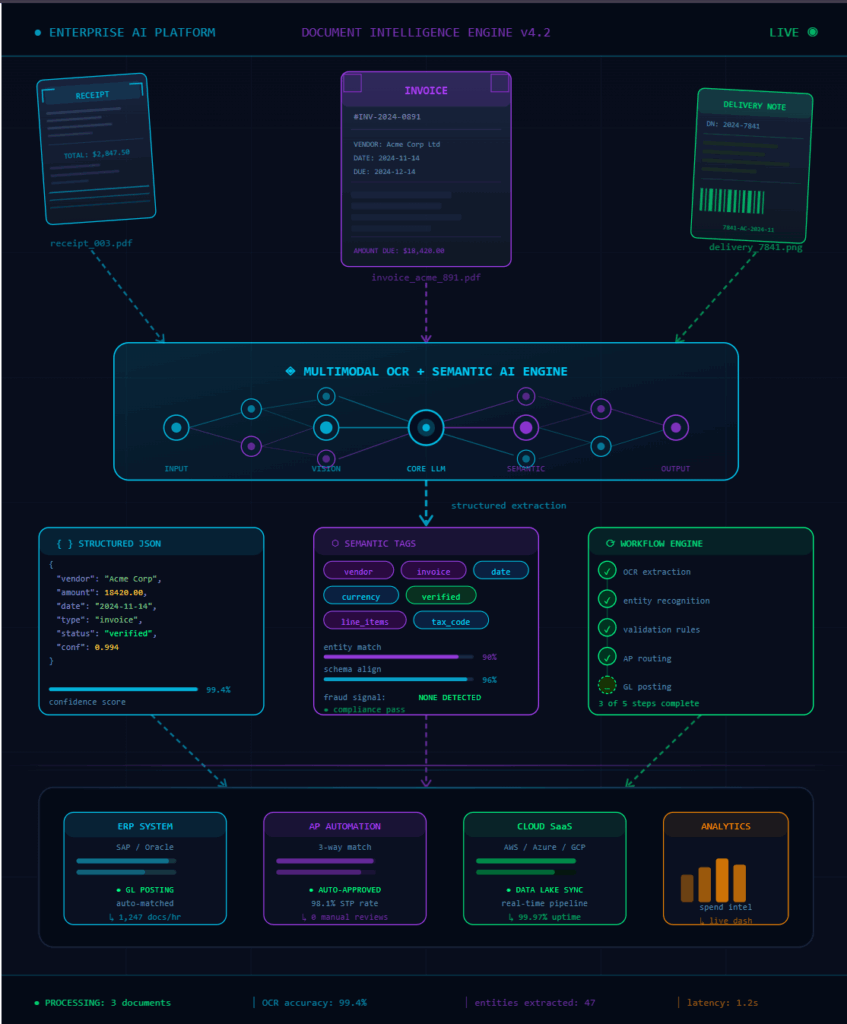
Receipt and invoice digitization has evolved far beyond traditional OCR systems. Modern SaaS platforms now combine OCR, AI, workflow automation, and enterprise integrations to automate complete financial document pipelines.
This article explores the current landscape of AI-powered receipt scanning platforms, how they differ from traditional OCR approaches, and where local AI pipelines like ReceiptFlow fit within this rapidly evolving ecosystem.
The goal is not to identify a single “best” platform, but to understand how the industry is shifting from simple text extraction toward intelligent, agentic financial workflows.
Introduction
For years, document digitization mostly meant OCR.
A scanned receipt would pass through an OCR engine, the text would be extracted, and then additional parsing logic would attempt to reconstruct the structure manually.
That workflow still exists today, but enterprise requirements have changed significantly.
Modern organizations now expect systems to:
- understand documents semantically
- integrate directly with ERP systems
- validate financial information
- automate workflows
- reduce human intervention
- scale across millions of documents
This demand created a new generation of AI-powered SaaS document platforms.
Instead of simply extracting characters, these systems attempt to understand the meaning of documents.
That difference fundamentally changes what receipt digitization systems can do.
The Shift from OCR to Intelligent Document Processing
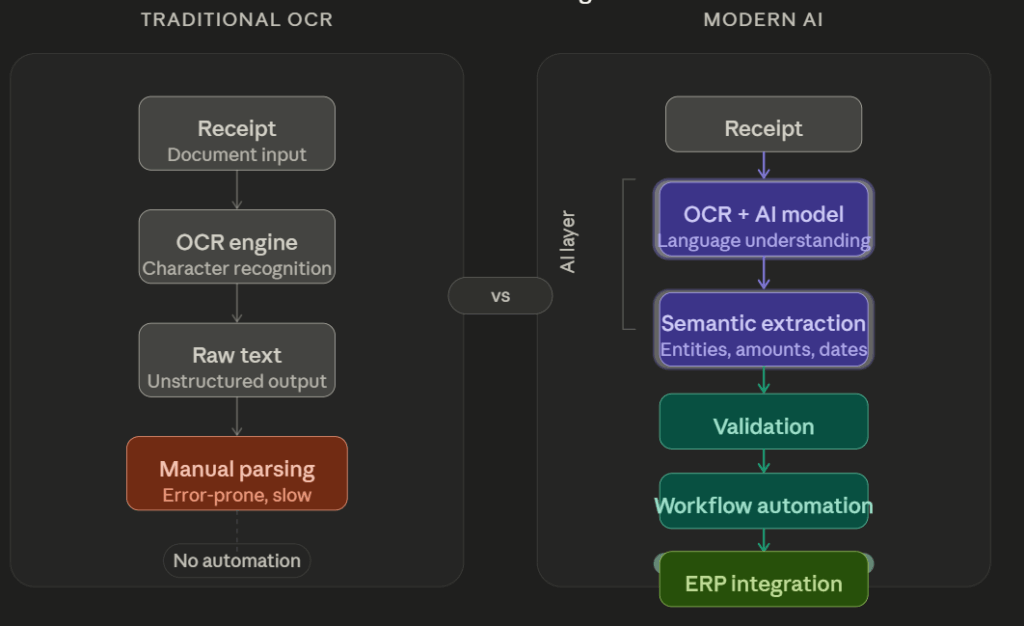
Traditional OCR pipelines typically follow this structure:
Receipt Image
→ OCR Engine
→ Raw Text
→ Regex / Parsing
→ Structured Data
Modern SaaS AI systems extend this significantly:
Receipt Image
→ OCR + AI Understanding
→ Semantic Extraction
→ Validation
→ Workflow Automation
→ ERP / Finance Integration
The focus is no longer only extraction.
It is automation.
Why Enterprises Are Investing in AI Receipt Digitization
According to McKinsey & Company, AI-powered invoice and procurement workflows are becoming a major enterprise automation priority.
Key reported benefits include:
- 25–40% productivity improvements
- reduced manual reconciliation
- faster invoice processing
- lower operational costs
- improved procurement efficiency
- reduced financial leakage
McKinsey also highlights a transition toward “agentic workflows,” where AI systems move beyond extraction and begin coordinating larger business processes autonomously.
That industry direction explains why receipt and invoice digitization has become much larger than a simple OCR problem.
📌 Add Link:
- McKinsey AI Procurement Article
- AI Invoice Automation Research
Major SaaS Platforms for Receipt and Invoice Digitization
1. Rossum AI
Website:
https://rossum.ai
Rossum positions itself as an AI-native document processing platform focused heavily on automation.
Key features:
- AI-based invoice extraction
- supplier document processing
- workflow automation
- ERP integrations
- human-in-the-loop validation
Rossum focuses strongly on reducing manual invoice handling inside enterprise finance teams.
2. UiPath Document Understanding
Website:
https://www.uipath.com/product/document-understanding
UiPath combines OCR with robotic process automation (RPA).
Instead of only extracting receipt data, UiPath integrates extraction into larger automation pipelines.
Common enterprise use cases:
- accounts payable automation
- procurement workflows
- invoice reconciliation
- document routing
- approval automation
3. Google Document AI
Website:
https://cloud.google.com/document-ai
Google Document AI provides cloud-native AI extraction APIs.
Features include:
- invoice parsing
- receipt analysis
- form extraction
- table understanding
- multilingual OCR
Its biggest advantage is integration with the broader Google Cloud ecosystem.
4. AWS Textract
Website:
https://aws.amazon.com/textract/
AWS Textract focuses on structured extraction from forms, tables, and invoices.
Capabilities include:
- key-value extraction
- table parsing
- receipt understanding
- enterprise cloud integration
Textract is widely adopted inside AWS-centric enterprise infrastructures.
5. Azure AI Document Intelligenct
Website:
https://azure.microsoft.com/en-us/products/ai-services/ai-document-intelligence
Previously known as Form Recognizer, Microsoft’s platform focuses on:
- invoice AI extraction
- financial document analysis
- enterprise integrations
- Azure ecosystem workflows
6. ABBYY Vantage
Website:
https://www.abbyy.com/vantage/
ABBYY has been one of the longest-standing enterprise OCR providers.
Their newer platforms combine:
- OCR
- AI extraction
- workflow orchestration
- document intelligence
ABBYY remains heavily used in banking and enterprise document workflows.
7. Veryfi
Website:
https://www.veryfi.com
Veryfi focuses specifically on:
- receipts
- invoices
- bookkeeping automation
- expense digitization
Its APIs are designed primarily for developers integrating financial OCR into applications.
8. Mindee
Website:
https://www.mindee.com
Mindee positions itself as a developer-first AI OCR platform.
Main focus areas:
- API-based extraction
- invoice digitization
- receipt parsing
- workflow integrations
It is popular among startups building AI document pipelines quickly.
9. Nanonets
Website:
https://nanonets.com
Nanonets provides:
- AI OCR
- invoice automation
- intelligent workflows
- document classification
Its emphasis is on reducing manual processing effort through AI-assisted extraction.
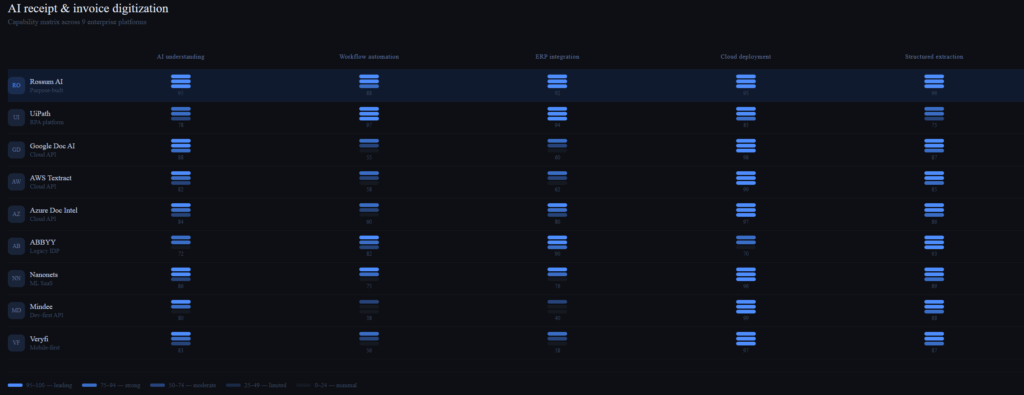
Comparing SaaS OCR Platforms
| Platform | Main Focus | Enterprise Integration | AI Understanding | Workflow Automation |
|---|---|---|---|---|
| Rossum | Invoice AI | Strong | High | High |
| UiPath | RPA + OCR | Very Strong | Medium | Very High |
| Google Document AI | Cloud APIs | Strong | High | Medium |
| AWS Textract | Structured OCR | Strong | Medium | Medium |
| Azure Document Intelligence | Enterprise AI | Strong | High | Medium |
| ABBYY | OCR + IDP | Very Strong | Medium | High |
| Veryfi | Expense OCR | Medium | Medium | Medium |
| Mindee | Developer APIs | Medium | Medium | Medium |
| Nanonets | AI OCR | Medium | Medium | High |
Where ReceiptFlow Fits
While most modern OCR systems operate as cloud-based SaaS platforms, ReceiptFlow was designed with a different philosophy:
fully local, CPU-based AI document processing.
Instead of relying on external APIs, ReceiptFlow combines:
- local OCR
- local LLM inference
- deterministic validation
- offline execution
The complete pipeline runs locally using open-source models.
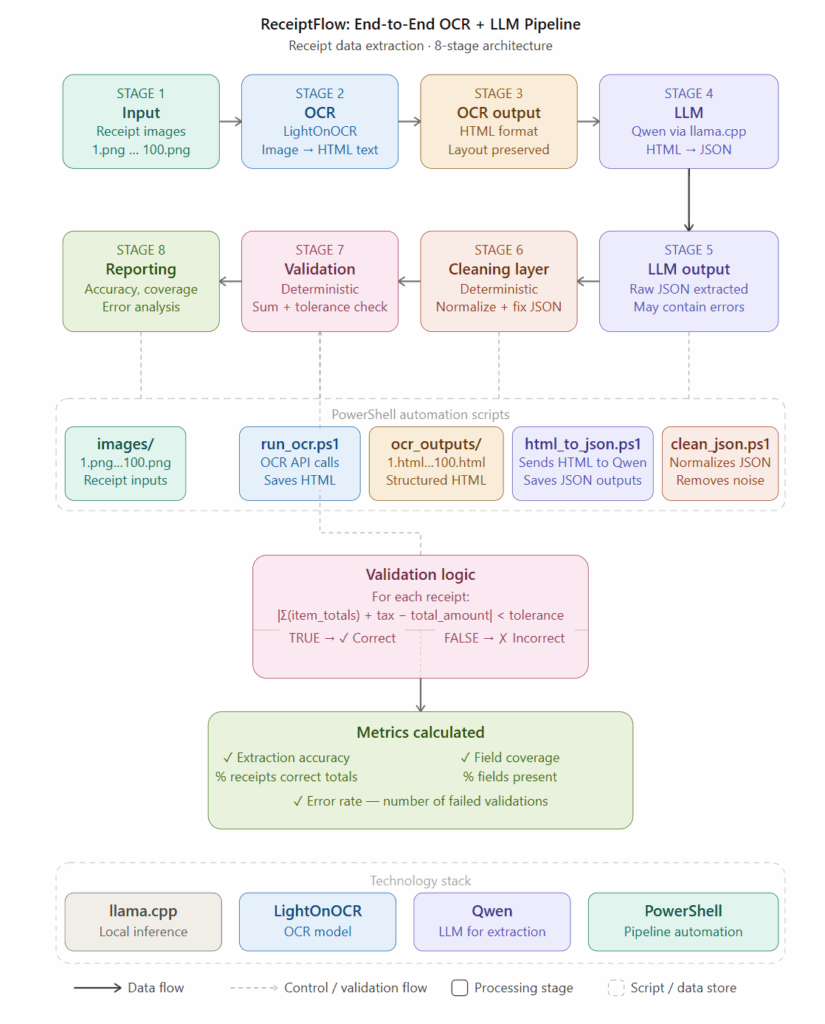
ReceiptFlow Architecture
Pipeline:
Receipt Image
→ LightOnOCR-2-1B
→ OCR HTML Output
→ Qwen 2.5 via llama.cpp
→ Raw JSON
→ Cleaning Layer
→ Mathematical Validation
→ Final Structured JSON
Unlike traditional OCR pipelines, ReceiptFlow focuses heavily on semantic structure understanding.
The system was tested across approximately 100 real-world receipts using:
- Qwen 0.8B
- Qwen 1.5B
- Qwen 2B
- Qwen 3B
Qwen 2B produced the best balance between:
- extraction quality
- hallucination rate
- CPU inference speed
Why Local AI Pipelines Matter
Many SaaS systems require:
- cloud APIs
- external storage
- recurring subscription costs
- vendor lock-in
Local AI pipelines solve several important challenges:
- privacy preservation
- offline deployment
- infrastructure ownership
- lower long-term operational costs
- enterprise data control
This becomes increasingly important in:
- finance
- procurement
- healthcare
- enterprise compliance environments
SaaS Platforms vs Local AI Pipelines
| Capability | SaaS OCR Platforms | Local AI Pipelines |
|---|---|---|
| Cloud Dependency | Required | Not Required |
| Offline Execution | Limited | Full |
| Privacy Control | Shared | Full Local Ownership |
| Infrastructure Cost | Subscription-Based | Hardware-Based |
| Deployment Flexibility | Managed Cloud | Fully Customizable |
| Vendor Lock-In | High | Low |
| AI Model Control | Limited | Full |
The Rise of Agentic Financial Workflows
The most interesting industry shift is that modern systems are no longer stopping at extraction.
The industry is moving toward:
- autonomous workflows
- AI agents
- semantic reconciliation
- intelligent approvals
- procurement automation
This is where AI systems begin behaving less like OCR software and more like operational copilots.
That transition is becoming one of the biggest differences between traditional OCR and modern AI-native platforms.
Key Industry Insight
The receipt digitization industry is no longer only about OCR accuracy.
It is increasingly about:
- automation
- workflow orchestration
- semantic understanding
- financial validation
- operational efficiency
The systems that combine OCR, AI understanding, and deterministic validation are becoming significantly more valuable than OCR-only solutions.
Conclusion
AI-powered receipt scanning platforms are transforming document digitization from a manual extraction task into intelligent automation workflows.
Traditional OCR still plays an important role, but modern systems increasingly combine:
- OCR
- AI understanding
- workflow orchestration
- enterprise integrations
- autonomous automation
ReceiptFlow explores this transition from a local-first perspective, demonstrating that small local LLMs and OCR models can already perform meaningful structured document extraction entirely offline on CPU hardware.
The next evolution is likely not just better OCR.
It is agentic financial document systems capable of understanding, validating, and coordinating workflows with minimal human intervention.
References
SaaS OCR Platforms
- https://rossum.ai
- https://www.uipath.com/product/document-understanding
- https://cloud.google.com/document-ai
- https://aws.amazon.com/textract/
- https://azure.microsoft.com/en-us/products/ai-services/ai-document-intelligence
- https://www.abbyy.com/vantage/
- https://www.veryfi.com
- https://www.mindee.com
- https://nanonets.com
Research & Industry Reports
Related Technologies
- https://github.com/ggerganov/llama.cpp
- https://huggingface.co/Qwen
- https://github.com/tesseract-ocr/tesseract
Suggested Article to Check Out:
- Receipt Scanning with Traditional OCR (Tesseract)
- How We Processed 100 Receipts with AI on CPU
- Testing OCR AI Models for Structured Receipt Extraction
- Why Small Local LLMs Are Becoming Viable for Agentic Receipt Processing